Cocoa Ice
by Diana Karter Appelbaum
On This Page
Description
A girl in Santo Domingo tells how cocoa is harvested during the late 1800s while at the same time her counterpart in Maine tells about the harvesting of ice.Tags
Recommendations





Member Reviews
A girl from Santo Domingo helps her father harvest cacao while a girl in Maine watches her father cut ice blocks from the river. This a fascinating story to me because these two girls are in entirely different worlds. It shows that what we think the world is like to somebody else isn't actually what it is like.
This book about the early chocolate trade between Maine and Santo Domingo is a lot of fun. It's told from the perspective of two children whose families are involved in different ends of the trade, one in Maine and the other in Santo Domingo. They are both vaguely aware of each other because of gifts that they've exchanged through Jacob whose niece makes up the Maine half of the narrative team. He transports the the gifts the two girls give each other, though they've never met. I like this story for a lot of reasons, but none more than the beautiful use of simile that envelops the whole text. So well done.
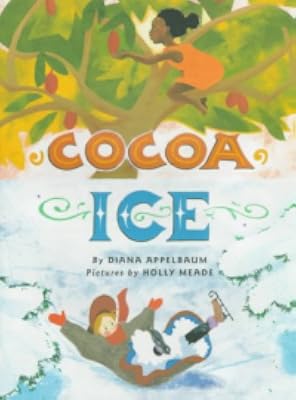
From judging the cover, I thought this book was going to be about the differences of hot weather places and then the cold. But, it turned out to be much more than that. I loved this book and the complexity of the diverse background of the wonderful characters. For being a children's book, we received so much history and character knowledge, in such a short period of time. The book is about a two girls living in very different areas of the world. Their two different worlds, are not that different after all. A beautiful read about ice and cocoa and how they interlace. This book is a must for any classroom library.
Read in a school textbook (LFL find). Not sure how much it's redesigned or abridged, so can't rate. Also not so sure the island girl would have such a happy childhood in this era*. (Note that textbooks tend to choose and adapt entries to fit with Texans' conservative values because Texas is such a big market for them. So I have a feeling this story is 'whitewashed.')
*What era? Schooners, icehouses, no electricity.
Interesting to learn about how to get chocolate, and how to make ice (hard work!).
"Conch" should have been in the vocabulary list in this textbook. At least tell kids how to pronounce it... I didn't know until I was in my 30s!
Oct. 2023
*What era? Schooners, icehouses, no electricity.
Interesting to learn about how to get chocolate, and how to make ice (hard work!).
"Conch" should have been in the vocabulary list in this textbook. At least tell kids how to pronounce it... I didn't know until I was in my 30s!
Oct. 2023
This book is about two little girls who have families on opposite sides of the cocoa/ice trade. We see one little girl on a hot island with her family harvesting cacao and making chocolate. We trace the trade to another little girl who lives in Maine. Her uncle works for an ice company, harvesting and storing the ice. This story shows students that two little girls who live in two different places actually live similar lives. I think this story also shows students how we are all connected throughout the world with items that we trade and give.
What a great idea for a book! A girl from Santo Domingo helps her father harvest cacao while a girl in Maine watches her father cut ice blocks from the river, teaching students that: a) not everything we use comes from where we are and b) simple things like chocolate and ice used to take a lot of work to make. I'm not sure if this would make a good read-aloud, but the independent reader might find it a fascinating lesson on the history of trade and production.
SUMMARY: A girl in Santo Domingo tells how cocoa is harvested during the late 1800s while at the same time her counterpart is Maine tells about the harvesting of ice.
REVIEW: This could almost be one of those topsy-turvy books were one story reads from the front and then you flip it over and read the second story starting from the back because it is the same story from two different points of view from two different locations that intersect on the high seas. Both girls, similar in age, have very different lives and are in awe of the their counterpart’s life and home. It is interesting to see that Santo Domingo needs ice to make their cocoa ice and Maine needs the cocoa to create their chocolate ice cream.
NOTE: The front endpage shows a show more large area map with the sea trip route marked. Did you notice the compass has in its center a cocoa pod cut in half showing the cocoa seeds inside
ACTIVITY: Can you compare the two girls, their homes, their families, the climate, their culture, their clothes, their treasures? show less
REVIEW: This could almost be one of those topsy-turvy books were one story reads from the front and then you flip it over and read the second story starting from the back because it is the same story from two different points of view from two different locations that intersect on the high seas. Both girls, similar in age, have very different lives and are in awe of the their counterpart’s life and home. It is interesting to see that Santo Domingo needs ice to make their cocoa ice and Maine needs the cocoa to create their chocolate ice cream.
NOTE: The front endpage shows a show more large area map with the sea trip route marked. Did you notice the compass has in its center a cocoa pod cut in half showing the cocoa seeds inside
ACTIVITY: Can you compare the two girls, their homes, their families, the climate, their culture, their clothes, their treasures? show less
Members
- Recently Added By
Author Information
4 Works 228 Members
Awards and Honors
Awards
Classifications
- Genre
- Children's Books
- DDC/MDS
- 372.214 — Society, government, & culture Education Primary education (Elementary education) Specific levels of primary education Preschool education Stories
- LCC
- PZ7 .A6415 .C — Language and Literature Fiction and juvenile belles lettres Fiction and juvenile belles lettres Juvenile belles lettres
Statistics
- Members
- 72
- Popularity
- 436,343
- Reviews
- 11
- Rating
- (4.18)
- Languages
- English
- Media
- Paper
- ISBNs
- 2