On This Page
Description
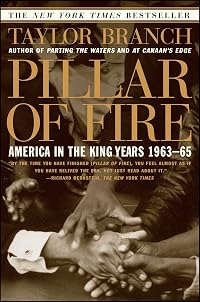
In Pillar of Fire, the second volume of his America in the King Years trilogy, Taylor Branch portrays the civil rights era at its zenith. The first volume, Parting the Waters, won the Pulitzer Prize for History. Pillar of Fire covers the far-flung upheavals of the years 1963 to 1965 - Dallas, St. Augustine, Mississippi Freedom Summer, LBJ's Great Society and the Civil Rights Act of 1964, Vietnam, Selma. And it provides a frank, revealing portrait of Martin Luther King, Jr. - haunted by show more blackmail, factionalism, and hatred while he tried to hold the nonviolent movement together as a dramatic force in history. Allies, rivals, and opponents addressed racial issues that went deeper than fair treatment at bus stops or lunch counters. Participants on all sides stretched themselves and their country to the breaking point over the meaning of simple words: dignity, equal votes, equal souls. Branch brings to bear fifteen years of research - archival investigation; nearly two thousand interviews; new primary sources, from FBI wiretaps to White House telephone recordings - in a seminal work of history. show lessTags
Recommendations










Member Reviews
Most of this book was as thorough and well-researched as the first in the trilogy. There were two significant issues, though.
First, the beginning of this book (at least 20% of the text) repeats time covered in the first book. There's enough new information that the reader can't skip it altogether, but enough repeated that reading gets pretty tedious.
Second, this book does not do a good job of explaining Malcolm X, Elijah Muhammad, or the Nation of Islam. None of them were substantially introduced in the first book (despite being active in that time period) and they don't receive enough background in this book. In particular, their role in the civil rights movement and their goals seem to receive less attention than their internal power show more struggles. show less
First, the beginning of this book (at least 20% of the text) repeats time covered in the first book. There's enough new information that the reader can't skip it altogether, but enough repeated that reading gets pretty tedious.
Second, this book does not do a good job of explaining Malcolm X, Elijah Muhammad, or the Nation of Islam. None of them were substantially introduced in the first book (despite being active in that time period) and they don't receive enough background in this book. In particular, their role in the civil rights movement and their goals seem to receive less attention than their internal power show more struggles. show less
The second volume in Taylor Branch's award-winning trilogy about the Civil Rights era covers the muddled years between 1963 and 1965, focusing specifically on Malcolm X, the Civil Rights Bill of 1964, Freedom Summer in Mississippi in 1964, and Martin Luther King's receiving the Nobel Peace Prize in 1964. From these topics, it becomes clear that the narrative is chronologically muddled as the narrative is more thematic than Branch's first volume, Parting the Waters.
If the story is more complex (and if perhaps, Branch seems less clear on its narrative arc), the book again demonstrates Branch's extensive research and fine writing in his epic endeavor. While the first volume significantly explored the Black church's role in shaping the show more Civil Rights movement, the underlying narrative in Pillar of Fire is the tension between various Civil Rights groups, especially King's Southern Christian Leadership Conference (SCLC) and the Student Nonviolent Coordinating Committee (SNCC), and the tension between Black Muslims in the United States, personified by Malcolm X in his split from the Nation of Islam.
If King himself were the heart of the first volume in the trilogy (and is again in the third), it seems that long-time SNCC worker Bob Moses is the heart of Pillar of Fire. The enigmatic Harvard graduate, who began working on voter registration in Mississippi in 1961, seems to be the quiet guiding force behind the student effort. From his long-time efforts, he is trusted by African-Americans in Mississippi of all classes and he is respected by the other students in SNCC because he's been active longer than they have. As a result, Moses seems to try to balance the tensions within the Mississippi Freedom Summer, between Black and White volunteers, between local voter registration and national legislation, between local efforts and national political efforts (like trying to seat alternative delegates to the 1964 Democratic National Convention). In the end, Moses also becomes a martyr to the cause, not because he is killed, but because he simply quits, changes his name and his attitudes (for a while, he refused to speak with any Whites), and moves to Africa for years.
King seems a conflicted presence in this book, unsure of how to proceed. Even though there are peaks for King in these years -- the passage of the Civil Rights Act and his being awarded the Nobel Peace Prize -- it is also a period of indecision. He seems unclear where to focus his energies, and he seems unclear how, or even whether, to capitalize on his growing reputation. King is an increasing target. The FBI, and J. Edgar Hoover in particular, become more aggressive in their anti-King tactics in these years, leading to increased negative newspaper coverage. Other Black leaders also try to nudge King from the spotlight, most notably Malcolm X, but even some other leaders within the SCLC and SNCC.
This is yet another fine work, and stands nobly beside the first volume in the series. Even if Branch seems a little unsure of how to find an overarching narrative structure for these nebulous years, the work is full of great insight and superb narrative history. show less
If the story is more complex (and if perhaps, Branch seems less clear on its narrative arc), the book again demonstrates Branch's extensive research and fine writing in his epic endeavor. While the first volume significantly explored the Black church's role in shaping the show more Civil Rights movement, the underlying narrative in Pillar of Fire is the tension between various Civil Rights groups, especially King's Southern Christian Leadership Conference (SCLC) and the Student Nonviolent Coordinating Committee (SNCC), and the tension between Black Muslims in the United States, personified by Malcolm X in his split from the Nation of Islam.
If King himself were the heart of the first volume in the trilogy (and is again in the third), it seems that long-time SNCC worker Bob Moses is the heart of Pillar of Fire. The enigmatic Harvard graduate, who began working on voter registration in Mississippi in 1961, seems to be the quiet guiding force behind the student effort. From his long-time efforts, he is trusted by African-Americans in Mississippi of all classes and he is respected by the other students in SNCC because he's been active longer than they have. As a result, Moses seems to try to balance the tensions within the Mississippi Freedom Summer, between Black and White volunteers, between local voter registration and national legislation, between local efforts and national political efforts (like trying to seat alternative delegates to the 1964 Democratic National Convention). In the end, Moses also becomes a martyr to the cause, not because he is killed, but because he simply quits, changes his name and his attitudes (for a while, he refused to speak with any Whites), and moves to Africa for years.
King seems a conflicted presence in this book, unsure of how to proceed. Even though there are peaks for King in these years -- the passage of the Civil Rights Act and his being awarded the Nobel Peace Prize -- it is also a period of indecision. He seems unclear where to focus his energies, and he seems unclear how, or even whether, to capitalize on his growing reputation. King is an increasing target. The FBI, and J. Edgar Hoover in particular, become more aggressive in their anti-King tactics in these years, leading to increased negative newspaper coverage. Other Black leaders also try to nudge King from the spotlight, most notably Malcolm X, but even some other leaders within the SCLC and SNCC.
This is yet another fine work, and stands nobly beside the first volume in the series. Even if Branch seems a little unsure of how to find an overarching narrative structure for these nebulous years, the work is full of great insight and superb narrative history. show less
This second volume of the America in the King Years trilogy was filled with more details than I wanted so my interest level flagged from time to time and it took me about 6 months to read it. On the other hand, it is well written and I learned a lot. Many things that were said or written during those years could just as easily be said or written today. It is almost trite to say that our country’s story of racism and violence is far from over, and because I went through my adolescence and idealism during the 60’s, I find that exceedingly sad.
Taylor Branch has written a three-volume history of the civil rights movement. Being three volumes, the book is comprehensive enough to include the names of the hymns sung in church services. These details help readers really get involved in the dramatic events of the time.
Reading about Selma and other events, you actually share the fear of the participants and appreciate what heroes these people really were. this volume also explains a lot of the actions of the Kennedy and Johnson administrations as well.
Reading about Selma and other events, you actually share the fear of the participants and appreciate what heroes these people really were. this volume also explains a lot of the actions of the Kennedy and Johnson administrations as well.
This is the second volume of Branch's trilogy on the King years. It covers the years from 1963 to March 1965 and is absorbing reading. It pays a lot of attention to Malcolm X. The feud between Malcom X and Elijah Mohummad was a fearsome thing, and it is disturbing that Elijah had such power that despite his evil ways he was able to inspire Malcolm X to be killed on Feb 20, 1965. Much in this book is fascinating reading, though the bickering and feuding in the ranks of the good guys fighting for racial justice do not inspire.
My review of Parting the Waters says, "As a work of craftsmanship, this book is flawless. Every sentence was clearly written, and despite many disparate threads and points of view I never once wished the material had been organized differently."
My assessment of Pillar of Fire is the complete opposite. Sentences are unreadable. Paragraphs are unreadable. Chapters require you to page back and forth to try to make sense of them. I did get any feeling for MLK's state of mind or his impact on those around him.
I did find it interesting how Johnson manipulated Hoover, versus the first book, where Hoover manipulated Kennedy, but otherwise I did not learn very much.
My assessment of Pillar of Fire is the complete opposite. Sentences are unreadable. Paragraphs are unreadable. Chapters require you to page back and forth to try to make sense of them. I did get any feeling for MLK's state of mind or his impact on those around him.
I did find it interesting how Johnson manipulated Hoover, versus the first book, where Hoover manipulated Kennedy, but otherwise I did not learn very much.
It was fine - I was just disappointed since it followed one of my favorite books ever
Members
- Recently Added By
Lists

Mustich's 1000 Books to Read Before You Die: A Life Changing List
1,001 works; 20 members

Books in the Bibliography of Freethinkers by Susan Jacoby
155 works; 1 member
Author Information

13+ Works 5,591 Members
Taylor Branch is the bestselling author of Parting the Waters: America in the King Years, 1954-63; Pillar of Fire: America in the King Years, 1963-65; At Canaan's Edge: America in the King Years, 1965-1968; and The Clinton Tapes. He has won the Pulitzer Prize, the National Book Critics Circle Award, the National Humanities Medal, and the Dayton show more Literary Peace Prize's Life-time Achievement Award. He lives in Baltimore with his wife, Christy Macy. show less
Some Editions
Awards and Honors
Series

Work Relationships
Common Knowledge
- Canonical title
- Pillar of Fire : America in the King Years, 1963-65
- Original publication date
- 1998
- People/Characters
- Martin Luther King, Jr.
- Important places
- Mississippi, USA; Alabama, USA
- Important events
- African-American Civil Rights Movement
- Dedication
- For Christy
- First words
- (Preface) There was no historical precedent for Birmingham, Alabama, in April and May of 1963, when the power balance of a great nation turned not on clashing armies or global commerce but on the youngest student demonstrator... (show all)s of African descent, down to first- and second-graders.
On April 27, 1962, Muslims gathered for the Friday evening prayer service at Muhammad's Temple No. 27 in South-Central Los Angeles, east of Culver City and west of Watts. - Last words
- (Click to show. Warning: May contain spoilers.)He said from Brown Chapel, "We will bring a voting bill into being on the streets of Selma."
(Click to show. Warning: May contain spoilers.)(Epilogue) Neither King nor the movement could turn America into a mass meeting, but for three more years they could look to a distant one, at Canaan's edge. - Original language
- English
Classifications
- Genres
- Politics and Government, History, Nonfiction, General Nonfiction, Biography & Memoir
- DDC/MDS
- 323.1196073 — Society, government, & culture Political science Civil Rights & Liberties/ Human Rights Minority Politics Specific Groups Biography And History African Origin
- LCC
- E185.61 .B7915 — History of the United States United States Elements in the population Afro-Americans Status and development since emancipation
- BISAC
Statistics
- Members
- 1,410
- Popularity
- 16,830
- Reviews
- 9
- Rating
- (4.44)
- Languages
- English
- Media
- Paper, Audiobook, Ebook
- ISBNs
- 15
- ASINs
- 9