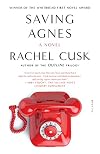
Saving Agnes
by Rachel Cusk
On This Page
Description
Winner of the British Whitbread First Novel Award, Saving Agnes is a delight to the ear of any listener who enjoys the English language at its best. Rachel Cusk's prose, rich with poetic imagery and insight, is spell-binding. Agnes Day is not quite certain of her own identity. Defining herself by her past failures and fearful of her future, she trudges through her days despising her editing job and searching for that special someone to help her forget the lover who jilted her. Although her show more naive attempts to bolster her self-esteem culminate in a series of one-night-stands and an affair with a mysterious heroin addict, Agnes' indomitable sense of humor somehow sustains her. Narrator Jenny Sterlin's British accent is the perfect accompaniment to a creation that is meant to be appreciated aloud in its native dialect. Her reading captures every nuance of mood and language to give listeners an unforgettable listening experience. show lessTags
Recommendations











Member Reviews
I came to this book after disliking my first Cusk: Outline– see my review to see my thoughts. I thought I might read her first novel, which was well received and see if I could glimpse something I like in her earlier work. It worked; I liked this book. At first I was annoyed by the complexity of the sentence structure and vocabulary, but I came to appreciate that she wasn't showing off, but using a lot of very good English words that are not routinely used, and the sentence structure is quite beautiful. So I enjoyed the writing style and I think the pacing of the story is good and I enjoyed how she slowly wrapped up the story. Things I didn’t like or feel confused about (spoilers ahead): The Ukrainian Canadian Character: her show more dialogue was not written accurately. For example, North Americans do not use the word, “heaps”. And being a Ukrainian Canadian from the Prairies myself, there are a lot of colourful (cringy) vocabulary that a young person from Saskatchewan would have surely used, especially one from the background described. So that was a fail for me. I’m interested by the rape and abuse story lines explored with both characters because I think it was handled so differently than it would be today. Does Agnes even realize at this point that her boyfriend raped her? What kind of life has Greta lived that she bounces back from her rape, also by a man she knows and has been dating, so quickly? It strikes me that the writer is too smart to be so flippant on this topic, even in the early 90s. I guess it can be tedious to read about a privileged white woman and her coming-of-age woes, but for me I was just reminded of how clueless and desperate for love I was at the same age (ok, slightly younger). I was a little thrown by the John character, because I was kind of regarding him as a significant love interest who had had some positive influence on Agnes, but by the end, he was clearly portrayed as a total user/abuser/jerk, which I actually think was taken too far in the subway scene. I hope the point was that he was both a positive and negative influence. Recommend the book and will be reading her next one, The Temporary. show less
Every so often I need to read a Rachel Cusk....a proper wordy workout for the brain, like doing a cryptic crossword. They should all come with a free dictionary because it’s a sure thing that I will be reaching for one before long. I would consider it a wasted read if it didn’t contribute at least three new words to my vocabulary.
In this novel we meet Agnes who finds just about everything in her life a mystifying ordeal – work, socialising, finding a boyfriend. At first she seemed hard to sympathise with – wealthy family, gainfully employed, living in a house share with two long standing friends...what’s to complain about? She should just stop over-thinking everything! Yet I found myself nodding time and time again in show more agreement with the musings of the embattled Agnes. I find myself in sympathy generally with any character who struggles socially, but I would hazard a guess that many people more sociable than me would agree with her on some things. Faced with the scenario with the ex-boyfriend in the restaurant my reaction would have been the same as Agnes’...just toe-curling and yet totally believable.
As with all Rachel Cusk’s novels, there were sentences I had to read numerous times to properly get the gist. All those long words jammed together....and yet when the picture emerges it just shimmers with clarity. I admire the way she builds up a paragraph with complex, wordy sentences like an archer gradually drawing back a bow, and then lets fly with a short snappy sentence – right into the centre of the target.
I wondered whether the end might let the whole thing down by being cheesy – Agnes sees the light etc etc, and yet it wasn’t like that. I loved the way the end was done, in fact it was one of my favourite parts of the novel.
So I’ve got my fix of vocabulary for a while – might be in need to some chick-lit to detox now, mind you. show less
In this novel we meet Agnes who finds just about everything in her life a mystifying ordeal – work, socialising, finding a boyfriend. At first she seemed hard to sympathise with – wealthy family, gainfully employed, living in a house share with two long standing friends...what’s to complain about? She should just stop over-thinking everything! Yet I found myself nodding time and time again in show more agreement with the musings of the embattled Agnes. I find myself in sympathy generally with any character who struggles socially, but I would hazard a guess that many people more sociable than me would agree with her on some things. Faced with the scenario with the ex-boyfriend in the restaurant my reaction would have been the same as Agnes’...just toe-curling and yet totally believable.
As with all Rachel Cusk’s novels, there were sentences I had to read numerous times to properly get the gist. All those long words jammed together....and yet when the picture emerges it just shimmers with clarity. I admire the way she builds up a paragraph with complex, wordy sentences like an archer gradually drawing back a bow, and then lets fly with a short snappy sentence – right into the centre of the target.
I wondered whether the end might let the whole thing down by being cheesy – Agnes sees the light etc etc, and yet it wasn’t like that. I loved the way the end was done, in fact it was one of my favourite parts of the novel.
So I’ve got my fix of vocabulary for a while – might be in need to some chick-lit to detox now, mind you. show less
No, no and just… no. I get that the story is supposed to be about middle-class angst in the form of a 20-something woman, fresh from college and embarking on the “big bad world” of adult life, but the delivery of the story is just plain torturous. I can appreciate that Cusk has a wonderful grasp of the English language, but it is almost as if she is too busy using her story as a showcase for her brilliant turns of phrase (like “hormonal terrorism” to describe a woman’s monthly cycle) and wants the reader to appreciate her writing over he story being told. Given that [Saving Agnes] was published when Cusk was only in her mid-twenties, which helps explain why the story stutters between youthful naivety and worldly show more observations… the story comes across as something rather too ambitious for the author to tackle. While I tend to like stories of a young professional woman trying to find herself in large metropolitan centre like London and New York, by the end of the story I was left thinking, “That was a long, arduous journey for the scant realization obtained.”
I know, there are some readers out there who feel that Saving Agnes is a brilliant book – it did win the 1993 Whitbread Award, so it must be appreciated by some readers – but it just came across as some convoluted expression of young adulthood immaturity and drama to me and I have never been more happy to reach the end of a story. show less
I know, there are some readers out there who feel that Saving Agnes is a brilliant book – it did win the 1993 Whitbread Award, so it must be appreciated by some readers – but it just came across as some convoluted expression of young adulthood immaturity and drama to me and I have never been more happy to reach the end of a story. show less
It is probably a little unfair to judge this debut novel having read most of Cusk's later fiction - at this distance it seems a little inconsequential but it does introduce many of her favourite themes, and it is quite funny in places, and quite dismissive of much of the culture and atmosphere of early 90s London.
The central character Agnes Day (and the obvious pun there is explained very early) is a young graduate sharing a ramshackle house in Highbury with two of her student friends. She gets a job in the office of a very dull diplomatic magazine, and has the usual rites of passage struggles with unsuitable men and finding some kind of meaning in life. The book is actually more enjoyable than that description makes it sound, but it show more is probably one for Cusk completists only. show less
The central character Agnes Day (and the obvious pun there is explained very early) is a young graduate sharing a ramshackle house in Highbury with two of her student friends. She gets a job in the office of a very dull diplomatic magazine, and has the usual rites of passage struggles with unsuitable men and finding some kind of meaning in life. The book is actually more enjoyable than that description makes it sound, but it show more is probably one for Cusk completists only. show less
This was an odd book.
It's really nicely written and enjoyable to read but didn't do anything to encourage me to keep reading it. I got about the thirds of the way through it and then, meh. can't be bothered finishing it.
Sorry Agnes, I hope all your troubles worked out okay in the end and you get a bit less whingy.
It's really nicely written and enjoyable to read but didn't do anything to encourage me to keep reading it. I got about the thirds of the way through it and then, meh. can't be bothered finishing it.
Sorry Agnes, I hope all your troubles worked out okay in the end and you get a bit less whingy.
Well I can't say I wasn't warned--a New Yorker review of another author mentioned that Rachel Cusk was a proponent of novels without stories. Sure enough, this prize winning novel has not story--well you don't give out prizes for books that people might actually want to read and press on their friends, do you. Aimless middle class woman with no particular goals or ambition drifting along through life, Read about 1/4 before giving up on it.
I had read and liked this author's previous book "The Country Life", so I picked up this one. It turned out to be a VERY BORING version of Bridget Jones.
August 2006
August 2006
Members
- Recently Added By
Author Information

30+ Works 9,013 Members
Rachel Cusk was born on Feb 8, 1967 in Canada. She spent much of her childhood in Los Angeles and finished her education at St Mary's Convent, Cambridge. her education at St Mary's Convent, Cambridge. In 2003, Rachel Cusk was nominated by Granta magazine as one of 20 'Best of Young British Novelists'. That year she published The Lucky Ones (2003), show more her fourth novel, which was shortlisted for the Whitbread Novel Award. Since then she has published four more novels; her latest is Outline (2014). She has also written several non-fiction books. A Life's Work: On Becoming a Mother (2001) is a personal exploration of motherhood. The Last Supper: A Summer in Italy (2009) is a memoir about time in southern Italy. In 2015 she made the Baileys Women's Prize for Fiction shortlist with her title Outline. (Bowker Author Biography) show less
Awards and Honors
Awards
Common Knowledge
- Original publication date
- 1993
Classifications
Statistics
- Members
- 317
- Popularity
- 99,880
- Reviews
- 8
- Rating
- (2.90)
- Languages
- English, Spanish
- Media
- Paper, Audiobook, Ebook
- ISBNs
- 14
- ASINs
- 4