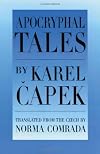
Apocryphal Tales
by Karel Čapek
On This Page
Description
An anthology of stories presenting famous events from the point of view of the man in the street. In one story, a baker describes Jesus' miracle of loaves and fish, in another, townspeople argue who is to blame for the invasion of the Huns. Thirty stories in all.Tags
Recommendations

















Member Reviews
This collection of 29 stories (most no more than three or four pages) starts off quite humorously; Capek is a master of satire and the introductory story, “The Moving Business,” tells about a entrepreneur on the make, someone whose brilliant idea for a new business is all about escaping our problems by moving into the past. Literally.
“Let's say some gentleman comes to me who wants to move somewhere out of this damned century; he's had it up to the eyeballs, he says, right up to the eyeballs with wars, the arms race, bolsheviks, fascism and, for that matter, progress in general. I let him go on cussing, and then I say: Please be so good, sir, as to select some other era; here are some brochures for several different show more centuries.”
The next few stories are amusing and entertaining, and gave me the impression that this would be light entertainment. Most of the stories (written in the 1920s and 1930s) are set among the ancient Greeks, the Romans, and even a few within the bounds of a few plays by Shakespeare. But the humor ebbs, increasingly displaced by sharp, even savage, satire. Cavemen complain about the “generation gap”; villagers argue about who is to blame for Attila the Hun’s approach; a baker claims that Jesus’s miracle of loaves and fishes is putting bakers out of business; the Greeks argue about the real reason for going to war with Troy. Capek’s achievement, in part, is his ability to use unexpected settings to pose hard questions about contemporary and timeless issues. He questions the meaning and value of subjects like wisdom, justice, religion, patriotism, and progress, doing so clearly and in surprisingly entertaining—almost modern—language. show less
“Let's say some gentleman comes to me who wants to move somewhere out of this damned century; he's had it up to the eyeballs, he says, right up to the eyeballs with wars, the arms race, bolsheviks, fascism and, for that matter, progress in general. I let him go on cussing, and then I say: Please be so good, sir, as to select some other era; here are some brochures for several different show more centuries.”
The next few stories are amusing and entertaining, and gave me the impression that this would be light entertainment. Most of the stories (written in the 1920s and 1930s) are set among the ancient Greeks, the Romans, and even a few within the bounds of a few plays by Shakespeare. But the humor ebbs, increasingly displaced by sharp, even savage, satire. Cavemen complain about the “generation gap”; villagers argue about who is to blame for Attila the Hun’s approach; a baker claims that Jesus’s miracle of loaves and fishes is putting bakers out of business; the Greeks argue about the real reason for going to war with Troy. Capek’s achievement, in part, is his ability to use unexpected settings to pose hard questions about contemporary and timeless issues. He questions the meaning and value of subjects like wisdom, justice, religion, patriotism, and progress, doing so clearly and in surprisingly entertaining—almost modern—language. show less
Czech author Karel Čapek continues to impress me as I traipse through his oeuvre. Published in newspapers between 1920 and 1938, the year of his death, the short stories here are imaginative takes on stories or figures from classic literature, the Bible, or history. He’s playful and light, but usually writes with a point, making his readers think about current events or the nature of mankind. He was a voice of reason and humanity during a frightening time in Europe, with fascism and hatred on the rise, and while he never preaches, it’s easy to see why he was wanted by the Gestapo. One can’t help but see parallels to some of today’s politics, as well, and Čapek’s central observations, including the wisdom of kindness, are show more timeless. show less
An amusing collection of short stories, by Karel Čapek, author of R.U.R. and War With the Newts. These are gently satirical takes on figures from history and literature – Prometheus, Alexander the Great, the Nativity, Hamlet, and so forth. A fun read.
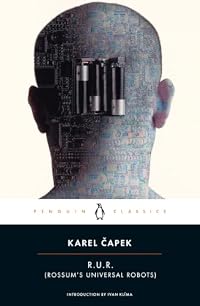
The great Czech writer Karel Capek is best known for his sci fi works – RUR, the play where the term ‘robot’ first appeared, and War of the Newts, a novel pitting mankind against intelligent amphibians – but his writings were impressively varied. His work includes a book on gardening, an idiosyncratic biography of T.G. Masaryk, travel writing and short stories in several genres. I greatly enjoyed Capek’s Tales from Two Pockets, a collection of short mysteries. I don’t know if I would have been impressed had I only read one or two but the whole collection is rather impressive in its sheer variety and the humorous but affectionate way Capek exposes his characters’ foibles and faults. Despite the fact that the occasional show more murder pops up, I always remember the book with a smile. Capek’s Apocryphal Stories has similar pleasures.
The stories are casual and funny; they usually have one interesting or humorous idea and end after a few pages. Capek’s conversational style emphasizes that people have been the same throughout history and will always be complaining, nostalgic, prejudiced and a little self-delusional. The day-to-day irritations are more important to his characters than the history that they are living. This is especially true in the Apocryphal Tales. Capek didn’t intend for the stories to be a collection and they were written between 1920 and 1938. However, one would never know that when reading them straight through. This book organizes them by time period and Capek touches on well-known moments in Western history (and literature). There are stories about the Greeks and Romans, Jesus Christ and biblical characters, Attila and Napoleon, Don Juan and characters from Shakespeare. Usually we see the story from a side character or a different angle. Alexander the Great has a whole string of justifications for his conquests. A baker is appalled at Jesus’ miracle with the loaves; Lazarus lives in fear of dying again after being brought back to life. Hamlet struggles over his desire to be both a poet and an actor and a priest tells the real story of Romeo and Juliet.
The other set of stories are the Would-Be Tales and they are set in Capek’s present day. These stories feature an ersatz libertine, an out of control lawsuit, a man who can fly, and a solution to the problem of being the first guest to arrive at a party. Some of the Apocryphal Tales can be seen as a comment on the political events of the day – the stories include vicious mobs, blind nationalism and unquestioning prejudices. Still, Capek’s warmth and humor make the stories less depressing than they might be otherwise. Two from the Would-Be Tales also touch on the atmosphere in 1938. The Anonymous Letter has a journalist who receives vicious hate mail (much like Capek was at the time) accidentally bumps into one of his persecutors. The man is polite but insignificant, at odds with all his detailed threats. The journalist feels surprise and finally pity and I thought of internet trolls who are probably for the most part normal people except for the online hate that they spew. In Ten Centavos, ostensibly set in Lisbon, Manoel Varga isn’t concerned about the new regime but suddenly finds himself accused of corrupting the nation and spreading subversive ideas due to his support of adult education. Capek has a happy ending for that one as Varga finds out that not everyone shuns him. Overall, very enjoyable stories. show less
The stories are casual and funny; they usually have one interesting or humorous idea and end after a few pages. Capek’s conversational style emphasizes that people have been the same throughout history and will always be complaining, nostalgic, prejudiced and a little self-delusional. The day-to-day irritations are more important to his characters than the history that they are living. This is especially true in the Apocryphal Tales. Capek didn’t intend for the stories to be a collection and they were written between 1920 and 1938. However, one would never know that when reading them straight through. This book organizes them by time period and Capek touches on well-known moments in Western history (and literature). There are stories about the Greeks and Romans, Jesus Christ and biblical characters, Attila and Napoleon, Don Juan and characters from Shakespeare. Usually we see the story from a side character or a different angle. Alexander the Great has a whole string of justifications for his conquests. A baker is appalled at Jesus’ miracle with the loaves; Lazarus lives in fear of dying again after being brought back to life. Hamlet struggles over his desire to be both a poet and an actor and a priest tells the real story of Romeo and Juliet.
The other set of stories are the Would-Be Tales and they are set in Capek’s present day. These stories feature an ersatz libertine, an out of control lawsuit, a man who can fly, and a solution to the problem of being the first guest to arrive at a party. Some of the Apocryphal Tales can be seen as a comment on the political events of the day – the stories include vicious mobs, blind nationalism and unquestioning prejudices. Still, Capek’s warmth and humor make the stories less depressing than they might be otherwise. Two from the Would-Be Tales also touch on the atmosphere in 1938. The Anonymous Letter has a journalist who receives vicious hate mail (much like Capek was at the time) accidentally bumps into one of his persecutors. The man is polite but insignificant, at odds with all his detailed threats. The journalist feels surprise and finally pity and I thought of internet trolls who are probably for the most part normal people except for the online hate that they spew. In Ten Centavos, ostensibly set in Lisbon, Manoel Varga isn’t concerned about the new regime but suddenly finds himself accused of corrupting the nation and spreading subversive ideas due to his support of adult education. Capek has a happy ending for that one as Varga finds out that not everyone shuns him. Overall, very enjoyable stories. show less
histórias com personagens retirados da realidade ou de relatos diversos, em situações inusitadas mas que dizem sobre o que no humano é relegado às margens da história, com muita ironia.
***
entre março de 2009 e março de 2010 participei de um grupo em são paulo, que procurava articular a criação de uma lei de fomento à música, naquela mesma cidade, moldada na lei de fomento à dança, da mesma. eu e vanderlei lucentini alimentamos um blogue na época.
existe um maravilhoso conto de karel čapek, chamado a iconoclastia, em que o amante da arte procópio pede ao pintor e padre influente nicéforo que intervenha ao grande sínodo e assim ao imperador para que a arte seja salva dos iconoclastas, que gritam “morte aos show more idólatras” e pedem a retirada da arte dos espaços públicos. nicéforo, entretanto, parece mais interessado em que mosaicos de uma infame escola de creta, essa arte moderna e deturpada, sejam por fim destruídos. show less
***
entre março de 2009 e março de 2010 participei de um grupo em são paulo, que procurava articular a criação de uma lei de fomento à música, naquela mesma cidade, moldada na lei de fomento à dança, da mesma. eu e vanderlei lucentini alimentamos um blogue na época.
existe um maravilhoso conto de karel čapek, chamado a iconoclastia, em que o amante da arte procópio pede ao pintor e padre influente nicéforo que intervenha ao grande sínodo e assim ao imperador para que a arte seja salva dos iconoclastas, que gritam “morte aos show more idólatras” e pedem a retirada da arte dos espaços públicos. nicéforo, entretanto, parece mais interessado em que mosaicos de uma infame escola de creta, essa arte moderna e deturpada, sejam por fim destruídos. show less
Amazon: This is a collection of short pieces from the Czechoslovakian author of "R.U.R." (the futuristic play in which he coined the term 'robot') who stands out as a calming voice among the chaos of Central Europe in the early 20th Century. The bulk of this volume is comprised of tight, pointed retellings of stories from classical literature: the Greeks, the Bible, and even Shakespeare. By taking a unique slant on some well-known stories, usually with humorous or sardonic overtones, Capek creates modern fables with clearly implied morals that provide practical advice for even the most contemporary readers. Themes range from fear of change, and the importance of the work ethic, to contempt for mob mentality. By placing these tales in show more the distant past, he is able to present specific political arguments without too openly offending the powers-of-the-moment. With his warm humanism, pointed humor, and continuing sociopolitical relevance, Capek should be a great favorite of fans of such political humorists as Art Buchwald and Jimmy Breslin. With the re-emergence of Eastern/Central Europe from communist domination, it's not too much to hope that Capek's work will soon enjoy the reputation it so richly deserves. show less
its a literary masturbatory-piece.
Members
- Recently Added By
Lists

Books Read in 2018
4,360 works; 110 members
Author Information

Karel Capek is best known abroad for his plays, but at home he is also revered as an accomplished novelist, short-story writer, essayist, and writer of political articles. His bitingly satirical novel The War with the Newts (1936) reveals his understanding of the possible consequences of scientific advance. The novel Krakatit (1924), about an show more explosive that could destroy the world, foreshadows the feared potential of a nuclear disaster. In his numerous short stories he depicts the problems of modern life and common people in a humorous and whimsically philosophical fashion. The plays of Karel Capek presage the Theater of the Absurd. R.U.R. (Rossum's Universal Robots) (1921) was a satire on the machine age. He created the word robot from the Czech noun robota, meaning "work" for the human-made automatons who in that play took over the world, leaving only one human being alive. The Insect Comedy (1921), whose characters are insects, is an ironic fantasy on human weakness. The Makropoulos Secret (1923), later used as the basis for Leos Janacek's opera, was an experimental piece that questioned whether immortality is really desirable. All the plays have been produced successfully in New York. Most deal satirically with the modern machine age or with war. Underlying all his work, though, is a faith in humanity, truth, justice, and democracy, which has made him one of the most beloved of all Czech writers. (Bowker Author Biography) show less
Some Editions
Awards and Honors
Distinctions
Series
Belongs to Publisher Series
Common Knowledge
- Canonical title*
- Von Prometheus bis Napoleon : Apokryphen zur Geschichte
- Original title
- Kniha apokryfů
- Original publication date
- 1932
*Some information comes from Common Knowledge in other languages. Click "Edit" for more information.
Classifications
- Genres
- Fiction and Literature, General Fiction
- DDC/MDS
- 891.8 — Literature & rhetoric Asian Literature East Indo-European and Celtic literatures West and South Slavic languages (Bulgarian, Slovene, Polish, Czech, Slovak, Serbo-Croatian, and Macedonian)
- LCC
- PG5038 .C3 .K613 — Language and Literature Slavic languages and literatures. Baltic languages. Albanian language Slavic. Baltic. Albanian Slavic Czech
- BISAC
Statistics
- Members
- 290
- Popularity
- 110,522
- Reviews
- 11
- Rating
- (3.93)
- Languages
- 15 — Catalan, Czech, Dutch, English, Esperanto, Estonian, French, German, Greek, Hebrew, Italian, Polish, Portuguese, Romanian, Spanish
- Media
- Paper, Ebook
- ISBNs
- 26
- ASINs
- 9