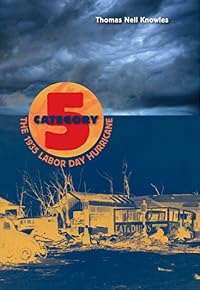
Category 5: The 1935 Labor Day Hurricane
by Thomas Neil Knowles
On This Page
Description
A frightening account of the first Category 5 storm to strike the U.S. "A gripping account. . . . Winds were so strong that they tore babies from the arms of their parents. Over four hundred people lost their lives, including over two hundred veterans of World War I. It was a tragedy that did not have to happen."--John Wallace Viele, author of The Florida Keys: A History of the Pioneers "Makes for fascinating reading about a period of time when science, politics, and nature converged, show more resulting in disaster."--Rodney E. Dillon Jr., Vice President, Past Perfect Florida History, Inc. In the midst of the Great Depression, a furious storm struck the Florida Keys with devastating force. With winds estimated at over 225 miles per hour, it was the first recorded Category 5 hurricane to make landfall in the United States. Striking at a time before storms were named, the catastrophic tropical cyclone became known as the 1935 Labor Day Hurricane, and its aftermath was felt all the way to Washington, D.C. In the hardest hit area of the Florida Keys, three out of every five residents were killed, while hundreds of World War I veterans sent there by the federal government perished. By sifting through overlooked official records and interviewing survivors and the relatives of victims, Thomas Knowles pieces together this dramatic story, moment by horrifying moment. He explains what daily life was like on the Keys, why the veteran work force was there (and relatively unprotected), the state of weather forecasting at the time, the activities of the media covering the disaster, and the actions of government agencies in the face of severe criticism over their response to the disaster. The Labor Day Hurricane of 1935 remains one of the most intense to strike America's shores. Category 5 is a sobering reminder that even with modern meteorological tools and emergency management systems, a similar storm could cause even more death and destruction today. show lessTags
Recommendations












Member Reviews
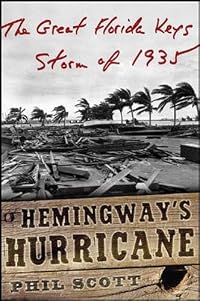
My latest read is Thomas Neil Knowles' book Category 5 - The 1935 Labor Day Hurricane. The book was Published by the University Press of Florida and is the result of 12 years of research and many interviews. This is actually my second book on this hurricane. Three years ago I read Phil Scott's 2006 book, Hemingway's Hurricane, so I was already familiar with the tragic events of the 1935 Labor Day weekend. Even with this background I found the book very interesting. Knowles graphically portrays the lives of Florida Keys residents immediately before the hurricane, during the day of the storm and the aftermath. Both books address the tragic loss of the hundreds of World War I veterans sent to the Keys to build a continuous road link to Key show more West. Unlike Scott's book, Knowles provides more information by way maps and graphics. Both books reproduce many photographs of the aftermath documenting the total devastation and lose of life. Through his vivid writing style, Knowles gives us a glimpse of life on the Florida Keys during the height of the depression and the life & death struggles experienced on that day. Knowles compliments the human stories with just enough factual background on hurricanes, the US Weather Service and the Florida East Coast Railway to keep the narrative flowing for easy reading.
In his epilogue, Knowles addresses whether if could happen again? The 1935 population of the Florida Keys at the center of the hurricane was 284 residents. In 2000 the same area had a population of 6,846. Current estimates are that an evacuation of the Keys would take 36 hours. I don't know if this estimate takes into account the Katrina experience but it seems to be a low end estimate to me. The Labor Day Hurricane (they weren't given names until 1953) went from Category 1 to Category 5 in the 36 hours prior to landfall. Knowles thus, answers the question "Unfortunately, the answer is yes, and such an event has the potential to be much worse in terms of the number of causalities and the amount of property damage."
Anyone contemplating a seaside home in the southeast should read either of these books. First as checkpoint on the potential devastation that a hurricane can reek and second, as motivation to evacuate the shore area when a hurricane threatens. Unlike 1935, today's technology of satellites, hurricane hunter aircraft, and knowledge of hurricane physics make any loss of life avoidable. show less
In his epilogue, Knowles addresses whether if could happen again? The 1935 population of the Florida Keys at the center of the hurricane was 284 residents. In 2000 the same area had a population of 6,846. Current estimates are that an evacuation of the Keys would take 36 hours. I don't know if this estimate takes into account the Katrina experience but it seems to be a low end estimate to me. The Labor Day Hurricane (they weren't given names until 1953) went from Category 1 to Category 5 in the 36 hours prior to landfall. Knowles thus, answers the question "Unfortunately, the answer is yes, and such an event has the potential to be much worse in terms of the number of causalities and the amount of property damage."
Anyone contemplating a seaside home in the southeast should read either of these books. First as checkpoint on the potential devastation that a hurricane can reek and second, as motivation to evacuate the shore area when a hurricane threatens. Unlike 1935, today's technology of satellites, hurricane hunter aircraft, and knowledge of hurricane physics make any loss of life avoidable. show less
In the midst of the Great Depression, a furious storm struck the Florida Keys with devastating force. With winds estimated at over 225 miles per hour, it was the first recorded Category 5 hurricane to make landfall in the United States.
Striking at a time before storms were named, the catastrophic tropical cyclone became known as the 1935 Labor Day Hurricane, and its aftermath was felt all the way to Washington, D.C.
In the hardest hit area of the Florida Keys, three out of every five residents were killed, while hundreds of World War I veterans sent there by the federal government perished.
By sifting through overlooked official records and interviewing survivors and the relatives of victims, Thomas Knowles pieces together this dramatic show more story, moment by horrifying moment. He explains what daily life was like on the Keys, why the veteran work force was there (and relatively unprotected), the state of weather forecasting at the time, the activities of the media covering the disaster, and the actions of government agencies in the face of severe criticism over their response to the disaster.
The Labor Day Hurricane of 1935 remains one of the most intense to strike America's shores. Category 5 is a sobering reminder that even with modern meteorological tools and emergency management systems, a similar storm could cause even more death and destruction today. show less
Striking at a time before storms were named, the catastrophic tropical cyclone became known as the 1935 Labor Day Hurricane, and its aftermath was felt all the way to Washington, D.C.
In the hardest hit area of the Florida Keys, three out of every five residents were killed, while hundreds of World War I veterans sent there by the federal government perished.
By sifting through overlooked official records and interviewing survivors and the relatives of victims, Thomas Knowles pieces together this dramatic show more story, moment by horrifying moment. He explains what daily life was like on the Keys, why the veteran work force was there (and relatively unprotected), the state of weather forecasting at the time, the activities of the media covering the disaster, and the actions of government agencies in the face of severe criticism over their response to the disaster.
The Labor Day Hurricane of 1935 remains one of the most intense to strike America's shores. Category 5 is a sobering reminder that even with modern meteorological tools and emergency management systems, a similar storm could cause even more death and destruction today. show less
Ratings
Members
- Recently Added By
Author Information
2 Works 37 Members
Common Knowledge
- Important places
- Florida Keys, Florida, USA
- Important events
- 1935 Labor Day Hurricane
- Dedication
- To the survivors and others who generously shared their experiences, and to my wife, Barbara, whose help and patience enabled me to write this book.
- First words
- Early on the first day of November 1870 in one of the rooms of the large, three story, cupola-topped Russell House in Key West, a Signal Corps observer-sergeant closely watched the minute hand of a clock.
- Quotations
- On the day after the storm's passage, the winds were too high and the waters too roiled to do anything even if recovery forces had been available. On Wednesday, while the emphasis was on finding and removing survivors, some c... (show all)ollection of the more accessible bodies was done. Not until Thursday did the harvesting of the dead begin in earnest. The National Guard coordinated recovery operations ashore, while the Coast Guard oversaw the collection of floaters and bodies brought in from the small islands in Florida Bay.....On board the Coast Guard cutters bodies were stowed on the afterdeck or other topside location. At the end of the day, the vessels put into Snake Creek and offloaded the corpses. Everything did not always go according to plan. One cutter was bringing in seventy-five bodies stacked on the afterdeck when it ran aground. With a falling tide, the crew could not free the vessel so they had to wait until the tide came in. To pass the time, the crew went below decks to play some cards. Just as they were beginning to relax and enjoy the game, a pounding on the sides of the hull began. The incessant thumping was caused by sharks drawn to the boat by blood and urine from the bodies running off the deck and into the water. The game was called off when a steady stream of blood began to drip onto the table from the bodies lying on the deck above. For obvious reasons, the cutters were periodically sent to the Coast Guard base in Miami for fumigation.
- Last words
- (Click to show. Warning: May contain spoilers.)In this context, the experiences of the people of the Upper Florida Keys during the 1935 Labor Day Hurricane should never be forgotten.
Classifications
Statistics
- Members
- 31
- Popularity
- 900,429
- Reviews
- 2
- Rating
- (4.07)
- Languages
- English
- Media
- Paper, Ebook
- ISBNs
- 3
- ASINs
- 1