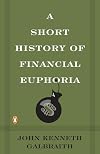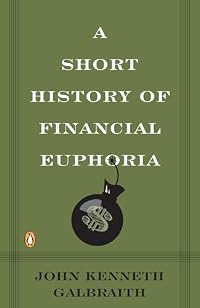
A Short History of Financial Euphoria
by John Kenneth Galbraith
On This Page
Description
The world-renowned economist offers an irreverent analyses of financial debacle from the tulip craze of the seventeenth century to the recent plague of junk bonds. With incomparable wisdom, skill, and wit, world-renowned economist John Kenneth Galbraith traces the history of the major speculative episodes in our economy over the last three centuries. Exposing the ways in which normally sane people display reckless behavior in pursuit of profit, Galbraith asserts that our "notoriously short" show more financial memory is what creates the conditions for market collapse. By recognizing these signs and understanding what causes them we can guard against future recessions and have a better hold on our country's (and our own) financial destiny. show lessTags
Recommendations




Member Reviews
Brilliant little book, or long essay, by perhaps the greatest economic mind of the late 20th century.
In summary: There is no true financial innovation, only variations on the theme of leverage, and the specious association, or perceived but nonexistent correlation, between money and intelligence contributes to speculative euphoria and programmed collapse. In fact, “having money may mean, as often in the past and frequently in the present, that the person is foolishly indifferent to legal constraints and may, in modern times, be a potential resident of a minimum-security prison.”
Particularly love this quote: “... the discovery that high-risk bonds leveraged on limited assets should have a higher interest rate hardly stands on par show more as an invention with the electric light.” Ouch. Take that, dumbass Michael Milken, and everyone that invested with him!
The repeated emphasis on the problem lying with the market itself, not some invented or, at best, subordinate external factor is bold and brilliant. Particularly in 1990, when few others dared blaspheme the myth of the rational market.
Drumph even makes a small appearance at the end, and, charitably, Galbraith reserves his ire not for the charlatan himself, but for the idiot bankers that loaned him their depositors’ money. show less
In summary: There is no true financial innovation, only variations on the theme of leverage, and the specious association, or perceived but nonexistent correlation, between money and intelligence contributes to speculative euphoria and programmed collapse. In fact, “having money may mean, as often in the past and frequently in the present, that the person is foolishly indifferent to legal constraints and may, in modern times, be a potential resident of a minimum-security prison.”
Particularly love this quote: “... the discovery that high-risk bonds leveraged on limited assets should have a higher interest rate hardly stands on par show more as an invention with the electric light.” Ouch. Take that, dumbass Michael Milken, and everyone that invested with him!
The repeated emphasis on the problem lying with the market itself, not some invented or, at best, subordinate external factor is bold and brilliant. Particularly in 1990, when few others dared blaspheme the myth of the rational market.
Drumph even makes a small appearance at the end, and, charitably, Galbraith reserves his ire not for the charlatan himself, but for the idiot bankers that loaned him their depositors’ money. show less
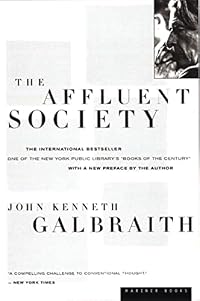
[a:Galbraith|23458|John Kenneth Galbraith|https://d.gr-assets.com/authors/1296955062p2/23458.jpg]'s reputation as an economist isn't what it once was. There are few takers these days for tomes such as [b:American Capitalism|270751|American Capitalism The Concept of Countervailing Power|John Kenneth Galbraith|https://d.gr-assets.com/books/1416182182s/270751.jpg|262478], [b:The New Industrial State|244904|The New Industrial State|John Kenneth Galbraith|https://d.gr-assets.com/books/1391061157s/244904.jpg|2085732], or [b:Economics and the Public Purpose|1802633|Economics and the Public Purpose|John Kenneth Galbraith|https://d.gr-assets.com/books/1349644692s/1802633.jpg|1466585], although [b:The Affluent Society|41589|The Affluent show more Society|John Kenneth Galbraith|https://d.gr-assets.com/books/1348310809s/41589.jpg|1511697] retains a readership. But as a writer of popular, accesible economics, he is, in my view, up there with [a:Bastiat|5614194|Bastiat, Frederick|https://s.gr-assets.com/assets/nophoto/user/u_50x66-632230dc9882b4352d753eedf9396530.png]. His [b:The Great Crash of 1929|41591|The Great Crash of 1929|John Kenneth Galbraith|https://d.gr-assets.com/books/1400087418s/41591.jpg|1466583] is an excellent bit of descriptive writing and this short book is another riff on its themes.
Are the causes of economic events such as assets bubbles and busts endogenous - originating within the economic system, such as central bank action or new innovations - or exogenous - originating outside it, such as natural disasters? Galbraith comes down very firmly for the latter, rooting his explanation entirely in group psychology. For the same reasons I didn't much like [b:Animal Spirits|6167162|Animal Spirits How Human Psychology Drives the Economy, and Why It Matters for Global Capitalism|George A. Akerlof|https://d.gr-assets.com/books/1347712043s/6167162.jpg|6346556], I find the total reliance on group psychology unsatisfactory. In the most recent boom and bust, that of sub prime mortgages and their derivatives, there were plenty of endogenous factors which cannot be ignored.
But Galbraith makes some good points. His focus on the repeated presence of leverage in these events is interesting and it is a shame that space does not allow for a more systematic analysis. Also, Galbraith is entirely right to castigate the quest for 'the' person to blame after the bust. For all the fuss about bankers since 2008, little popular flak has been directed at central bankers. show less
Are the causes of economic events such as assets bubbles and busts endogenous - originating within the economic system, such as central bank action or new innovations - or exogenous - originating outside it, such as natural disasters? Galbraith comes down very firmly for the latter, rooting his explanation entirely in group psychology. For the same reasons I didn't much like [b:Animal Spirits|6167162|Animal Spirits How Human Psychology Drives the Economy, and Why It Matters for Global Capitalism|George A. Akerlof|https://d.gr-assets.com/books/1347712043s/6167162.jpg|6346556], I find the total reliance on group psychology unsatisfactory. In the most recent boom and bust, that of sub prime mortgages and their derivatives, there were plenty of endogenous factors which cannot be ignored.
But Galbraith makes some good points. His focus on the repeated presence of leverage in these events is interesting and it is a shame that space does not allow for a more systematic analysis. Also, Galbraith is entirely right to castigate the quest for 'the' person to blame after the bust. For all the fuss about bankers since 2008, little popular flak has been directed at central bankers. show less
This short book should be a must read for all those involved in our financial institutions. Galbraith shows how we have repeatedly allowed ourselves to ride the boom/bust roller coaster and how the pattern repeats itself. If only we could see it while it was happening and be willing to put on the brakes!
Pros: timeless; good scornful tone;
Cons: not very insightful; basic descriptive accounts; lack of treatment on systematic exploitation (rather than pure speculation)
Cons: not very insightful; basic descriptive accounts; lack of treatment on systematic exploitation (rather than pure speculation)
humanity's perdition: not learning lessons for long enough
ameno pamfleto un tanto personal acerca de los ciclos de especulativos y sus "autosemejanzas"
Received from Giftboxes
Members
- Recently Added By
Lists

Política - Clásicos
164 works; 2 members
Author Information

76+ Works 11,212 Members
John Kenneth Galbraith is a Canadian-born American economist who is perhaps the most widely read economist in the world. He taught at Harvard from 1934-1939 and then again from 1949-1975. An adviser to President John F. Kennedy, he served from 1961 to 1963 as U.S. ambassador to India. His style and wit in writing and his frequent media appearances show more have contributed greatly to his fame as an economist. Galbraith believes that it is not sufficient for government to manage the level of effective demand; government must manage the market itself. Galbraith stated in American Capitalism (1952) that the market is far from competitive, and governments and labor unions must serve as "countervailing power." He believes that ultimately "producer sovereignty" takes the place of consumer sovereignty and the producer - not the consumer - becomes ruler of the marketplace. (Bowker Author Biography) John Kenneth Galbraith, born in 1908, is the Paul M. Warburg Professor of Economics Emeritus at Harvard University and a past president of both the American Academy of Arts and Letters and the American Economic Association. He is the author of thirty-one books spanning five decades. He has received honorary degrees from, among others, Harvard University, Oxford University, the University of Paris, the University of Toronto, and Moscow State University. He is Commandeur de la Legion d'Honneur in France, and in 1997 he was inducted into the Order of Canada. In 2000, at a White House ceremony, he was given the Presidential Medal of Freedom. He lives in Cambridge, Massachusetts. (Publisher Provided) show less
Common Knowledge
- Canonical title
- A Short History of Financial Euphoria
Classifications
Statistics
- Members
- 379
- Popularity
- 82,293
- Reviews
- 8
- Rating
- (3.94)
- Languages
- 7 — English, French, German, Hungarian, Italian, Korean, Spanish
- Media
- Paper, Audiobook, Ebook
- ISBNs
- 16
- ASINs
- 6