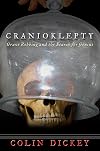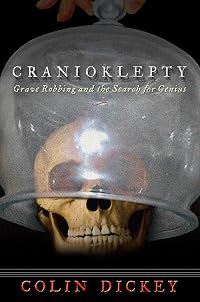
Cranioklepty: Grave Robbing and the Search for Genius
by Colin Dickey
On This Page
Description
The after-death stories of Franz Joseph Haydn, Ludwig Beethoven, Swedenborg, Sir Thomas Browne and many others have never before been told in such detail and vividness. Fully illustrated with some surprising images, this is a fascinating and authoritative history of ideas carried along on the guilty pleasures of an anthology of real-after-life gothic tales. Beginning dramatically with the opening of Haydn's grave in October 1820, cranioklepty takes us on an extraordinary history of a show more peculiar kind of obsession. The desire to own the skulls of the famous, for study, for sale, for public (and private) display, seems to be instinctual and irresistible in some people. The rise of phrenology at the beginning of the 19th century only fed that fascination with the belief that genius leaves its mark on the very shape of the head. show lessTags
Recommendations













Member Recommendations

Member Reviews
Most history books we read nowadays deal with dead people. Cranioklepty, however, deals with a different aspect of its dead people: it chronicles their journeys AFTER they've died.
Cranioklepty, the word pertains to skull theft, which, while widespread in the lesser civilized parts of the world, made its leap into civilization through a little pseudoscience known as "phrenology," which uses the bumps and valleys on one's skull to determine aptitude and skill and whatnot.
Phrenology led to skulduggery, and pretty soon, even respected individuals were collecting the skulls of other respected individuals. Headhunting left the forest and tribal scene and became a passtime of highbrow individuals (including an ancestor of the Bush dynasty).
The show more book itself is written in clear language, has annotations for all the bizarre and possibly unbelievable passages, and does not hesitate to call a spade a spade, or explain how one goes from a recently deceased body to a bleached skull. Some passages may not be for the squeamish!
It chronicles the post-death story of several severed heads: Haydn, Mozart, Beethoven, Thomas Browne, and so forth, tracing the historical twists and turns that led each of these great minds (now hollow skulls) into the hands of different collectors.
The book mixes humor with history, being factual and funny. All in all, if you're not easily turned off by the subject matter at hand, you will find Cranioklepty to be a book worth reading. I highly recommend you get this book for yourself, or perhaps for that large-headed friend of yours. show less
Cranioklepty, the word pertains to skull theft, which, while widespread in the lesser civilized parts of the world, made its leap into civilization through a little pseudoscience known as "phrenology," which uses the bumps and valleys on one's skull to determine aptitude and skill and whatnot.
Phrenology led to skulduggery, and pretty soon, even respected individuals were collecting the skulls of other respected individuals. Headhunting left the forest and tribal scene and became a passtime of highbrow individuals (including an ancestor of the Bush dynasty).
The show more book itself is written in clear language, has annotations for all the bizarre and possibly unbelievable passages, and does not hesitate to call a spade a spade, or explain how one goes from a recently deceased body to a bleached skull. Some passages may not be for the squeamish!
It chronicles the post-death story of several severed heads: Haydn, Mozart, Beethoven, Thomas Browne, and so forth, tracing the historical twists and turns that led each of these great minds (now hollow skulls) into the hands of different collectors.
The book mixes humor with history, being factual and funny. All in all, if you're not easily turned off by the subject matter at hand, you will find Cranioklepty to be a book worth reading. I highly recommend you get this book for yourself, or perhaps for that large-headed friend of yours. show less
What do Haydn, Beethoven and Mozart all have in common besides being great composers? For one thing, they all had their skulls, or at least part of their skulls, stolen from their graves. Cranioklepty relates the intriguing history of Phrenology and the attempts made by phrenologists to validate their beliefs. According to Webster, phrenology is “the study of the conformation of the skull based on the belief that it indicates mental faculties and character traits.” It was developed in 1796 by Franz Gall and was very popular through the 1800’s. There were famous supporters of phrenology, including Walt Whitman who made references to it in some of his writings. There were famous skeptics as well. Mark Twain was openly critical when show more writing about the skull readings he received. Phrenologists were careful to “not to predict genius from the shape of the skulls but instead to confirm the already established genius in the heads before them.”
Skulls of prisoners and insane asylum patients were easy to acquire, but phrenologists were desperate to study the skulls of famous citizens, especially anyone with creative or intellectual genius. Since no one was offering to donate their skulls to this strange science, practitioners had to resort to grave robbing. The collecting of skulls became a hobby for some, and an obsession for others. Elaborate glass cases were designed to display the skulls in homes and offices. What we think of as morbid today, was thought of very differently in the 19th century. Keeping relics of someone you knew or admired was considered an honor. One collector, Joseph Hyrtl, donated his collection which is now housed in Philadelphia’s Mutter Museum. If you are a fan of the macabre, you should read “Cranioklepty”. If you are ever in Philadelphia, you should visit the Mutter Museum. show less
Skulls of prisoners and insane asylum patients were easy to acquire, but phrenologists were desperate to study the skulls of famous citizens, especially anyone with creative or intellectual genius. Since no one was offering to donate their skulls to this strange science, practitioners had to resort to grave robbing. The collecting of skulls became a hobby for some, and an obsession for others. Elaborate glass cases were designed to display the skulls in homes and offices. What we think of as morbid today, was thought of very differently in the 19th century. Keeping relics of someone you knew or admired was considered an honor. One collector, Joseph Hyrtl, donated his collection which is now housed in Philadelphia’s Mutter Museum. If you are a fan of the macabre, you should read “Cranioklepty”. If you are ever in Philadelphia, you should visit the Mutter Museum. show less
Alas, poor Yorick! I knew him, Horatio: a fellow of infinite jest, of most excellent fancy: he hath borne me on his back a thousand times; and now, how abhorred in my imagination it is! My gorge rims at it. Here hung those lips that I have kissed I know not how oft. Where be your gibes now? Your gambols? Your songs? Your flashes of merriment, that were wont to set the table on a roar?
–Hamlet Act V, Scene I
Phrenology: n. The science of picking the pocket through the scalp. It consists of locating and exploiting the organ that one is a dupe with.
–Ambrose Bierce, The Devil’s Dictionary
When Hamlet muses upon the skull of his old jester in a very odd and rather disturbingly forensic scene in the play (A tanner, lectures the show more gravedigger, will last longer in the ground than other kinds of corpses because “his hide is so tanned with his trade, that he will keep out water a great while; and your water is a sore decayer of your whoreson dead body”) he is commenting about the inevitability of death, its great equalizing effect. The things of this earth are but fleeting, our triumphs and our disasters all come to this—a piles of bones in the earth.
About two hundred years after theater audiences first contemplated, with Hamlet, the ephemeral nature of men’s lives on earth, another man was looking at the skull of another friend, and thinking something quite different. Unlike Yorick, who had lain in the ground some three and twenty years, this skull was but a week buried, and thus not just a skull, but a head. “The sight made a life-long impression on me,” wrote the observer, a Viennese accountant named Carl Joseph Rosenbaum.
One imagines that it would. Rosenbaum was standing in what passed for a morgue at the Vienna General Hospital, observing as medical professionals cleaned the skull of its hair, flesh, and decaying organs. “The dissection lasted for one hour,” he wrote later in his diary, “the brain, which was of large proportions, stank the most terribly of all.” The head, which he had bribed a local sexton to pilfer from its grave, belonged to his very great friend, the composer Joseph Haydn.
Exactly how it came about that a well-to-do and educated gentleman could arrange to rob the grave of a recently deceased good friend of such notable fame and watch with perfect moral justification (if not perfect physical equanimity) as the remains of his friend’s face, skin, hair, eyes, and brain were stripped away to leave only white bone—this is the question that starts off Colin Dickey’s eccentric and only mildly morbid book Cranioklepty: Grave Robbing and the Search for Genius. Read full review show less
–Hamlet Act V, Scene I
Phrenology: n. The science of picking the pocket through the scalp. It consists of locating and exploiting the organ that one is a dupe with.
–Ambrose Bierce, The Devil’s Dictionary
When Hamlet muses upon the skull of his old jester in a very odd and rather disturbingly forensic scene in the play (A tanner, lectures the show more gravedigger, will last longer in the ground than other kinds of corpses because “his hide is so tanned with his trade, that he will keep out water a great while; and your water is a sore decayer of your whoreson dead body”) he is commenting about the inevitability of death, its great equalizing effect. The things of this earth are but fleeting, our triumphs and our disasters all come to this—a piles of bones in the earth.
About two hundred years after theater audiences first contemplated, with Hamlet, the ephemeral nature of men’s lives on earth, another man was looking at the skull of another friend, and thinking something quite different. Unlike Yorick, who had lain in the ground some three and twenty years, this skull was but a week buried, and thus not just a skull, but a head. “The sight made a life-long impression on me,” wrote the observer, a Viennese accountant named Carl Joseph Rosenbaum.
One imagines that it would. Rosenbaum was standing in what passed for a morgue at the Vienna General Hospital, observing as medical professionals cleaned the skull of its hair, flesh, and decaying organs. “The dissection lasted for one hour,” he wrote later in his diary, “the brain, which was of large proportions, stank the most terribly of all.” The head, which he had bribed a local sexton to pilfer from its grave, belonged to his very great friend, the composer Joseph Haydn.
Exactly how it came about that a well-to-do and educated gentleman could arrange to rob the grave of a recently deceased good friend of such notable fame and watch with perfect moral justification (if not perfect physical equanimity) as the remains of his friend’s face, skin, hair, eyes, and brain were stripped away to leave only white bone—this is the question that starts off Colin Dickey’s eccentric and only mildly morbid book Cranioklepty: Grave Robbing and the Search for Genius. Read full review show less
Craniokepty by Colin Dickey is a gruesome yet sexy work of historical non-fiction. What makes it sexy? The book follows the mysterious after-death journeys of the skulls of some very famous celebrities, in particular, the skulls of Mozart, Haydn, and Beethovan. Odd details on the post-death mystery surrounding the skull of Spanish artist, Goya, add dark appeal to this tale.
The fascinating processes of how the skulls of men of genius were acquired and traded, collected, displayed or mutilated is discussed in sometimes horrifying detail. In addition to the skulls of famous musicians, artists, and philosophers, the skulls of murderers, suicides and a particular skull formerly belonging to a famous Viennese teenage prostitute were show more collected and studied.
The reason for the sudden popularity of skull theft was an intense interest in phrenology from 1790s to the mid-nineteenth century. Phrenology is the once respected pseudo-science of reading character traits from bumps on the head.
Cranioklepty is packed with information on race and disease, science and pseudo-science, but what makes this book come alive is scenes like the one where the head of actress, Elizabeth Roose, was stolen from her coffin and defleshed. Her face was cut off and all the remaining flesh boiled off. The fact that one of Roose's close friends was invited to and attended the private burial of the cooked flesh from the actress's dead head is almost beyond belief.
While reading Craniokepty, I realized that was a reason that Warner Brothers Golden Age cartoons frequently show a skull perched on a stack of books and it doesn't have much to do with Hamlet. Read Craniokepty for more on the almost forgotten connection between skulls, books and libraries. Pay attention to the famous photograph of the skull of Sir Thomas Browne on page 232.
If you are a fan of history who doesn't mind your non-fiction taking you on macabre journeys from death bed to crypt to laboratory, Craniokepty is a literary gem which you will find revolting, yet fascinating! show less
The fascinating processes of how the skulls of men of genius were acquired and traded, collected, displayed or mutilated is discussed in sometimes horrifying detail. In addition to the skulls of famous musicians, artists, and philosophers, the skulls of murderers, suicides and a particular skull formerly belonging to a famous Viennese teenage prostitute were show more collected and studied.
The reason for the sudden popularity of skull theft was an intense interest in phrenology from 1790s to the mid-nineteenth century. Phrenology is the once respected pseudo-science of reading character traits from bumps on the head.
Cranioklepty is packed with information on race and disease, science and pseudo-science, but what makes this book come alive is scenes like the one where the head of actress, Elizabeth Roose, was stolen from her coffin and defleshed. Her face was cut off and all the remaining flesh boiled off. The fact that one of Roose's close friends was invited to and attended the private burial of the cooked flesh from the actress's dead head is almost beyond belief.
While reading Craniokepty, I realized that was a reason that Warner Brothers Golden Age cartoons frequently show a skull perched on a stack of books and it doesn't have much to do with Hamlet. Read Craniokepty for more on the almost forgotten connection between skulls, books and libraries. Pay attention to the famous photograph of the skull of Sir Thomas Browne on page 232.
If you are a fan of history who doesn't mind your non-fiction taking you on macabre journeys from death bed to crypt to laboratory, Craniokepty is a literary gem which you will find revolting, yet fascinating! show less
 This review was written for LibraryThing Early Reviewers.
Histories and biographies far too often conclude with the subject’s burial and a few pages of contrived reflection on the figure’s life and contributions.
But what happens to the famous when they die?
Colin Dickey’s Cranioklepty attempts to shed light on the post-mortem fates of some of history’s most well-known people. Dickey interweaves a series of (sometimes astonishingly) true tales on the theft of famous skulls. Beginning with opening of Haydn’s grave, the author guides us through the skull thefts of such persons as Beethoven, Mozart, Swedenborg, Sir Thomas Browne, and Descartes. Dickey lays out the cast of characters behind the skull thefts and the individuals who coveted them so much, sometimes passing them on to show more children in their wills as if they were family heirlooms. These stories are coupled with a history of the beginning - and end - of cranioscopy and phrenology and how they affected the study of medicine.
Cranioklepty is as well-written as it is interesting and would make a good addition to any historical, biographical, or medical library. The text is accompanied by many illustrations and photographs of the skulls and ideas discussed in the book, which themselves can be difficult enough to find. But perhaps most important in a book which attempts to blend history with science (or one that presents a history of science) is that it is eminently readable and clear, even for those who lack substantive medical or scientific knowledge. show less
But what happens to the famous when they die?
Colin Dickey’s Cranioklepty attempts to shed light on the post-mortem fates of some of history’s most well-known people. Dickey interweaves a series of (sometimes astonishingly) true tales on the theft of famous skulls. Beginning with opening of Haydn’s grave, the author guides us through the skull thefts of such persons as Beethoven, Mozart, Swedenborg, Sir Thomas Browne, and Descartes. Dickey lays out the cast of characters behind the skull thefts and the individuals who coveted them so much, sometimes passing them on to show more children in their wills as if they were family heirlooms. These stories are coupled with a history of the beginning - and end - of cranioscopy and phrenology and how they affected the study of medicine.
Cranioklepty is as well-written as it is interesting and would make a good addition to any historical, biographical, or medical library. The text is accompanied by many illustrations and photographs of the skulls and ideas discussed in the book, which themselves can be difficult enough to find. But perhaps most important in a book which attempts to blend history with science (or one that presents a history of science) is that it is eminently readable and clear, even for those who lack substantive medical or scientific knowledge. show less
This review was written for LibraryThing Early Reviewers.Finally! It seems ages ago (by the by it was) that I started reading this. Cranioklepty is far off the beaten path of books I would usually choose to entertain my mind, buy why not try something different I thought when I picked it from the batch of Early Reviewers.
The book had a strong beginning and I learned many interesting facts I enjoyed sharing with friends and family. Toward the middle of the book I felt I had no choice, but to find another book to read. It lacked the intrigue the beginning had. Only recently did I tell myself, “You must finish this book!” I picked it up and began to blaze through it. Thank goodness the pace picked up.
Mr. Dickey did a wondrous amount of research and a good job connecting different bits of show more history. I was thrilled with two instances particularly that occurred while reading his book. For one, my place of work owns a replica bust of L.N. Fowler’s Phrenology chart (discussed in the book). Second when the author tells the story of the Piltdown skull, it rang a bell in my memory. I quickly went home and asked my mom, “Didn’t you have me read an article in school about the Piltdown skull?” She didn’t remember for sure, but I looked through the files and found that yes I had. I was ready to get out my fighting words ready to disprove the author. However, the next chapter put him back on the same page as me . . . that the whole Piltdown affair was a hoax. Anyway I love these types of connections that flow over to everyday life.
The book was overall a good read and a must for history buffs interested in cranioklepty. It was sad to read the measures people went to, for essentially just a skull. The way they idolized the skulls causes one to wonder what the people themselves would think if they were still alive. show less
The book had a strong beginning and I learned many interesting facts I enjoyed sharing with friends and family. Toward the middle of the book I felt I had no choice, but to find another book to read. It lacked the intrigue the beginning had. Only recently did I tell myself, “You must finish this book!” I picked it up and began to blaze through it. Thank goodness the pace picked up.
Mr. Dickey did a wondrous amount of research and a good job connecting different bits of show more history. I was thrilled with two instances particularly that occurred while reading his book. For one, my place of work owns a replica bust of L.N. Fowler’s Phrenology chart (discussed in the book). Second when the author tells the story of the Piltdown skull, it rang a bell in my memory. I quickly went home and asked my mom, “Didn’t you have me read an article in school about the Piltdown skull?” She didn’t remember for sure, but I looked through the files and found that yes I had. I was ready to get out my fighting words ready to disprove the author. However, the next chapter put him back on the same page as me . . . that the whole Piltdown affair was a hoax. Anyway I love these types of connections that flow over to everyday life.
The book was overall a good read and a must for history buffs interested in cranioklepty. It was sad to read the measures people went to, for essentially just a skull. The way they idolized the skulls causes one to wonder what the people themselves would think if they were still alive. show less
This review was written for LibraryThing Early Reviewers.Fascinating read for a macabre anthro major such as myself. The only negative is that the modern history of skull robbing was rather limited -- based on the book jacket I was hoping for more on the Skull and Bones at Yale. Given the detail and meticulous research for the first 85% of the book, I would have loved more "meat" in the last 15%. I don't know if it was b/c it was a publisher's copy, but the footnotes were about distracting and would have been more useful as end notes. Overall, it was fascinating, engaging, and well written. For those who enjoy learning more about such topics, I highly recommend.
This review was written for LibraryThing Early Reviewers.Members
- Recently Added By
Lists

The Hermenautic Bookshelf
111 works; 7 members

Books Read in 2009
464 works; 11 members
Author Information

6+ Works 1,609 Members
Colin Dickey is the co-editor (with Nicole Antebi and Robby Herbst) of Failure! Experiments in Aesthetic and Social Practices. His fiction and nonfiction have appeared in Lapham's Quarterly, Cabinet, TriQuarterly, and The Santa Monica Review. A native of the San Francisco Bay Area, he now lives in Los Angeles.
Common Knowledge
- Canonical title
- Cranioklepty: Grave Robbing and the Search for Genius
- Original publication date
- 2009
- Epigraph
- The end of the story isn't the end of the story at all. It's simply the opening shot in the next story: the necrological sequel, the story of the writer's after-life, the tale of the graveyard things to follow.
Malcolm B... (show all)radbury, To the Hermitage - Dedication
- For Alex, Audrey, and Shane
- First words
- At 2 o'clock in the afternoon on October 30, 1820, workers disinterred the body of the composer Joseph Haydn from his grave in Hundsthurmer Church in Vienna, preparing it for transit to the nearby city of Eisenstadt, home of ... (show all)his powerful patrons, the Esterhazy family.
- Last words
- (Click to show. Warning: May contain spoilers.)Perhaps the vicar of St. Peter Mancroft, F. J. Meyrick, was thinking along these lines when he entered the reinterment of Sir Thomas Browne's skill into the church registry and wrote, in the "age" column, "317 years."
Classifications
Statistics
- Members
- 185
- Popularity
- 177,374
- Reviews
- 12
- Rating
- (3.92)
- Languages
- English
- Media
- Paper, Ebook
- ISBNs
- 3
- ASINs
- 2