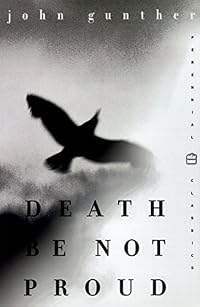
Death Be Not Proud
by John Gunther
On This Page
Description
"If courage is the antidote to pain and grief, the disease and the cure are both in this book. . . . A story of great unselfishness and great heroism." --New York Times Johnny Gunther was only seventeen years old when he died of a brain tumor. During the months of his illness, everyone near him was unforgettably impressed by his level-headed courage, his wit and quiet friendliness, and, above all, his unfaltering patience through times of despair. This deeply moving book is a father's show more memoir of a brave, intelligent, and spirited boy. show lessTags
Recommendations





Member Reviews
"As a professional writer, Johnny's father was capable of incarnating the spirit and intelligence of his ardent and precocious son. I am really convinced the world lost a brilliant inventor-scientist, but through this book we can all meet this atheist old soul and travel with him through 1940s cancer treatment.
Inlcuded in the book is many letters, quotes, and writings of Johnny. Among this impressive intellectual output, signifying an accomplished and seeking mind, is Johnny's list of chess tips, which I am saving.
Inlcuded in the book is many letters, quotes, and writings of Johnny. Among this impressive intellectual output, signifying an accomplished and seeking mind, is Johnny's list of chess tips, which I am saving.
Gut-heartwrenchingly moving. I tried reading this years ago but couldn't get into the way Gunther told the story––too erudite for me at the time. I guess I've matured because I rolled through this in one day. I couldn't put it down. I was intrigued by the 1940s dialogue and history and medicine capability at that time, but I was thoroughly enchanted with Johnny and his heroic quest just to live. The reminder of how precious life is sometimes can sound so trite, but put forth in this memoir of a 17-year-old who had the zen of life to end each day with "What a great day, Mom"––even if his brain had just been opened up again for drainage––brought me to my knees. When I'm having a bad day, I will think of this young, brave man show more and try to follow his example every day of my life. show less
I vaguely remembered reading Gunther's tribute to his son early in my high school years. Decades later, shortly after my best friend died at age 37 of a brain tumor, I stumbled upon a yellowed copy of "Death Be Not Proud" at a roadside sale. I didn't even quite remember what it was about, but I bought it. After reading about Johnny's valiant struggle with a brain tumor, I was struck by the familiarity of it all. The author skillfully captured so many of the emotions, including the cruel roller coaster of hope and hopelessness. Most of all, the book vividly illustrates how courage, friendship and even humor can help to make even a "hopeless" situation memorable and meaningful.
I first read this book in 1964. Back then it was about a boy my age who died. I read it again in 2000 when my fifteen-year-old daughter read it for school. And the book had changed -- now it was about a parent my age who lost a child my child's age. John Gunther was trained as a journalist in the first half of the twentieth century. Very personal memoirs about an emotional experience were not the style at all then. This book is an early example of the genre, and I can see Gunther's training on every page. Even with the restraint, it is a powerful testament by a parent who has suffered the ultimate tragedy.
This is my second time reading this moving, truly sad memoir of the death of the author's son from a glioma tumor. It appears the 17-year-old was a truly remarkable young man with a hopeful, positive outlook and talents including the gifts of a future, experimental chemist and scholastic ability to get him admitted to Harvard.In the long and ultimately futile course of treatment, detail are shared on mustard gas injections and Gerson Therapy, a dietary-based alternative cancer treatment. The chronology concludes with excerpts from a Johnny's journal and reflections in a chapter from each parent.
One of the nascent genius' other passions was chess and I know recall I still try and apply his eleven precepts to the game (p 83 of my show more edition):
One of the nascent genius' other passions was chess and I know recall I still try and apply his eleven precepts to the game (p 83 of my show more edition):
...So that I might improve my game he wrote out a series of hints and precepts; any chess enthusiast will realize how sound they are, and at the risk of boring the non-chess-playing reader I will print them:show less
1. Always try to maintain control of as many center squares as possible with pawns.
2. Never bring out the queen early.
3. If winning, that is if you are ahead in material, exchange pieces but not pawns, so as to make it easier to queen a pawn.
4. If behind, exchange pawns not pieces.
5. The Kings bishop pawn is a weak pawn and always try to protect the KB square.
6. Never defend a piece by attacking another, since a good move by your opponent will mean that you will have two pieces to defend instead of one.
7. In a Ruy Lopez, if the opponent does not move the rook’s pawn up, castle.
8. There’s a great difference between attacking and just exchanging pieces.
9. Storm your opponent by attack by pawns on the opposite side to the one he’s castled on.
10. Castling on the opposite side to your opponent and attacking when your position is mature will usually win.
11. In queening a pawn, keep the king in front of the pawn while moving.
My favorite topic, death. John writes about the death of his 17 year old son from a brain tumor in 1947. (They still have no treatment for this and it is usually deadly within a year). The interesting part of this book for me is the formal language spoken and how different we treat cancer patients today. To not tell their son he had a fatal brain tumor seems unethical. But they "kept it from him" even though he apparently was somewhat aware and chose to put on a happy face for his parents. (IE: they are both lying to each other). They try everything to save him, including the Gerson diet. But when death was imminent they brought him to the hospital, even though it really wasn't a choice at the time.
Death Be Not Proud chronicles Johnny Gunther's gallant struggle against the malignant brain tumor that killed him at the age of seventeen. The book opens with his father's fond, vivid portrait of his son - a young man of extraordinary intellectual promise, who excelled at physics, math, and chess, but was also an active, good-hearted, and fun-loving kid. But the heart of the book is a description of the agonized months during which Gunther and his former wife Frances try everything in their power to halt the spread of Johnny's cancer and to make him as happy and comfortable as possible. In the last months of his life, Johnny strove hard to complete his high school studies. The scene of his graduation ceremony from Deerfield Academy is show more one of the most powerful - and heartbreaking - in the entire book. Johnny maintained his courage, wit and quiet friendliness up to the end of his life. He died on June 30, 1947, less than a month after graduating from Deerfield. show less
Members
- Recently Added By
Lists

Best Medical Nonfiction
79 works; 29 members

I am sick, I must die . . . .
24 works; 5 members

Read the book and saw the movie
1,170 works; 192 members

Blue Pyramid 1,276 Best Books of All Time
1,248 works; 32 members
Read For Your Life
157 works; 1 member
Author Information

48+ Works 5,353 Members
Born in Chicago, John Gunther began a career in journalism in 1922 as a reporter for the Chicago Daily News. A war correspondent during World War II, Gunther later devoted all his time to writing and is famous for his Inside books. Following his fourth visit to Russia in 1956, he presented important as well as trivial facts in Inside Russia Today show more (1958). "The greatest service Mr. Gunther has done is to bring Russia down to a level we can all understand and talk and argue about" (N.Y. Times). In 1958 he received the Geographic Society of Chicago Publication Award for his Inside books. Unfortunately, Inside U.S.A. (1951) is out of print. Gunther wrote several biographies and a deeply moving account of the death of his young son of a brain tumor, Death Be Not Proud (1949). His Procession (1965) is a group of sketches of international political figures drawn from his Inside books and from articles. Inside Australia (1972), completed and edited by William Forbis, was published posthumously. (Bowker Author Biography) show less
Awards and Honors
Distinctions
Series
Belongs to Publisher Series
Harper Perennial (P111)
Work Relationships
Is abridged in
Has as a teacher's guide
Common Knowledge
- Canonical title
- Death Be Not Proud
- Original publication date
- 1949
- People/Characters
- John Gunther, Jr.; John Gunther, Sr.; Frances Gunther
- Important places
- Deerfield, Massachusetts, USA; Connecticut, USA; New York, New York, USA
- Related movies
- Death Be Not Proud (1975 | IMDb)
- Epigraph
- Death, be not proud, though some have called thee
Mighty and dreadful, for thou art not so:
For those whom thou think'st thou dost overthrow
Die not, poor Death: not yet canst thou kill me.
From Rest and Sleep... (show all), which but thy picture be,
Much pleasure, then from thee much more must flow;
And soonest our best men with thee do go—
Rest of their bones and souls' delivery!
Thou'rt slave to fate, chance, kings, and desperate men,
And dost with poison, war, and sickness dwell;
And poppy or charms can make us sleep as well
And better than thy stroke. Why swell'st thou then?
One short sleep past, we wake eternally,
And Death shall be no more: Death, thou shalt die!
—John Donne - Dedication
- In Memoriam
John Gunther Junior
1929—1947 - First words
- Foreword
This is not so much a memoir of Johnny in the conventional sense as the story of a long, courageous struggle between a child and Death.
1
Johnny came home for the Christmas holiday in 1945, and he looked fit and fine. He was lengthening out physically and otherwise, as children do all of a sudden, responding as it were to the release of some hid... (show all)den inner spring. We saw a lot of each other, and just before getting on the train to return to school in January, he exclaimed, "Pop, that was the best ten days I ever had!" - Last words
- (Click to show. Warning: May contain spoilers.)Unbeliever's Prayer
Almighty God
forgive me for my agnosticism;
For I shall try to keep it gentle, not cynical,
nor a bad influence.
And O!
if Thou art truly in the heavens,
accept my gratitude
for all Thy gifts
and I shall try
to fight the good fight. Amen.
—John Gunther, Jr.
May, 1946 - Original language
- English
Classifications
- Genres
- Biography & Memoir, Nonfiction, Teen
- DDC/MDS
- 362.196994810092 — Social sciences Social problems and social services Social problems of and services to groups of people People with physical illnesses Services to people with specific conditions Diseases Other diseases
- LCC
- CT275 .G855 .G8 — Auxiliary Sciences of History Biography Biography National biography
- BISAC
Statistics
- Members
- 2,676
- Popularity
- 6,894
- Reviews
- 40
- Rating
- (3.79)
- Languages
- English
- Media
- Paper, Ebook
- ISBNs
- 23
- ASINs
- 47