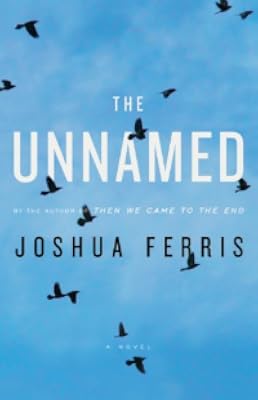
The Unnamed
by Joshua Ferris
On This Page
Description
Tim Farnsworth is a handsome, healthy man, aging with the grace of a matinee idol. His wife Jane still loves him, and for all its quiet trials, their marriage is still stronger than most. Then one day he stands up and walks out. And keeps walking.Tags
Recommendations












Member Recommendations
albanyhill Mad Travelers is nonfiction about dissociative fugue in the 1890s, which had as a symptom compulsive bouts of walking.
Member Reviews
So the book's protagonist ambles around aimlessly, involuntarily, endlessly, and perhaps it is a metaphor of sorts that the book does exactly the same thing. The story bobs and weaves to avoid meaning. At the end of the day the moral of the story appears to be that nothing matters, that our biology is our destiny, and that we all die alone. It is about as cynical a book as I have ever read, but there is no fire to the cynicism. The whole enterprise seems steeped in exhausted capitulation. This is neither my first nor my last Ferris book. He is a beautiful writer. That said, IMHO this was a pointless read, depressing not because of its depth or honesty, but because the writer just gave up.
"The Unnamed" follows Tim, a high powered New York lawyer who has an unnamed disease. Tim's disease causes him to drop everything at a moment's notice and take off on long, meandering walks. Tim's wife, Jane, stays at his side as he has bouts of the disease, even though they last up to a year. Tim has seen every doctor that money can buy, but none of them can offer an explanation for the disease that plagues him. Will Tim and Jane's love be able to overcome the disease, or will it, and the miles it causes Tim to put between them, ultimately lead to their undoing.
"The Unnamed" is a puzzle of a novel that sucks its reader in from the very first page. Tim and Jane appear to be a fairly normal suburban couple, until Tim's disease reveals a show more whole subtext to their relationship that is complex and unexpected. Ferris uses the disease to explore his character's inner thoughts and emotions, and the disease operates as a stand in for the realities of modern life--long separations and distractions due to work, children, and other relationships--that can tear apart a marriage. I liked how Ferris made the point that Tim's money can't save him, anymore than it can save his relationships. Although Tim, Jane, and their daughter Becka change significantly over the course of the novel, Ferris always brings them back together in a way that makes them human and accessible to the reader.
This novel really made me think, and it is really much more complex than it seems on the surface. I think ultimately this novel could stand as a metaphor for our times. And although overall it is bleak, Ferris leaves his reader with some hope at the end that like Tim, maybe we could find a way to overcome our unnamed. show less
"The Unnamed" is a puzzle of a novel that sucks its reader in from the very first page. Tim and Jane appear to be a fairly normal suburban couple, until Tim's disease reveals a show more whole subtext to their relationship that is complex and unexpected. Ferris uses the disease to explore his character's inner thoughts and emotions, and the disease operates as a stand in for the realities of modern life--long separations and distractions due to work, children, and other relationships--that can tear apart a marriage. I liked how Ferris made the point that Tim's money can't save him, anymore than it can save his relationships. Although Tim, Jane, and their daughter Becka change significantly over the course of the novel, Ferris always brings them back together in a way that makes them human and accessible to the reader.
This novel really made me think, and it is really much more complex than it seems on the surface. I think ultimately this novel could stand as a metaphor for our times. And although overall it is bleak, Ferris leaves his reader with some hope at the end that like Tim, maybe we could find a way to overcome our unnamed. show less
I think I have a book crush on Joshua Ferris (or "Josh" as I call him when I talk back to his narration). I super liked [b:And Then We Came to the End|2025667|Then We Came to the End|Joshua Ferris|http://photo.goodreads.com/books/1210008278s/2025667.jpg|2926759] and listening to The Unnamed, I felt hypnotized by the soft rhythms of his voice. Oh, Josh. Your new book is so sad. Are you, okay?
Here's the plot: Tim Farnsworth and his wife Jane are happily married, well off, etc. But they are dealing with a strange unnamed affliction. Tim has this problem where he just starts walking and he can't stop. He can't control where he's walking or how long he walks. He doesn't know when the walks will start or stop. He just get carried away by his show more legs and there's nothing he can do to stop it.
To me, this almost sounds like a funny premise. It has slapstick potential, right? But in my dear Josh's hands it is tragic. It adds stress to Tim and Jane's life the way that a terminal illness would, only Tim can't get the automatic sympathy a named illness would grant.
There is a really interesting look at the mind/body dichotomy in this book because Tim can't control his body and it's ruining his life. So he has a kind of psychotic break where he feels like he's two people: his mind that wants to stay put and his body that demands he walk.
Ultimately, it's Josh's writing that I love. The man has a gift for unpretentious, moving prose. This book is crushingly sad, but not in a way that made me angry or depressed. Instead I felt grateful that I don't have a disease, especially a strange unnamed walking one. show less
Here's the plot: Tim Farnsworth and his wife Jane are happily married, well off, etc. But they are dealing with a strange unnamed affliction. Tim has this problem where he just starts walking and he can't stop. He can't control where he's walking or how long he walks. He doesn't know when the walks will start or stop. He just get carried away by his show more legs and there's nothing he can do to stop it.
To me, this almost sounds like a funny premise. It has slapstick potential, right? But in my dear Josh's hands it is tragic. It adds stress to Tim and Jane's life the way that a terminal illness would, only Tim can't get the automatic sympathy a named illness would grant.
There is a really interesting look at the mind/body dichotomy in this book because Tim can't control his body and it's ruining his life. So he has a kind of psychotic break where he feels like he's two people: his mind that wants to stay put and his body that demands he walk.
Ultimately, it's Josh's writing that I love. The man has a gift for unpretentious, moving prose. This book is crushingly sad, but not in a way that made me angry or depressed. Instead I felt grateful that I don't have a disease, especially a strange unnamed walking one. show less
First, a confession: I don’t read a lot of contemporary fiction, and what I do read, I usually am ambivalent about. I’m much more of a poetry and classic literature kind of girl. I’m trying to read more in this genre, though, since I work in a bookstore and books like The Unnamed are exactly what my customers want recommendations for.
That said, this is the type of book I like to read late at night, when my body is tired and my mind is slowly getting there, when all I want is a warm bath and a decent plot. I started reading this book in the middle of the night after a very long, very cold December day. I needed something smart, but something I could still follow in my half-frozen state. The Unnamed fit the bill perfectly. The show more storyline is intriguing but not overly demanding, meaning that I was comfortable putting it down in the middle of a chapter but still eager to start up again the next day.
While I would definitely put this book in the “good” pile and not the “great” one, it does do a fine job of discussing how illness affects an entire family, rather than focusing on the plight of the one sick person. I think that, a lot of the time, American society sees illness as being a burden to the individual, and neglects to recognize its effects on family or community. This book goes far to undermine that notion. When you take hope, of a cure or simply a normal way of life, away from someone who is sick, I think what is lost might be exactly what normally holds people to each other in times of crisis. Not to politicize things, but when your health fails and there’s nothing that can help you, it’s not just your life that’s ruined – that damage runs through the lives of your friends, family, neighbors… everyone you know, or will know, or might have known if things had worked out differently. show less
That said, this is the type of book I like to read late at night, when my body is tired and my mind is slowly getting there, when all I want is a warm bath and a decent plot. I started reading this book in the middle of the night after a very long, very cold December day. I needed something smart, but something I could still follow in my half-frozen state. The Unnamed fit the bill perfectly. The show more storyline is intriguing but not overly demanding, meaning that I was comfortable putting it down in the middle of a chapter but still eager to start up again the next day.
While I would definitely put this book in the “good” pile and not the “great” one, it does do a fine job of discussing how illness affects an entire family, rather than focusing on the plight of the one sick person. I think that, a lot of the time, American society sees illness as being a burden to the individual, and neglects to recognize its effects on family or community. This book goes far to undermine that notion. When you take hope, of a cure or simply a normal way of life, away from someone who is sick, I think what is lost might be exactly what normally holds people to each other in times of crisis. Not to politicize things, but when your health fails and there’s nothing that can help you, it’s not just your life that’s ruined – that damage runs through the lives of your friends, family, neighbors… everyone you know, or will know, or might have known if things had worked out differently. show less
 This review was written for LibraryThing Early Reviewers.
So, I read this at the same time I was reading Voluntary Simplicity by Duane Elgin, and a lot of the same ideas come up in both books. No, Voluntary Simplicity does not encourage people to chuck it all, take a walk, and not turn back. But it does deal a lot with conscious action and awareness and how living consciously can often alienate us from the rest of society. In The Unnamed, main character Tim is trapped in the dichotomy between mind and body. He prefers---as many of us do---to live almost exclusively in his mind, until his malady hits and he's at the mercy of his body, his mind a mere passenger.
There's a scene in which Tim is sitting still, absorbed in something at the office late at night when he's surprised by the show more motion-sensor lights shutting off. The surprise pulls him back into his body, reminds him that he's not just a mind functioning on its own. This scene sums up the premise of the book for me.
There's the micro-version of this single-minded attention that excludes all else with Tim and his attorney colleagues focusing laser-like attention on the task at hand and ignoring all else around them, including their bodily needs and their families and the weather. Then there's the macro-version, in which there are signs all over of global warming and ecological disaster and people all over the country barely notice them (if at all) as they go about their lives. (This scenario is in Voluntary Simplicity, too.) Of course, everything seen from Tim's point of view is suspect, so the reader needs to decide for herself whether to trust Tim's perspective or not. Maybe there really aren't bees dying off; only Tim sees them because they don't exist for anyone else.
The story of Tim's illness seems to be a metaphor for the journey through life. We travel through life feeling complacent until something wakes us up and we reconnect mind and body and notice our surroundings as if for the first time. We travel through life as one individual ego, essentially separate from everyone else even though we are, in fact, connected to and dependent upon every other entity with which we share this world. What does it take to bring awareness to this interdependence and the need for compassion and collective action? What is the motion sensor light that will bring us back into the world?
All of which is a long way of saying I came upon this book at the exact right moment, I think, and I found it immensely satisfying. show less
There's a scene in which Tim is sitting still, absorbed in something at the office late at night when he's surprised by the show more motion-sensor lights shutting off. The surprise pulls him back into his body, reminds him that he's not just a mind functioning on its own. This scene sums up the premise of the book for me.
There's the micro-version of this single-minded attention that excludes all else with Tim and his attorney colleagues focusing laser-like attention on the task at hand and ignoring all else around them, including their bodily needs and their families and the weather. Then there's the macro-version, in which there are signs all over of global warming and ecological disaster and people all over the country barely notice them (if at all) as they go about their lives. (This scenario is in Voluntary Simplicity, too.) Of course, everything seen from Tim's point of view is suspect, so the reader needs to decide for herself whether to trust Tim's perspective or not. Maybe there really aren't bees dying off; only Tim sees them because they don't exist for anyone else.
The story of Tim's illness seems to be a metaphor for the journey through life. We travel through life feeling complacent until something wakes us up and we reconnect mind and body and notice our surroundings as if for the first time. We travel through life as one individual ego, essentially separate from everyone else even though we are, in fact, connected to and dependent upon every other entity with which we share this world. What does it take to bring awareness to this interdependence and the need for compassion and collective action? What is the motion sensor light that will bring us back into the world?
All of which is a long way of saying I came upon this book at the exact right moment, I think, and I found it immensely satisfying. show less
Tim, a middle-aged lawyer, struggles with an unnamed disease that causes him to walk without stopping for hours. His wife Jane and teenage daughter Becka try to understand it and how it affects all of their lives. To me the point of this book is not the disease itself, but instead the relationships it affects.
A subplot is woven throughout the story that deals with a murder case Tim is working on. The case acted like a litmus test for the severity of his disease at the time. It was an interesting way to show how bad the symptoms were at any given point.
I loved the way Ferris describes each of the characters. I became fascinated not by the walking, but by his wife and daughter's responses to his walking over time. Their anger, show more frustration, love, disbelief, hopelessness were intoxicating. His own reactions were also interesting, but it was their point-of-view that I loved. I would absolutely recommend this.
An excerpt from the book...
"From the first bite of his sandwich to the last he ate mechanically and without pleasure. The ache of his jaw told him he had to finish. The duty of lunch had been acquitted." show less
A subplot is woven throughout the story that deals with a murder case Tim is working on. The case acted like a litmus test for the severity of his disease at the time. It was an interesting way to show how bad the symptoms were at any given point.
I loved the way Ferris describes each of the characters. I became fascinated not by the walking, but by his wife and daughter's responses to his walking over time. Their anger, show more frustration, love, disbelief, hopelessness were intoxicating. His own reactions were also interesting, but it was their point-of-view that I loved. I would absolutely recommend this.
An excerpt from the book...
"From the first bite of his sandwich to the last he ate mechanically and without pleasure. The ache of his jaw told him he had to finish. The duty of lunch had been acquitted." show less
A writer as talented as Joshua Ferris can almost be forgiven for making a botch of a second novel, especially when the failed novel is more fascinating than most other writers' successful novels. The Unnamed is the story of Tim Farnsworth, prosperous New York lawyer, partner with the prestigious firm Troyer, Barr. In the novel's opening pages Tim informs his wife Jane that a condition that has plagued him on two previous occasions has come back. This turn of events is momentous because whatever is wrong with Tim seizes control of his body and forces him to walk for hours until, exhausted, he collapses wherever he happens to be. Until this latest recurrence he has been in remission, and he and Jane and daughter Becka have been living a show more stable, steady life together. But no more, and for Jane the news that she must once again contend with a husband who may vanish without prior notice and then phone her from some unknowable location in the middle of the night is devastating. Tim is lead counsel in a high-profile murder case and makes a valiant effort to conceal his condition from the client and his colleagues. But things go from bad to worse. It soon becomes apparent to the other partners at Troyer, Barr that Tim is ill and when he repeatedly behaves erratically and proves himself unreliable he is stripped of his partnership. Despite another short-lived remission Tim eventually becomes totally dysfunctional and at about the midpoint of the novel walks out on his family altogether. For the remainder of the book, Tim struggles with a condition that gives him no rest and ultimately descends into the itinerant lifestyle of an agoraphobic wanderer and social outcast, sleeping out of doors under all weather conditions and occasionally ending up in hospitals and institutions, being treated for frostbite or else in restraints and being forcibly medicated. His wife and daughter move on with their own lives without him. Ferris's narrative is repetitive and lurches from one crisis to the next, and there is little holding the story together--certainly nothing as coherent as a plot. The tedious final section in which Tim crosses country on foot, heading eastward in order to return home to Jane, is hardly more than a random litany of people, places and things he encounters along the way. And yet throughout the book the writing is lush and evocative and often brilliant in the precise manner in which it conveys Tim's misery to the reader. The Unnamed is in some ways a virtuoso performance and Ferris was obviously committed to the task of churning out Tim's story to the bitter end and making a statement about the indomitable nature of the human spirit. However, one cannot read this book without suspecting that somewhere along the way something went horribly wrong and that the resulting work is a case of an ill-conceived notion brought ill-advisedly to fruition. Surely, this is not the novel that Joshua Ferris thought he was going to end up with when he set out to write a follow-up to Then We Came to the End, his much praised debut. It's easy to understand how a writer might not want to trash a work in progress after investing a couple of years in it. Even plagued by doubt, plowing forward to the end might at the time have seemed the best, or only, course of action. Only the author knows if it ever crossed his mind to toss the manuscript into the bin and start working on a new project. Whatever happened or didn't happen, The Unnamed remains a fascinating book because as we read we sense the author doggedly setting word after word after word down on the page, closing in on that elusive ending, much as his protagonist plods along, taking step after agonizing step, compelled by his unnamed affliction to walk, going nowhere, until the body expires. show less
Members
- Recently Added By
Published Reviews
ThingScore 88
Joshua Ferris’ 2007 debut Then We Came To The End fearlessly wielded the first-person plural to chronicle the fall of a Chicago advertising agency through its employees’ eyes. There is no “we” in The Unnamed, his superbly depressing follow-up about a marital crisis with no exit, but the descent is more personal, frightening, and ultimately meaningful.
added by Shortride
Though his idea might have worked equally well as a short story, Ferris paces his scenes and writes dialogue that sustains the tension, walking a line between realism and something more estranged, catching the invisible shifting energy in the room when words get spoken.
added by Shortride
Lists

Indie Next Picks
196 works; 4 members
Author Information

10+ Works 7,706 Members
Joshua Ferris, is bestselling author best known for his debut 2007 novel, Then We Came to the End. The book is a comedy about the American workplace, told in the first-person plural. He graduated from the University of Iowa with a BA in English and Philosophy 1996. He then moved to Chicago and worked in advertising for several years before show more obtaining an MFA in writing from UC Irvine. His first published story, Mrs. Blue, appeared in the Iowa Review in 1999. Then We Came to the End has been greeted by positive reviews from The New York Times Book Review, The New Yorker, Esquire, and Slate, has been published in twenty-five languages, was a finalist for the National Book Award, and received the 2007 PEN/Hemingway Award. Joshua's other books include The Unnamed and To Rise Again at a Decent Hour, which is New York Times bestseller. (Bowker Author Biography) show less
Some Editions
Awards and Honors
Series
Belongs to Publisher Series
btb (74399)
Common Knowledge
- Canonical title*
- De naamlozen
- Original title
- The Unnamed
- Original publication date
- 2010-01-18
- People/Characters
- Tim Farnsworth; Jane Farnsworth; Becka Farnsworth
- Dedication
- For Chuck Ferris and Patty Haley
- First words
- It was the cruelest winter.
- Last words
- (Click to show. Warning: May contain spoilers.)Never had to walk, never had to seek out food, never had to carry around the heavy and the weary weight, and in a measure of time that may have been the smallest natural unit known to man, or that may have been and may still remain all of eternity, he realized that he was still thinking, his mind was still afire, that he had just scored if not won the whole damn thing, and that the exquisite thought of his eternal rest was how delicious that cup of water was going to taste the instant it touched his lips.
- Blurbers
- Astor, Michael; Charles, Ron; Cryer, Dan; Holt, Karen; Stern, Gabriella; Sachs, Lloyd (show all 7); Miller, Laura
*Some information comes from Common Knowledge in other languages. Click "Edit" for more information.
Classifications
Statistics
- Members
- 1,256
- Popularity
- 19,616
- Reviews
- 96
- Rating
- (3.49)
- Languages
- 7 — Dutch, English, French, German, Italian, Portuguese, Turkish
- Media
- Paper, Audiobook, Ebook
- ISBNs
- 34
- ASINs
- 11
