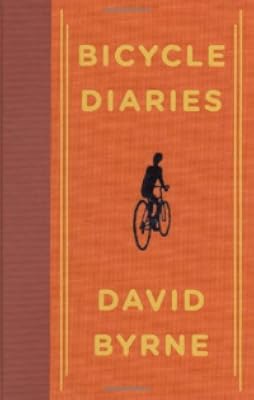
Bicycle Diaries
by David Byrne
On This Page
Description
Since the early 1980s, renowned musician and visual artist David Byrne has been riding a bike as his principal means of transportation in New York City. Two decades ago, he discovered folding bikes and started taking them with him when traveling around the world. Byrne's choice was initially made out of convenience rather than political motivation, but the more cities he saw from his bicycle, the more he became hooked on this mode of transport and the sense of liberation, exhilaration, and show more connection it provided. This point of view, from his bike seat, became his panoramic window on urban life, a magical way of opening one's eyes to the inner workings and rhythms of a city's geography and population. Bicycle Diaries chronicles Byrne's observations and insights--what he is seeing, whom he is meeting, what he is thinking about--as he pedals through and engages with some of the world's major cities.--Publisher. show lessTags
Recommendations





















Member Recommendations
Member Reviews
David Byrne really is kind of an “ordinary guy”. And if you find him interesting, from his music and the other things he’s been involved in (including his activism for cycling), you’ll be interested in this book. It’s a David Byrne’s eye view of the world, often from the perspective of a bicycle rider.
I would never classify this as a memoir — it’s actually more of a travel book. Byrne doesn’t strive for objectivity — he offers his own special experience of each of the cities he visits (and Byrne is a city person). He’s very attentive to the distinctive aspects of each city’s social life and how it is both reflected in and influenced by the city’s architecture. Cities like New York offer, in some neighborhoods show more at least, walkability and cycling access, making for lively street life. Other cities, like Los Angeles . . . not so much.
Byrne is right — it’s hard to casually drop in somewhere that’s not really reachable without a plan. In so many cities, the culture and architecture of the highway imposes considerable friction on spontaneity in social life. Spontaneity and deviation from thenorm is clearly something that Byrne values, and contributes greatly to the kinds of cities and architecture he likes and finds having a positive influence on people and art.
Art and creativity in general are core to Byrne’s view of the world. Where art thrives, people thrive. Creativity is viral — it lives in the social life of healthy, vibrant people. And the design of the spaces in which we live can either kill or contribute.
Byrne doesn’t really speak as an expert. He’s certainly an activist for cycling accessibility, and I’m sympathetic with him there. Cities and streets that force you into a car, either because of the distances between heres and theres or simply because of safety, are confining, lacking anything recognizable as a “neighborhood”. They don’t encourage divergence from the norm — they seem to force us all toward the norm.
This is not a hit-you-over-the-head book. It’s as if you were standing beside a surprisingly down to earth, straightforward guy who happens to be (or have been) a rock star, as he told you what he thinks. I did enjoy hanging out with him. show less
I would never classify this as a memoir — it’s actually more of a travel book. Byrne doesn’t strive for objectivity — he offers his own special experience of each of the cities he visits (and Byrne is a city person). He’s very attentive to the distinctive aspects of each city’s social life and how it is both reflected in and influenced by the city’s architecture. Cities like New York offer, in some neighborhoods show more at least, walkability and cycling access, making for lively street life. Other cities, like Los Angeles . . . not so much.
Byrne is right — it’s hard to casually drop in somewhere that’s not really reachable without a plan. In so many cities, the culture and architecture of the highway imposes considerable friction on spontaneity in social life. Spontaneity and deviation from thenorm is clearly something that Byrne values, and contributes greatly to the kinds of cities and architecture he likes and finds having a positive influence on people and art.
Art and creativity in general are core to Byrne’s view of the world. Where art thrives, people thrive. Creativity is viral — it lives in the social life of healthy, vibrant people. And the design of the spaces in which we live can either kill or contribute.
Byrne doesn’t really speak as an expert. He’s certainly an activist for cycling accessibility, and I’m sympathetic with him there. Cities and streets that force you into a car, either because of the distances between heres and theres or simply because of safety, are confining, lacking anything recognizable as a “neighborhood”. They don’t encourage divergence from the norm — they seem to force us all toward the norm.
This is not a hit-you-over-the-head book. It’s as if you were standing beside a surprisingly down to earth, straightforward guy who happens to be (or have been) a rock star, as he told you what he thinks. I did enjoy hanging out with him. show less
David Byrne has a folding bike and takes it with him on his travels around the world. This book collects his ruminations from cycling through many great cities. Sometimes they are observations on what he sees from the saddle, but often they ponder more deeply place of the city from architecture to culture to politics. He is admittedly didactic at times, but he often makes a good point. Knowing Byrne as the singer/songwriter for Talking Heads, I found his narrative voice not at all what I expected, sometimes a little crude, sometimes a little lofty, but usually compelling. This is a good book for learning about the necessary changes that need to be made to our cities to survive an uncertain future.
Favorite Passages:
My generation makes show more fun of the suburbs and the shopping malls, the TV commercials and the sitcoms that we grew up with -- but they're part of us too. So our ironic view is leavened with something like love. Though we couldn't wait to get out of these places they are something like comfort food for us. Having come from those completely uncool places we are not and can never be urban sophisticates we read about, and neither are we rural specimens -- stoic, self-sufficient, and relaxed -- at ease and comfortable in the wild. These suburbs, where so many of us spent our formative years, still push emotional buttons for us; they're both attractive and deeply disturbing. - p. 9
These [modern] buildings represent the triumph of both the cult of capitalism and the cult of Marxist materialism. Opposing systems have paradoxically achieved more or less the same aesthetic result. Diverging paths converge. The gods of reason triumph over beauty, whimsy, and animal instincts and our innate aesthetic sense -- if one believes that people have such a thing. We associate these latter qualities with either peasants -- the unsophisticated, who don't know any better than to build crooked walls and add peculiar little decorative touches -- or royalty and the upper classes -- our despicable former rulers with their frilly palaces, whom we can now view, in this modern world, as equals, at least on some imaginary or theoretical level. - p. 79
I'm in my midfifties, so I can testify that biking as a way of getting around is not something only for the young and energetic. You don't really need the spandex, and unless you want it to be, biking is not necessarily all the strenous. It's the liberating feeling -- the physical and psychological sensation -- that is more persuasive than any practical argument. Seeing things from a point of view that is close enough to pedestrians, vendors, and storefronts combined with getting around in a way that doesn't feel completely divorced from the life that occurs on the streets is pure pleasure. Observing and engaging in a city's life -- even for a reticent and often shy person like me -- is one of life's great joys. Being a social creature -- it is part of what it means to be human. - p. 292 show less
Favorite Passages:
My generation makes show more fun of the suburbs and the shopping malls, the TV commercials and the sitcoms that we grew up with -- but they're part of us too. So our ironic view is leavened with something like love. Though we couldn't wait to get out of these places they are something like comfort food for us. Having come from those completely uncool places we are not and can never be urban sophisticates we read about, and neither are we rural specimens -- stoic, self-sufficient, and relaxed -- at ease and comfortable in the wild. These suburbs, where so many of us spent our formative years, still push emotional buttons for us; they're both attractive and deeply disturbing. - p. 9
These [modern] buildings represent the triumph of both the cult of capitalism and the cult of Marxist materialism. Opposing systems have paradoxically achieved more or less the same aesthetic result. Diverging paths converge. The gods of reason triumph over beauty, whimsy, and animal instincts and our innate aesthetic sense -- if one believes that people have such a thing. We associate these latter qualities with either peasants -- the unsophisticated, who don't know any better than to build crooked walls and add peculiar little decorative touches -- or royalty and the upper classes -- our despicable former rulers with their frilly palaces, whom we can now view, in this modern world, as equals, at least on some imaginary or theoretical level. - p. 79
I'm in my midfifties, so I can testify that biking as a way of getting around is not something only for the young and energetic. You don't really need the spandex, and unless you want it to be, biking is not necessarily all the strenous. It's the liberating feeling -- the physical and psychological sensation -- that is more persuasive than any practical argument. Seeing things from a point of view that is close enough to pedestrians, vendors, and storefronts combined with getting around in a way that doesn't feel completely divorced from the life that occurs on the streets is pure pleasure. Observing and engaging in a city's life -- even for a reticent and often shy person like me -- is one of life's great joys. Being a social creature -- it is part of what it means to be human. - p. 292 show less
There isn't much cycling, or a lot about bikes, in David Byrne's Bicycle Diaries, but luckily the places he and his bike visit provide plenty of other opportunities for rambling on about stuff that he finds interesting and entertaining.
If you are interested in the same sort of stuff – music, art, food and urban living – then this will be a pleasant, though-provoking few hours in the company of an erudite and genial guide to early twenty-first century life. If you aren't you will probably think that he is a pretentious, self-important wanker who only gets his witterings published between hardcovers because he once sang Psychokiller.
I thought it was mostly great, but then again I would probably also score quite highly on the show more pretentious wanker index.
He starts out with a quick and fairly simplistic history lesson about American cities and how many developed into inhuman car-centric, planning disasters with desolate centres and soulless, endless tracts of suburbia. As he acknowledges though, not all American cities are like this and many may still be rescued, helped by the recent economic downturn, peak oil and climate change:
"Cities as a rule use less energy per capita than do suburban communities where people are living spread out [Thanks for explaining that David!], so as the cost of energy spirals up, those grimy urban streets start to look like they might have possibilities. The economy has tanked, the United States can lose its place as number one world power, but that doesn't mean that many of these cities can't still become more livable. Life can still be good – not only good, it can be better than most of us can imagine. A working class neighborhood can be full of life. A neighborhood that has many different kinds of people and business in it is usually a good place to live. If there were some legislation that ensured a mixed-use and mixed-income neighborhood would emerge when developers move in, it would be wise, because those are the liveliest and healthiest kinds of communities."
Then he heads off round the world to demonstrate what he means. Berlin – Istanbul – Buenos Aries – Manila – Sydney – London – San Francisco and back to his hometown New York. Although he seems to forget what it was that he set out to do and gets distracted by all the interesting people, music and art that he meets on the way. Which is fine, and I suspect makes for a much less dull book than if he had spent all his time trying to force his experiences to prove the point.
And to be fair he does get back to the point in the epilogue, The Future of Getting Around, which talks about how we can make our cities more attractive, livable and safer places. show less
If you are interested in the same sort of stuff – music, art, food and urban living – then this will be a pleasant, though-provoking few hours in the company of an erudite and genial guide to early twenty-first century life. If you aren't you will probably think that he is a pretentious, self-important wanker who only gets his witterings published between hardcovers because he once sang Psychokiller.
I thought it was mostly great, but then again I would probably also score quite highly on the show more pretentious wanker index.
He starts out with a quick and fairly simplistic history lesson about American cities and how many developed into inhuman car-centric, planning disasters with desolate centres and soulless, endless tracts of suburbia. As he acknowledges though, not all American cities are like this and many may still be rescued, helped by the recent economic downturn, peak oil and climate change:
"Cities as a rule use less energy per capita than do suburban communities where people are living spread out [Thanks for explaining that David!], so as the cost of energy spirals up, those grimy urban streets start to look like they might have possibilities. The economy has tanked, the United States can lose its place as number one world power, but that doesn't mean that many of these cities can't still become more livable. Life can still be good – not only good, it can be better than most of us can imagine. A working class neighborhood can be full of life. A neighborhood that has many different kinds of people and business in it is usually a good place to live. If there were some legislation that ensured a mixed-use and mixed-income neighborhood would emerge when developers move in, it would be wise, because those are the liveliest and healthiest kinds of communities."
Then he heads off round the world to demonstrate what he means. Berlin – Istanbul – Buenos Aries – Manila – Sydney – London – San Francisco and back to his hometown New York. Although he seems to forget what it was that he set out to do and gets distracted by all the interesting people, music and art that he meets on the way. Which is fine, and I suspect makes for a much less dull book than if he had spent all his time trying to force his experiences to prove the point.
And to be fair he does get back to the point in the epilogue, The Future of Getting Around, which talks about how we can make our cities more attractive, livable and safer places. show less
This wasn't quite what I was expecting — the title made me imagine a travel book or a piece of cycle advocacy, but actually it's more of a semi-random collection of short essays about cities, the people who live there, and the arts, inspired by Byrne's travels to different parts of the world in the course of his work as a musician. When he travels, he likes to take a folding bike with him and use that to explore, but the cycling per se is only a rather minor part of the story. The format of the book is said to be loosely modelled on W G Sebald, with a mix of first-hand impressions, rambling philosophical sidetracks, and black-and-white photos, but there's a lot more shooting from the hip and a lot less evidence of weeks spent show more researching stuff in libraries than you would get in an actual Sebald book. Which is fair enough: I don't think anyone would be buying this book expecting to get heavyweight academic delvings.
Byrne is clearly an intelligent, thoughtful person, and his situation in life allows him to meet interesting people in the course of his travels (assuming that you accept artists, gallery-owners and musicians as "interesting people"...), so this makes for a pleasant, lively read, but I don't think you will find anything very earth-shattering here, unless you are someone who loves motor cars and thinks of the USA as the model of perfect urban planning (in which case it might annoy you a little...). A good short-attention-span book to read on a journey or in a hospital waiting-room, probably. show less
Byrne is clearly an intelligent, thoughtful person, and his situation in life allows him to meet interesting people in the course of his travels (assuming that you accept artists, gallery-owners and musicians as "interesting people"...), so this makes for a pleasant, lively read, but I don't think you will find anything very earth-shattering here, unless you are someone who loves motor cars and thinks of the USA as the model of perfect urban planning (in which case it might annoy you a little...). A good short-attention-span book to read on a journey or in a hospital waiting-room, probably. show less
If you started reading David Byrne's Bicycle Diaries thinking that it would be a guide to taking a cycling trip around the cities mentioned, you probably were a little confused to start with. And then rapidly found that if this is a guide, it is really a guide to viewing life, the environment around you, society and culture. Or at least an insight into how Byrne - artist, musician, and writer - views those things. Via meditations on his cycling experiences in various cities, Byrne gives the reader a lot to think about, letting them into a slightly off-skew, always entertaining, way of looking at things.
That is not to say that this book is not a good guide for travellers - it is. It will challenge you to look at things differently, which show more is one of the joys, and perhaps even purposes, of travelling. While much of the focus is on urban-planning and the built environment (as you would probably expect from a book based around cycling experiences) this book is, at a deeper level, a profound meditation on modern life. Don't let such deep thoughts put you off however - it is also a humorous and entertaining read. show less
That is not to say that this book is not a good guide for travellers - it is. It will challenge you to look at things differently, which show more is one of the joys, and perhaps even purposes, of travelling. While much of the focus is on urban-planning and the built environment (as you would probably expect from a book based around cycling experiences) this book is, at a deeper level, a profound meditation on modern life. Don't let such deep thoughts put you off however - it is also a humorous and entertaining read. show less
Nice little collection of essays about various cities that Byrne has biked in, with various musings about art, architecture, society, people, etc. A little too preachy sometimes- he tries not to be but it comes out.
Ah, to be David Byrne and live the life of a world-travelling, songwriting, artmaking, genre-hopping, bike-riding cosmopolite. This book (taken largely from his online journal) follows DB from city to city as he soaks up the local culture at eye-level, or rather bike-level. He makes a good argument for ditching the car and using the pedals. After all, why whiz through life at blinding speed when you can slow down and appreciate it? Especially if you're lucky enough to meet with artists and interesting people of all kinds in many countries, as DB happens to be. Some people may find his prose flat and disturbingly free of affect, but I find Byrne an excellent observer with a refreshing reluctance to express opinion over-quickly. This book show more makes me want to be David Byrne, or at the very least acquire an excellent folding bike show less
Members
- Recently Added By
Lists

Finished in 2024
19 works; 1 member

The War on Cars podcast
108 works; 1 member
Author Information

56+ Works 3,946 Members
David Byrne (born May 14, 1952) is a Scottish-American musician and artist perhaps best known as a founding member and principal songwriter of the new wave band Talking Heads, which was active between 1974 and 1991. Since then, Byrne has released his own solo projects on record, and worked in a variety of media, including film, photography, opera, show more and Internet-based projects. He has received Grammy, Oscar, and Golden Globe awards for his achievements. In 1981, Byrne partnered with choreographer Twyla Tharp, scoring "The Catherine Wheel," a ballet prominently featuring unusual rhythms and lyrics. Productions of "The Catherine Wheel" appeared on Broadway that same year. Byrne is also known for his activism in support of increased cycling, and for having used a bike as his main means of transport for most of his life, especially cycling around New York, where he has designed innovative bicycle parking racks. He has written widely on cycling, including a 2009 book, Bicycle Diaries. In August 2009, he auctioned his Montague folding bike in order to raise money for the London Cycling Campaign. His title Bicycle Diaries made the New York Times Best Seller List for 2011. (Bowker Author Biography) show less
Some Editions
Common Knowledge
- Canonical title*
- Diari della bicicletta
- Original title
- Bicycle Diaries
- Important places
- Berlin, Germany; Istanbul, Turkey; Buenos Aires, Argentina; Manila, The Philippines; Sydney, New South Wales, Australia; London, England, UK (show all 8); San Francisco, California, USA; New York, New York, USA
- Dedication
- For Malu--who doesn't ride a bike... yet
- First words
- A bike is the world's most used form of transportation.
*Some information comes from Common Knowledge in other languages. Click "Edit" for more information.
Classifications
- Genres
- Travel, Nonfiction, Sports and Leisure, Biography & Memoir, General Nonfiction
- DDC/MDS
- 796.64 — Arts & recreation Recreation, sports, and performing arts Sports Cycling Bike touring
- LCC
- GV1044 .B97 — Geography, Anthropology and Recreation Recreation. Leisure Recreation. Leisure Sports Cycling. Bicycling. Motorcycling
- BISAC
Statistics
- Members
- 1,037
- Popularity
- 24,904
- Reviews
- 34
- Rating
- (3.50)
- Languages
- 10 — Dutch, English, French, German, Italian, Polish, Portuguese, Russian, Serbian, Spanish
- Media
- Paper, Ebook
- ISBNs
- 27
- ASINs
- 9