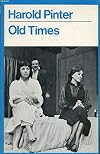
Old Times
by Harold Pinter
On This Page
Description
Old Times was first presented by the Royal Shakespeare Company at the Aldwych Theatre, London, on 1 June 1971. It was revived at the Donmar Warehouse, London, in July 2004. 'Old Times is a joyous, wonderful play that people will talk about as long as we have a theatre.' New York Times 'What am I writing about? Not the weasel under the cocktail cabinet . . . I can sum up none of my plays. I can describe none of them, except to say: that is what happened. This is what they said. That is what show more they did.' Harold Pinter show lessTags
Recommendations




























Member Reviews
A strange and disturbing look at a couple hosting an old friend for dinner. The play runs more on what is not said than on what is said. Snippets of ideas presented, never quite completed, as the couples talk around whatever it is that was in their past. It starts off simply enough, but the conversation gets progressively weirder as the evening goes on, and at times appears to blur time itself. A fascinating work that stays with you long after you put it down.
bookshelves: published-1971, winter-20132014, nobel-laureate, play-dramatisation, radio-3, fradio, midlife-crisis, mental-health, too-sexy-for-maiden-aunts, music, lifestyles-deathstyles
Recommended for: BBC Radio Listeners
Read from January 04 to 07, 2014
R3 Sun 5/1/14
BBC description: In a remote farmhouse, Deeley and Kate await a visitor. Anna is Kate's best friend, though Deeley has never met her. Is the past really as they remember it?
Old Times is a play about memory and desire. Tantalisingly enigmatic, it is a play about people in their forties looking back on old times, about reconciling the young person and the adult, about how you imagined things were going to be and how they turned out.
”I remember you dead.”
In this show more production, the BBC blanks out the inhalation, exhalation smoking sounds, and this play is FULL of cigarettes. show less
Recommended for: BBC Radio Listeners
Read from January 04 to 07, 2014
R3 Sun 5/1/14
BBC description: In a remote farmhouse, Deeley and Kate await a visitor. Anna is Kate's best friend, though Deeley has never met her. Is the past really as they remember it?
Old Times is a play about memory and desire. Tantalisingly enigmatic, it is a play about people in their forties looking back on old times, about reconciling the young person and the adult, about how you imagined things were going to be and how they turned out.
”I remember you dead.”
In this show more production, the BBC blanks out the inhalation, exhalation smoking sounds, and this play is FULL of cigarettes. show less
Elusive and portentous. It's Pinter, after all. Not his best, to my mind, but it's difficult for me to put into words why this doesn't quite do it for me the way No Man's Land or The Homecoming does. Maybe if I were Pinter, I could express it better.
From: Harold Pinter: Tense Memory Play Recalls Old Times
Old Times, Harold Pinter (1971)
http://wp.me/p14mpp-b3
The Stanford Summer Theater Production 2011
Harold Pinter's play Old Times opens with a medley of music standards of the 30s and 40s. Anna, the surprise guest, appears outside the farmhouse widow and slowly looks over the room. She moves to the second window and then walks into the room to position herself with her back to the audience looking out of the room. Deeley, the host, enters and walks across the stage to the armchair and sits. Kate, his wife of 20 years, enters and sits on the right divan, and says, reflectively, “Dark”. There is a pause before Deeley responds. This is an upsetting and mysterious way to begin a play, show more but it is an attention grabber—the normally restless Stanford audience was quiet. The play was off to a great start.
Pinter studied drama at the Central School of Speech and Drama in London and worked in repertory theatre in Ireland and England. In 1958 he wrote the following:
"There are no hard distinctions between what is real and what is unreal, nor between what is true and what is false. A thing is not necessarily either true or false; it can be both true and false."
The play Old Times continues, Kate and Deeley discuss Kate's old friend Anna, who is, in fact, standing in the room. Kate volunteers reluctantly that Anna was her best friend, actually, her only friend. Deeley says he's never met Anna, and is surprised to hear that Kate and Anna shared the same bedroom 20 years ago. Kate remembers that Anna occasionally stole her underwear. This erotic theme will continue throughout the play
When Kate punched the word underwear, the Stanford audience chuckled, releasing the tension that had been building. Anna, who has been a silent presence, then turned from the window, took a seat on the second divan, and the play is off to a good start.
Anna’s opening speech evokes memories of the time that she shared with Kate, and it becomes clear that there is going to be competition for Anna's attention. Raising the question: Who will succeed, Kate or Deeley? The Stanford production continued without any scene breaks. The play was presented as written except for slight variations in the blocking at the beginning and end of the play.
This is a provocative play, full of pauses that allow reflection. A wonderful short play that is more acessable than many other modern or avant garde works for the theater.
Harold Pinter was a trained actor, and he played the roll of Deeley at The American Theater, USA in October 1985, and at the Henry Fonda Theater in November 1985. An extensive list of productions and reviews of performances is online at the Harold Pinter Organization web site.
http://www.haroldpinter.org/home/index.shtml
Carto
### show less
Old Times, Harold Pinter (1971)
http://wp.me/p14mpp-b3
The Stanford Summer Theater Production 2011
Harold Pinter's play Old Times opens with a medley of music standards of the 30s and 40s. Anna, the surprise guest, appears outside the farmhouse widow and slowly looks over the room. She moves to the second window and then walks into the room to position herself with her back to the audience looking out of the room. Deeley, the host, enters and walks across the stage to the armchair and sits. Kate, his wife of 20 years, enters and sits on the right divan, and says, reflectively, “Dark”. There is a pause before Deeley responds. This is an upsetting and mysterious way to begin a play, show more but it is an attention grabber—the normally restless Stanford audience was quiet. The play was off to a great start.
Pinter studied drama at the Central School of Speech and Drama in London and worked in repertory theatre in Ireland and England. In 1958 he wrote the following:
"There are no hard distinctions between what is real and what is unreal, nor between what is true and what is false. A thing is not necessarily either true or false; it can be both true and false."
The play Old Times continues, Kate and Deeley discuss Kate's old friend Anna, who is, in fact, standing in the room. Kate volunteers reluctantly that Anna was her best friend, actually, her only friend. Deeley says he's never met Anna, and is surprised to hear that Kate and Anna shared the same bedroom 20 years ago. Kate remembers that Anna occasionally stole her underwear. This erotic theme will continue throughout the play
When Kate punched the word underwear, the Stanford audience chuckled, releasing the tension that had been building. Anna, who has been a silent presence, then turned from the window, took a seat on the second divan, and the play is off to a good start.
Anna’s opening speech evokes memories of the time that she shared with Kate, and it becomes clear that there is going to be competition for Anna's attention. Raising the question: Who will succeed, Kate or Deeley? The Stanford production continued without any scene breaks. The play was presented as written except for slight variations in the blocking at the beginning and end of the play.
This is a provocative play, full of pauses that allow reflection. A wonderful short play that is more acessable than many other modern or avant garde works for the theater.
Harold Pinter was a trained actor, and he played the roll of Deeley at The American Theater, USA in October 1985, and at the Henry Fonda Theater in November 1985. An extensive list of productions and reviews of performances is online at the Harold Pinter Organization web site.
http://www.haroldpinter.org/home/index.shtml
Carto
### show less
Versione italiana di Romeo De Baggis: "Altri tempi"
Dec 9, 2013Italian
Ratings
Members
- Recently Added By
Lists

Favourite Theatre of the Absurd
30 works; 4 members

Favourite Books
1,819 works; 316 members

Books Read in 2017
4,249 works; 130 members

1970s
657 works; 23 members

20th Century Literature
1,161 works; 55 members
Author Information

254+ Works 9,352 Members
English playwright, poet, and political activist Harold Pinter was born on October 10, 1930, in London's East End. From childhood he was interested in literature and acting. He studied at both the Royal Academy of Dramatic Arts and the Central School of Speech and Drama. Pinter was a Nobel Prize-winning English playwright and screenwriter. One of show more the most influential modern British dramatists, his writing career spanned more than 50 years. His best-known plays include The Birthday Party (1957), The Homecoming (1964), and Betrayal (1978), each of which he adapted to film. Pinter published his first poems in 1950. He worked as a bit-part actor in a BBC Radio program and also toured with a Shakespearean troupe. Pinter has written over 30 plays, achieving great success internationally. He has also directed several of his dramas. Pinter was married to actress Vivien Merchant from 1956 to 1980, before wedding biographer Lady Antonia Fraser. From his first marriage he has a son who is a writer and musician. Pinter has won numerous prestigious literary prizes in poetry and theatre. He was awarded the Hermann Kesten Medallion for outstanding commitment on behalf of persecuted and imprisoned writers. He has been granted honorary degrees at universities in England, Scotland, the United States, Bulgaria, Ireland, Italy, and Greece. In 2005, Pinter received the Nobel Prize for Literature. He died from cancer on December 24, 2008 at the age of 78. (Bowker Author Biography) show less
Awards and Honors
Work Relationships
Common Knowledge
- Original title
- Old Times
- Original publication date
- 1971
Classifications
Statistics
- Members
- 288
- Popularity
- 111,913
- Reviews
- 6
- Rating
- (3.55)
- Languages
- 5 — English, French, German, Italian, Spanish
- Media
- Paper
- ISBNs
- 12
- ASINs
- 7