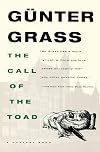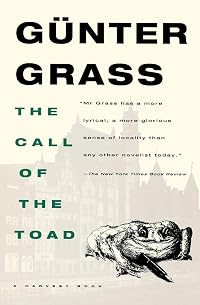
The Call of the Toad
by Günter Grass (Illustrator)
On This Page
Description
A couple from Gdansk has a unique idea for a business: selling cemetery plots in Gdansk to Germans who were exiled after WWII.Tags
Recommendations

















Member Reviews
Alexander and Alexandra are strangers who get into conversation after they bump into each other at a flower stall in the Dominican market hall in Gdánsk on All Souls' Day 1989. One thing leads to another, a cemetery visit is followed by a mushroom (Steinpilz/porcini) supper, and the two of them also cook up, first, an interesting business idea, and second, what turns into a serious relationship. They are both widowed and around sixty, and they were both exiled in their teens by the border-changes of 1945, he as a German from Danzig/Gdánsk and she as a Pole from Wilno/Vilnius. Their sharing of family memories leads them to the grand scheme: a service to allow exiles like their parents and themselves to profit from the end of the Cold show more War and seek burial in the places where they came from.
The German-Polish-Lithuanian Funeral Company soon becomes a reality: they are clearly tapping into a serious demand, and the money starts rolling in. And of course it soon starts going wrong, the idealistic notions of reconciliation in death are overtaken by the demands of free-market capitalism, and Alexander and Alexandra find themselves repelled by the monster they have created.
Grass, of course, enjoys nothing more than being the lonely pessimistic toad raining on the West German parade of reunification and the end of the iron curtain. He had great fun in those days, when he was being attacked in editorials and political speeches practically non-stop. And it probably gave him a certain satisfaction to have been largely right about all the things that the free market was going to smash up in the former socialist states. He didn't quite manage to predict the rise of populist nationalism in places like Poland and Hungary, but he did put his finger on a lot of the external causes of that trend. And this is also a lively story, with a lot of detail about Gdánsk and the way its German and Polish sides come together, and some entertaining characters like the octogenarian Erna Brakup with her felt hat and antediluvian Danzig-German dialect, or the British-Bengali Mr Chatterjee, who is developing a pedal-rickshaw empire across Polish cities and takes over part of the Lenin Shipyard to build his own rickshaws. show less
The German-Polish-Lithuanian Funeral Company soon becomes a reality: they are clearly tapping into a serious demand, and the money starts rolling in. And of course it soon starts going wrong, the idealistic notions of reconciliation in death are overtaken by the demands of free-market capitalism, and Alexander and Alexandra find themselves repelled by the monster they have created.
Grass, of course, enjoys nothing more than being the lonely pessimistic toad raining on the West German parade of reunification and the end of the iron curtain. He had great fun in those days, when he was being attacked in editorials and political speeches practically non-stop. And it probably gave him a certain satisfaction to have been largely right about all the things that the free market was going to smash up in the former socialist states. He didn't quite manage to predict the rise of populist nationalism in places like Poland and Hungary, but he did put his finger on a lot of the external causes of that trend. And this is also a lively story, with a lot of detail about Gdánsk and the way its German and Polish sides come together, and some entertaining characters like the octogenarian Erna Brakup with her felt hat and antediluvian Danzig-German dialect, or the British-Bengali Mr Chatterjee, who is developing a pedal-rickshaw empire across Polish cities and takes over part of the Lenin Shipyard to build his own rickshaws. show less
An extremely dull account given by a fictional narrator of the movements of two elderly people who have the idea of creating a Cemetery of Reconciliation for the bodies of Polish expats and nationals from surrounding countries displaced in life by war. A seemingly endless account of board and committee meetings, capital transferred between accounts to fund developments, visits to potential expansion sites, etc., etc., punctuated by emotional takes from marginally annoying cantankerous old people in broken German who laugh for no apparent reason every time they speak. There is an egomaniacal late-Bradbury-esque quality to the distracting interjections of the narrator complaining about his process that made me feel as though I were show more reading some sort of private writing exercise not intended to build emotional investment by readers who are not Günter Grass. show less
A funny novel of the clash of the past and the future--when it becomes environmentally sound to reuse cemetery space in old Europe.
Minor Grass, without question, yet I harbor a sentimental link to the book as I read days before travelling to Rome.
Macabre humor and deft narrative control spice this doleful, satiric tale of love, mortality and politics in a changing Eastern Europe from the pen of the contemporary German master. When Alexander Reschke first meets Alexandra Piatkowska, she is on her way to a cemetery in Gdansk, Poland. The two discover they have much in common: she is a middle-aged Polish widow, he a German widower; she is an art restorer specializing in gilding, he a professor of art history specializing in tombstones; both were displaced from their birthplaces by the redrawing of borders after WW II; both champion the deceased's right to be returned home for burial. As their romance quickly blooms, so do their shared ambitions; over a bottle of wine they found the show more Polish-German-Lithuanian Cemetery Association (PGLCA). Soon they have an international board of directors and acres of burial land in Gdansk, and the corpses of dead Germans (born there when it was Danzig, Germany), along with the survivors' mighty Deutschemarks, are sent their way in daunting quantities. But the forces of capitalism overwhelm the pair's good intentions, and they find themselves building resorts and golf courses on the would-be burial ground. Grass ( The Tin Drum ; Two States--One Nation? ) tells their story in the voice of Alexander's former schoolmate, who has been commissioned to write a history of the PGLCA. This insightful, reluctant narrator cites photographs, recordings, videotapes, receipts and Alexander's diaries--interjecting the occasional editorial remark--to portray a strange love affair and odd benevolence gone awry. show less
Ratings
Members
- Recently Added By
Lists

German Literature
518 works; 55 members
Author Information

211+ Works 22,842 Members
Günter Wilhelm Grass was born on October 16, 1927 in the Free City of Danzig, which is now Gdansk, Poland. He was a member of the Hitler Youth and at the age of 17, he was drafted into the German army. Near the end of the war, he served as a tank gunner in the 10th SS Panzer Division. He was captured by the Americans and forced to visit the newly show more liberated Dachau concentration camp. After his release from a POW camp in 1946, he worked in a potash mine and as a stonemason's apprentice and studied painting and sculpture in Düsseldorf. His first novel, The Tin Drum, was published in 1959. It was adapted into a film and won the Academy Award for Best Foreign Film in 1979. His other works included Cat and Mouse, Dog Years, From the Diary of a Snail, The Flounder, The Rat, and Crabwalk. He also wrote a memoir entitled Peeling the Onion. He received the Nobel Prize for Literature in 1999. He was also a political activist and liberal provocateur. He advocated for environmental conservation, debt relief for poor countries, and generous policies regarding political asylum. He died on April 13, 2015 at the age of 87. (Bowker Author Biography) show less
Some Editions
Awards and Honors
Distinctions
Series
Belongs to Publisher Series
Common Knowledge
- Canonical title
- The Call of the Toad
- Original title
- Unkenrufe: Eine Erzählung
- Alternate titles*
- Onheilspad : roman
- Original publication date
- 1992; 1992 (Nederlands) (Nederlands)
- People/Characters*
- Alexander Reschke; Alexandra Piatkowska
- Important places*
- Danzig, Duitsland
- Dedication*
- Voor Helen Wolf
- Original language*
- Duits
*Some information comes from Common Knowledge in other languages. Click "Edit" for more information.
Classifications
- Genres
- General Fiction, Fiction and Literature
- DDC/MDS
- 833.914 — Literature & rhetoric German & related literatures German fiction 1900- 1900-1990 1945-1990
- LCC
- PT2613 .R338 .U513 — Language and Literature German, Dutch and Scandinavian literatures German literature Individual authors or works 1860/70-1960
- BISAC
Statistics
- Members
- 464
- Popularity
- 65,619
- Reviews
- 5
- Rating
- (3.17)
- Languages
- 14 — Catalan, Danish, Dutch, English, Finnish, French, German, Greek, Hungarian, Italian, Norwegian (Bokmål), Portuguese (Portugal), Spanish, Swedish
- Media
- Paper, Ebook
- ISBNs
- 34
- ASINs
- 8