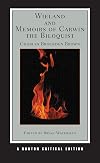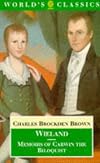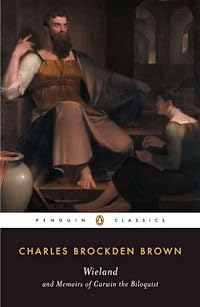
Wieland; and, Memoirs of Carwin the Biloquist
by Charles Brockden Brown
On This Page
Description
Wieland, named by his father after a German nickname for the devil, inherits both his father's estate and religious susceptibility. His idyllic rural life is disrupted when he falls prey to the ventriloquist Carwin, who convinces Wieland that a divine voice is commanding him to slaughter his family. He is tried for the murders of his wife and children, for which he expresses no remorse. He later escapes prison in an attempt to kill his sister Clara, who narrates the story. Clara and Carwin show more have an ambiguous relationship of attraction and repulsion.Brown's work was an important precursor to such Gothic masters as Edgar Allan Poe and Mary Shelley.
. show less
Tags
Recommendations






Member Reviews
honestly really enjoyed this. the pleyels' and wielands' friendships/familitude for the first half of Wieland was just genuinely fun to read & the disarray carwin caused quite spooky. clara, too, is SUCH a fun narrator.
carwin's memoir was a rather baffling addendum i must admit! that it is unfinished is wholly dissatisfying. what the hell was going on with ludloe.
read for engl 2200
carwin's memoir was a rather baffling addendum i must admit! that it is unfinished is wholly dissatisfying. what the hell was going on with ludloe.
read for engl 2200
One of the earliest American novels. Still worth reading. A bizarre pre-Gothic tale including spontaneous combustion, sleep-walking, and muuuurder.
The language of this story, as well as the narrator's (& author's?) need to share every little detail, made this story a slow read. The story is a little skewed since the narrator gives every detail about Latin pronunciations or plays the group puts on, but glosses over the scary parts of who's hiding in her closet. The ending is a deus ex machina, and a major letdown as far as whodunit goes. I guess this can be looked past, since it IS the first American mystery, but it's not worth the read outside of class. If I hadn't been reading it for a class, and therefore discussing every little aspect, I wouldn't have had a clue of what was going on, and would have been even angrier at trooping through the whole book for such a crappy ending.
The ending of Wieland is a MAJOR cop-out for anyone who is reading the book for fun. If you're reading it to analyze it in relationship to its social context, then the ending (along with the rest of the book) says a lot of interesting things about what ideas were in the air at that time, but as an ending for a seeming horror/supernatural story, it is just stupid, implausible, and not even all that thought-provoking.
This is a fascinating, though admittedly strange, tale that I read as an undergraduate. It is chock full of atmosphere and suspense, though the plot device that drives the work seems pretty flimsy. If you can get beyond that point, the book is an interesting study in gothic writing from an American author.
Weird story about a tight-knit group of classically-minded friends whose lives change for the worse when they admit a mysterious man into their circle. I agree with the reviewer who wrote that he/she thought it will never end.
Members
- Recently Added By
Lists

Best Gothic Fiction
110 works; 31 members

Fiction (Mostly) in Selective Bibliography of American Literature 1775-1900
431 works; 3 members
Author Information

36+ Works 2,572 Members
Charles Brockden Brown was born on January 17, 1771 in Philadelphia, Pennsylvania. After he completed his schooling in 1787, he began apprenticing at the law offices of Alexander Wilcocks and pursued literary interests. When he was 18, he published his first literary works: the Rhapsodist sketches, which appeared anonymously in the Columbian show more Magazine, and a poem entitled An Inscription for General Washington's Tomb Stone, which appeared in the State Gazette of North Carolina. In 1793, he abandoned the law to attempt a life of letters. Within four years, between 1789 and 1801, he published six novels: Wieland, Ormand, Arthur Mervyn, Edgar Huntly, Clara Howard and Jane Talbot. He died of tuberculosis on February 22, 1810. (Bowker Author Biography) show less
Some Editions
Series
Belongs to Publisher Series
Work Relationships
Common Knowledge
- Canonical title
- Wieland; and, Memoirs of Carwin the Biloquist
- Original publication date
- 1798
- Important places
- Pennsylvania Colony
- Important events
- 18th century (1798)
- Epigraph
- From Virtue's blissful paths away / The double-tongued are sure to stray; / Good is a forth-right journey still, / And mazy paths but lead to ill.
- First words
- Wieland or the Transformation: An American Tale
I feel little reluctance in complying with your request. - Last words
- (Click to show. Warning: May contain spoilers.)How Ludloe came into possession of this paper; how he was apprised of incidents, to which only the female mentioned and myself were privy; which she had too good reason to hide from all the world, and which I had taken infinite pains to bury in oblivion, I vainly endeavoured to conjecture.
- Canonical DDC/MDS
- 813.2
Classifications
Statistics
- Members
- 876
- Popularity
- 30,951
- Reviews
- 11
- Rating
- (3.48)
- Languages
- English, French, Russian
- Media
- Paper, Ebook
- ISBNs
- 34
- ASINs
- 12