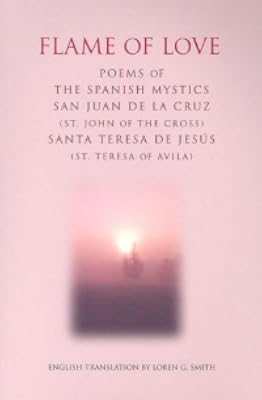
Flame of Love: Poems of the Spanish Mystics St. John of the Cross And St. Teresa of Avila
by Saint John of the Cross
On This Page
Description
St. John of the Cross (1542-1591) is regarded as one of the greatest poets of the Spanish language and among the greatest mystical poets of any language. Drawn to the contemplative life, he joined St. Teresa of Avila in her reform of the discalced Carmelites. John considered his poetry to be the most authentic expression of his theology and his ineffable mystical experience. St. Teresa of Avila (1515-1582) is famous for her extraordinary accomplishments in the reform of the Carmelite order show more and the founding of new monasteries, for her prose writings on the spiritual life, prayer and contemplation, and for her extraordinary sanctity. Her poetry has not received the same acclaim and attention as John's. But like him, she used poetry as a way of expressing the ineffable - the divine flame of love which consumed her. In preparing these translations, the primary emphasis has been placed on accurately preserving the meaning of the original poems, while retaining their rhyming schemes and utilizing meters as close to the original as possible. Each page of English translation faces the original Spanish text of the poems. Book jacket. show lessTags
Members
- Recently Added By
Author Information

365+ Works 8,721 Members
St. John of the Cross represents the pinnacle of Spanish mysticism. In contrast to St. Teresa's works, which refer frequently to things of this world, St. John's poetry works on a purely spiritual, abstract plane. His poems consist of allegorical descriptions of the journey of his spirit through mortification of earthly appetites, illumination, show more and purification of the soul to union with God. In his prose commentaries on his own poems he laments the insufficiency of language to communicate his mystical experiences and his interior life. A disciple of St. Teresa, he became the spiritual director of her convent at Avila in 1572 and was responsible for carrying out many of her rigorous new programs for the Carmelite Order. Objections to his extreme reforms led to a period of imprisonment and torture in Toledo. During this time, according to tradition, he wrote Spiritual Canticle. His concentrated symbolic poetry has been studied with enthusiasm by such modern poets as T. S. Eliot, Paul Valery, and Jorge Guillen. (Bowker Author Biography) show less
Classifications
- Genres
- Poetry, Fiction and Literature, Music
- DDC/MDS
- 861.30803824822 — Literature & rhetoric Spanish Literature Spanish poetry Spanish Golden Age (1499-1681)
- LCC
- PQ6400 .J8 .A235 — Language and Literature French, Italian, Spanish and Portuguese literatures Spanish literature Individual authors and works to 1700
- BISAC
Statistics
- Members
- 10
- Popularity
- 2,143,976
- Languages
- English
- Media
- Paper
- ISBNs
- 1