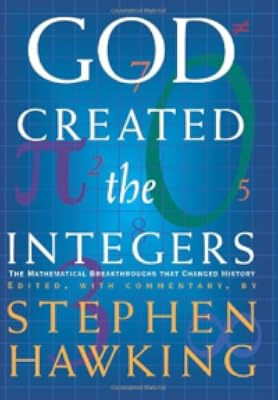
God Created the Integers: The Mathematical Breakthroughs That Changed History
by Stephen Hawking
On This Page
Description
Bestselling author and physicist Stephen Hawking explores the "masterpieces" of mathematics, 25 landmarks spanning 2,500 years and representing the work of 15 mathematicians, including Augustin Cauchy, Bernard Riemann, and Alan Turing. This extensive anthology allows readers to peer into the mind of genius by providing them with excerpts from the original mathematical proofs and results. It also helps them understand the progression of mathematical thought, and the very foundations of our show more present-day technologies. Each chapter begins with a biography of the featured mathematician, clearly explaining the significance of the result, followed by the full proof of the work, reproduced from the original publication. show lessTags
Recommendations







Member Reviews
Stephen Hawking is famous for both his expertise in the field of modern physics, and for popularizing the most recent discoveries for the lay audience. He said about his latter books, "For every equation I put in, sales are halved."
This new book is a significant departure from his past design philosophy - he has compiled, edited, and presented some of the great works of mathematical history, with the intent of presenting the lay reader with some of the great and elegant proofs of ages past, from Archimedes to Alan Turing.
There is one glaring flaw - whoever edited the book has made numerous errors - not only typos, but in the actual proofs and formulas and equations themselves! It will be difficult enough for most people to follow these show more lines of work if they are correct, but some of these mistakes are just nonsensical!
This could be a much better book than it is. I humbly suggest Professor Hawking should switch his Moog synthesizer to a stern voice and give the editors a good dressing down, for mangling the work of his distinguished forebearers. show less
This new book is a significant departure from his past design philosophy - he has compiled, edited, and presented some of the great works of mathematical history, with the intent of presenting the lay reader with some of the great and elegant proofs of ages past, from Archimedes to Alan Turing.
There is one glaring flaw - whoever edited the book has made numerous errors - not only typos, but in the actual proofs and formulas and equations themselves! It will be difficult enough for most people to follow these show more lines of work if they are correct, but some of these mistakes are just nonsensical!
This could be a much better book than it is. I humbly suggest Professor Hawking should switch his Moog synthesizer to a stern voice and give the editors a good dressing down, for mangling the work of his distinguished forebearers. show less
Not a proper review, but some notes I made while reading this:
Some reviewers have noted that this book only includes Western mathematicians. That's true, but the discussion of Euclid at least talks about the independent development of some of the principles of geometry and arithmetic in India. (That's about it, though.)
In the Euclid chapter it's unclear to me if the commentary is from Hawking or from a translator.
There's a lot of untranslated Greek, Latin, German...
There's a weird number of exclamation marks in the biography sections. For example "When war broke out in September 1939, Turing left his Cambridge fellowship and immediately reported to the facility the GCCS had established in the small town of Bletcheley Park, the town show more where the rail line from Oxford to Cambridge intersected the main rail line from London to the north!" OMG!
On the whole I'd skip this and just read the mathematicians' biographies on wikipedia or something. show less
Some reviewers have noted that this book only includes Western mathematicians. That's true, but the discussion of Euclid at least talks about the independent development of some of the principles of geometry and arithmetic in India. (That's about it, though.)
In the Euclid chapter it's unclear to me if the commentary is from Hawking or from a translator.
There's a lot of untranslated Greek, Latin, German...
There's a weird number of exclamation marks in the biography sections. For example "When war broke out in September 1939, Turing left his Cambridge fellowship and immediately reported to the facility the GCCS had established in the small town of Bletcheley Park, the town show more where the rail line from Oxford to Cambridge intersected the main rail line from London to the north!" OMG!
On the whole I'd skip this and just read the mathematicians' biographies on wikipedia or something. show less
(Original Review, 2005)
Random thoughts while attempting to read the book (the edition is shitty: it's full of typos)
In EM theory, which is Lorentz invariant, there's a relation between the magnitudes of the E and B fields for light (not if you use Planck units. The magnitudes of c and h tell you nothing about physics, but a lot about biology. I don't claim that's original, BTW. I'm trying to recall who said it first, Monod or Schrödinger, E/B = c. That's quite a magnitude difference of the E over the B already. So if you could gradually increase c the structure of a light beam changes radically. But the reason for c is probably tied to quantum vacuum properties so you've got changes there too. In fact I would find it entirely show more reasonable not to expect invariance in E and/or B while the early universe was trying to sort out its equilibrium conditions during falling out of the gravitational, electromagnetic, weak forces just after the BB.
Why does light (1) have the same speed as gravitational waves (2)? Separate phenomena. The wave equation for 2 is a perfect wave equation with speed c from assuming a weak gravitational field. And that traces all the way back to observationally seeing c the same in all inertial frames for light. The last implies using an (x, ict) description for any motion, not an (x, t) one, i.e. x^2-c^2t^2 = constant. So space-time comes first, where the wave wobble 1 must go at c because of the way we must describe space-time from the previous sentence, and light cannot go faster than this wave at least. Maybe a bit like saying you can't have a faster (light) wave within the gravitational wave. But the assumption/observation of c constant at the very beginning of the model sets the scene for the rest. However, the wave equation for 2 is a weak gravitational field equation, so for strong fields what is the gravitational wave speed since the form of the equation changes? The same? (Answer at the bottom of the post*)
Then there's that light is a quantum thing, E = hv but also E = pc. Where's the gravity in the first equation? The second comes from relativity, so together a wave frequency (v) is connected to space-time via c ... v = pc/h.
While c in vacuum is conventionally regarded as isotopic and isotropic in Einsteinian relativity, it is not really required that it be isotemporal. The value of c was shown to be predictable, even in the 19th century, from first principles, using the permeability and permittivity of the vacuum. It is not at all unreasonable that those values were different, especially during the phase-transition marking the fractionation of the 'forces' in the embryonic space-time manifold. All Einstein's axiom requires is the constancy of c in all (more or less co-temporal) reference frames. It merely happens that that constancy seems to be temporally fixed. But then that may only be due to the fact that the extremely non-linear 'expansion' (whether by Guth's or Magueijo's reckoning of the concept) of the early cosmos vanished billions and billions of years ago.
Bottom-line: The fact that the E and B fields of matter so easily meddle with c should be a red flag. That the E and B values would instantly equilibrate to current values during the cosmos' early phase-change and the differentiation of the fields ought to be questioned.
NB: The editors of this book should burn in hell...
(*) They are the same as a requirement of the two fields' (electromagnetic and gravitational) massless exchange particles. Einstein's c-axiom can be restated as 'there exists a velocity that is measured as constant in all reference frames'. Photons, gravitons, and neutrinos conform to the (essentially) massless parameter and thus conform to this velocity. show less
Random thoughts while attempting to read the book (the edition is shitty: it's full of typos)
In EM theory, which is Lorentz invariant, there's a relation between the magnitudes of the E and B fields for light (not if you use Planck units. The magnitudes of c and h tell you nothing about physics, but a lot about biology. I don't claim that's original, BTW. I'm trying to recall who said it first, Monod or Schrödinger, E/B = c. That's quite a magnitude difference of the E over the B already. So if you could gradually increase c the structure of a light beam changes radically. But the reason for c is probably tied to quantum vacuum properties so you've got changes there too. In fact I would find it entirely show more reasonable not to expect invariance in E and/or B while the early universe was trying to sort out its equilibrium conditions during falling out of the gravitational, electromagnetic, weak forces just after the BB.
Why does light (1) have the same speed as gravitational waves (2)? Separate phenomena. The wave equation for 2 is a perfect wave equation with speed c from assuming a weak gravitational field. And that traces all the way back to observationally seeing c the same in all inertial frames for light. The last implies using an (x, ict) description for any motion, not an (x, t) one, i.e. x^2-c^2t^2 = constant. So space-time comes first, where the wave wobble 1 must go at c because of the way we must describe space-time from the previous sentence, and light cannot go faster than this wave at least. Maybe a bit like saying you can't have a faster (light) wave within the gravitational wave. But the assumption/observation of c constant at the very beginning of the model sets the scene for the rest. However, the wave equation for 2 is a weak gravitational field equation, so for strong fields what is the gravitational wave speed since the form of the equation changes? The same? (Answer at the bottom of the post*)
Then there's that light is a quantum thing, E = hv but also E = pc. Where's the gravity in the first equation? The second comes from relativity, so together a wave frequency (v) is connected to space-time via c ... v = pc/h.
While c in vacuum is conventionally regarded as isotopic and isotropic in Einsteinian relativity, it is not really required that it be isotemporal. The value of c was shown to be predictable, even in the 19th century, from first principles, using the permeability and permittivity of the vacuum. It is not at all unreasonable that those values were different, especially during the phase-transition marking the fractionation of the 'forces' in the embryonic space-time manifold. All Einstein's axiom requires is the constancy of c in all (more or less co-temporal) reference frames. It merely happens that that constancy seems to be temporally fixed. But then that may only be due to the fact that the extremely non-linear 'expansion' (whether by Guth's or Magueijo's reckoning of the concept) of the early cosmos vanished billions and billions of years ago.
Bottom-line: The fact that the E and B fields of matter so easily meddle with c should be a red flag. That the E and B values would instantly equilibrate to current values during the cosmos' early phase-change and the differentiation of the fields ought to be questioned.
NB: The editors of this book should burn in hell...
(*) They are the same as a requirement of the two fields' (electromagnetic and gravitational) massless exchange particles. Einstein's c-axiom can be restated as 'there exists a velocity that is measured as constant in all reference frames'. Photons, gravitons, and neutrinos conform to the (essentially) massless parameter and thus conform to this velocity. show less
Libro dedicado a las grandes obras de la Física y la Astronomía. Stephen Hawking presenta los 31 logros fundamentales del pensamiento matemático, desde la geometría básica hasta la teoría de los números transfinitos
Dec 30, 2019Spanish
Members
- Recently Added By
Lists

HS Mathematics class library
79 works; 6 members

Mind Expanding Books by hackerkid
581 works; 8 members

In Our Time books
4,934 works; 2 members
Author Information

133+ Works 54,841 Members
Stephen William Hawking was born in Oxford, England on January 8, 1942. He received a first class honors degree in natural science from Oxford University and a Ph.D. from Cambridge University. He was a theoretical physicist and has held the post of Lucasian Professor of Mathematics at Cambridge University from 1982 until his death. In 1974, he was show more elected a Fellow of the Royal Society, the world's oldest scientific organization. In 1963, he learned he had amyotrophic lateral sclerosis, a neuromuscular wasting disease also known as Lou Gehrig's disease. The disease confined him to a wheelchair and reduced his bodily control to the flexing of a finger and voluntary eye movements, but left his mental faculties untouched. He became a leader in exploring gravity and the properties of black holes. He wrote numerous books including A Brief History of Time: From the Big Bang to Black Holes, Black Holes and Baby Universes, On the Shoulders of Giants, A Briefer History of Time, The Universe in a Nutshell, The Grand Design, and Brief Answers to the Big Questions. In 1982, he was named a commander of the British Empire. A film about his life, The Theory of Everything, was released in 2014 and was based on his first wife Jane Hawking's book Traveling to Infinity: My Life with Stephen. He died on March 14, 2018 at the age of 76. (Bowker Author Biography) show less
Common Knowledge
- Canonical title
- God Created the Integers: The Mathematical Breakthroughs That Changed History
- Original title
- God Created the Integers: The Mathematical Breakthroughs That Changed History
- Original publication date
- 2005
- First words
- "We are lucky to live in an age in which we are still making discoveries. It is like the discovery of America -- You only discover it once. The age in which we live in is the age in which we are discovering the fundamental la... (show all)ws of nature..."
-- American Physicist Richard Feynman, spoken in 1964
Classifications
Statistics
- Members
- 1,037
- Popularity
- 24,966
- Reviews
- 4
- Rating
- (3.85)
- Languages
- English, French, Spanish
- Media
- Paper, Ebook
- ISBNs
- 11
- ASINs
- 8