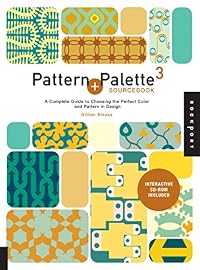
Pattern and Palette Sourcebook 3: A Complete Guide to Choosing the Perfect Color and Pattern in Design (v. 3)
by Gillian Blease
Pattern and Palette Sourcebook (3)
On This Page
Description
Pattern and Palette Sourcebook 3 is a desktop library of colors and patterns that addresses the professional ?s real-world needs in working with harmonies and contrasts.Tags
Member Reviews
When I received Pattern and Palette Sourcebook 3: A Complete Guide to Choosing the Perfect Color and Pattern in Design by Gillian Blease I was totally blown away by what was contained between the two covers.
At first glance you might think it’s no big deal. There’s no text beyond one introductory page. There’s just page after page of rectangles, each with a different pattern and/or color grouping. But upon looking closer you see the genius of it. How the colors play off each other. How the lines and shapes work together to form distinctly modern patterns, some simple and some complex.
As the introduction says:
“… Color can be used to demonstrate many things: mood and tension, warm and cold, density and space. We engage with and show more respond to color signals in our everyday lives both on a basic level and on a much more subtle and complex level in relation to such factors as environment, activity, or food. It plays an enormous role in how we interpret meaning and function, and for the designer is a powerful tool for communication.
The origins of the patterns in the book can be found in the details of the world around us, from the mundane to the sublime. The palettes for each of the six chapters – Botanics, Mechanics, Utility, Sugar and Spice, Ancient and Modern, and Maritime – reflect color associations both inherent to the subject and as applied by society…
Each of the patterns in the following chapters is reworked a number of times using one or more colors from the palette at the top of the page (author note: CMYK), allowing you to compare different color schemes for each pattern…”
I immediately painted a canvas in which my design was influenced by one of the patterns in the book and my colors were definitely inspired by those in the Sugar and Spice section. I also can see myself using several of these patterns as the basis for doodles in my journal. In fact, that is the real reason I wanted the book. I love other people’s journal doodles but have never really felt comfortable with my skill in that area. There are so many in here I can’t wait to try. Really the painting was just a very happy accident! Because I also sew I’m sure this will help me put together colors and fabrics in a more striking way as well.
As you can see I was incredibly taken with this book. I highly recommend it for artists of all types – illustrators, painters, and fiber artists. show less
At first glance you might think it’s no big deal. There’s no text beyond one introductory page. There’s just page after page of rectangles, each with a different pattern and/or color grouping. But upon looking closer you see the genius of it. How the colors play off each other. How the lines and shapes work together to form distinctly modern patterns, some simple and some complex.
As the introduction says:
“… Color can be used to demonstrate many things: mood and tension, warm and cold, density and space. We engage with and show more respond to color signals in our everyday lives both on a basic level and on a much more subtle and complex level in relation to such factors as environment, activity, or food. It plays an enormous role in how we interpret meaning and function, and for the designer is a powerful tool for communication.
The origins of the patterns in the book can be found in the details of the world around us, from the mundane to the sublime. The palettes for each of the six chapters – Botanics, Mechanics, Utility, Sugar and Spice, Ancient and Modern, and Maritime – reflect color associations both inherent to the subject and as applied by society…
Each of the patterns in the following chapters is reworked a number of times using one or more colors from the palette at the top of the page (author note: CMYK), allowing you to compare different color schemes for each pattern…”
I immediately painted a canvas in which my design was influenced by one of the patterns in the book and my colors were definitely inspired by those in the Sugar and Spice section. I also can see myself using several of these patterns as the basis for doodles in my journal. In fact, that is the real reason I wanted the book. I love other people’s journal doodles but have never really felt comfortable with my skill in that area. There are so many in here I can’t wait to try. Really the painting was just a very happy accident! Because I also sew I’m sure this will help me put together colors and fabrics in a more striking way as well.
As you can see I was incredibly taken with this book. I highly recommend it for artists of all types – illustrators, painters, and fiber artists. show less
Members
- Recently Added By
Author Information
1 Work 14 Members
Series

Common Knowledge
- Original title
- Pattern + Palette Sourcebook 3
- Original publication date
- 2008-12-31
Classifications
Statistics
- Members
- 14
- Popularity
- 1,668,941
- Reviews
- 1
- Rating
- (5.00)
- Languages
- English
- Media
- Paper, Ebook
- ISBNs
- 4
- UPCs
- 1
- ASINs
- 1