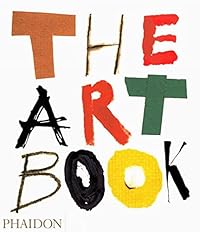
The Art Book
by Phaidon Press
On This Page
Description
A brand-new revised and updated edition of Phaidon's accessible, acclaimed A-Z guide to the most important artists of all time. Updated for only the third time in its 16-year history, this new edition of the award-winning landmark publication has been refreshed with more than 40 important new artists, including many previously overlooked and marginal practitioners. The new edition spotlights more than 600 great artists from medieval to modern times. Breaking with traditional classifications, show more it throws together brilliant examples from all periods, schools, visions, and techniques, presenting an unparalleled visual sourcebook and a celebration of our rich, multifaceted culture. Artists featured for the first time in this edition include: Berenice Abbott, Hilma af Klint, El Anatsui, Romare Bearden, Mark Bradford, Cao Fei, Cecily Brown, Judy Chicago, John Currin, Guerrilla Girls, Lee Krasner, Jacob Lawrence, Kerry James Marshall, Joan Mitchell, Zanele Muholi, Takashi Murakami, Louise Nevelson, Clara Peeters, Jenny Saville, Wolfgang Tillmans, and more. show lessTags
Recommendations











Member Reviews
So if you re-titled this, "The (Almost Entirely Western) Painting and Sculpture (14th - 20th Century) Book, you'd know what you're in for - but it's not exactly pithy. Only the "Painting and Sculpture" part is openly acknowledged by the editors. The rest is deduced from what actually appears in the book, which is an alphabetically arranged list of 500 artists with one image each and a paragraph or two of annotation about the artist and the work displayed. There's also basic biographical details and information on the chosen image.
As the editors note, the alphabetical arrangement leads to some startling contrasts since proximate works in the book can be separated by centuries and continents in terms of their actual production. This was show more actually quite fun, just look elsewhere for an education on how everything fits together conceptually, geographically and historically. 500 entries gives room for all the most famous artists (given the constraints of my alternative title) with plenty of space left over for people I had not heard of, some of whom piqued my interest. It was also pleasing to find women represented as far back as the 1600s, their work being of a quality matching that of the book generally.
Great for flipping through - a perfect "coffee table" book. show less
As the editors note, the alphabetical arrangement leads to some startling contrasts since proximate works in the book can be separated by centuries and continents in terms of their actual production. This was show more actually quite fun, just look elsewhere for an education on how everything fits together conceptually, geographically and historically. 500 entries gives room for all the most famous artists (given the constraints of my alternative title) with plenty of space left over for people I had not heard of, some of whom piqued my interest. It was also pleasing to find women represented as far back as the 1600s, their work being of a quality matching that of the book generally.
Great for flipping through - a perfect "coffee table" book. show less
I'm almost done, and still waiting, after almost two months, for an epiphany. But I keep feeling frustrated, not only by the lack of organization, but by the choices, and by the text.
How is 'alphabetical by artist' supposed to illuminate anything? It can't. It's effectively random. There happen to be a couple of interesting juxtapositions, but those few certainly don't justify this approach.
The editors have an amazingly high Euro (and, in the more modern entries, American) bias, with only two token Japanese artists (sorry, don't remember which) and Kahlo & Rivera. Yet they don't include the truly classical, for example the Parthenon or a Grecian Urn (as in Ode to...). In fact they don't include architecture at all - expect for a stiff show more painting of an English manor that's more a record for the owner than art. And yet they do include Christo, of the environmental 'sculpture.'
The bias to the Euro is tiresome. ... in the northern style..." Um, hello, northern *what*? For awhile I thought Northern Italian, as I was seeing the reference primarily in the notes about works of the Florentine Renaissance, but then I saw it applied more broadly - to Northern Europe. But lower-case 'northern' is not appropriate.
And every few pages I have to wonder whether the writer of the notes is looking at the same work that I am. For example, Rivera's 'The Tortilla Maker' is *not* portraying "peasant women making tortillas.' There's one woman making tortillas, and one little girl watching.
In other painting, the so-called expert refers to 'a sister and brother' - but the male figure is significantly taller & leaner, and has male-pattern baldness. If he's not meant to be the father, rather than the brother, I want to know a lot more than one paragraph about that painting.
And so many times the notes will describe a scene, a manner, or a composition as 'tender' or 'horrifying' or 'calm' or even 'unsophisticated' and I see the exact opposite. Redon's 'The Cyclops' is not horrifying - look it up for yourself.
If the notes were meant to illuminate, to guide, they should have been written with more care, and vetted. Or at least Beta-Tested.
I will say this would be a fun app for a tablet device. I can imagine using the 'see also artist 1, artist 2, artist 3' links' to begin to discover some patterns, some meaning, or at least some implications. The app could also link the works by other tags, such as date, subject matter, sponsor (was the work commissioned by a noble, or by a church, or created in hopes of finding a gallery or buyer), medium, etc....
Hopefully now that I've vented my spleen, so to speak, I can finish the last 60 artists/works with a fresh mind and find something good to say about the book. At this point, I'm wavering between two stars for the book as a resource and an interesting idea, and one star for massive fail.
---------------------
OK, finally done. I just don't have anything to add. It never worked out in any interesting way. As an app, with instant access to any related work, probably five stars. As a page by page book, one random work by an alphabetical list of - please note - exactly 500 authors, nope.
Hey, I have another idea for a sequence that sounds facetious but would actually be enlightening - Size. What subjects are portrayed, in what medium, by the largest, the medium-sized, and the smallest works? I tell you what, whenever you're reading an art book, definitely look at the dimensions and imagine what it would be like to see the work irl. You'll be surprised which intimate scenes are writ large, and what relatively simple portraits, still lifes, etc., consume whole walls...." show less
How is 'alphabetical by artist' supposed to illuminate anything? It can't. It's effectively random. There happen to be a couple of interesting juxtapositions, but those few certainly don't justify this approach.
The editors have an amazingly high Euro (and, in the more modern entries, American) bias, with only two token Japanese artists (sorry, don't remember which) and Kahlo & Rivera. Yet they don't include the truly classical, for example the Parthenon or a Grecian Urn (as in Ode to...). In fact they don't include architecture at all - expect for a stiff show more painting of an English manor that's more a record for the owner than art. And yet they do include Christo, of the environmental 'sculpture.'
The bias to the Euro is tiresome. ... in the northern style..." Um, hello, northern *what*? For awhile I thought Northern Italian, as I was seeing the reference primarily in the notes about works of the Florentine Renaissance, but then I saw it applied more broadly - to Northern Europe. But lower-case 'northern' is not appropriate.
And every few pages I have to wonder whether the writer of the notes is looking at the same work that I am. For example, Rivera's 'The Tortilla Maker' is *not* portraying "peasant women making tortillas.' There's one woman making tortillas, and one little girl watching.
In other painting, the so-called expert refers to 'a sister and brother' - but the male figure is significantly taller & leaner, and has male-pattern baldness. If he's not meant to be the father, rather than the brother, I want to know a lot more than one paragraph about that painting.
And so many times the notes will describe a scene, a manner, or a composition as 'tender' or 'horrifying' or 'calm' or even 'unsophisticated' and I see the exact opposite. Redon's 'The Cyclops' is not horrifying - look it up for yourself.
If the notes were meant to illuminate, to guide, they should have been written with more care, and vetted. Or at least Beta-Tested.
I will say this would be a fun app for a tablet device. I can imagine using the 'see also artist 1, artist 2, artist 3' links' to begin to discover some patterns, some meaning, or at least some implications. The app could also link the works by other tags, such as date, subject matter, sponsor (was the work commissioned by a noble, or by a church, or created in hopes of finding a gallery or buyer), medium, etc....
Hopefully now that I've vented my spleen, so to speak, I can finish the last 60 artists/works with a fresh mind and find something good to say about the book. At this point, I'm wavering between two stars for the book as a resource and an interesting idea, and one star for massive fail.
---------------------
OK, finally done. I just don't have anything to add. It never worked out in any interesting way. As an app, with instant access to any related work, probably five stars. As a page by page book, one random work by an alphabetical list of - please note - exactly 500 authors, nope.
Hey, I have another idea for a sequence that sounds facetious but would actually be enlightening - Size. What subjects are portrayed, in what medium, by the largest, the medium-sized, and the smallest works? I tell you what, whenever you're reading an art book, definitely look at the dimensions and imagine what it would be like to see the work irl. You'll be surprised which intimate scenes are writ large, and what relatively simple portraits, still lifes, etc., consume whole walls...." show less
A fascinating concept; taking just one representative work from the world's major artists and filing them alphabetically. This leads to some interesting juxtapositions in that a renaissance master could be opposite pop art - compare and contrast. A brilliant jumping off point for a wider appreciation of art than you'd get in any book limited by genre.
I feel like this is required reading for all Art Studies 101 courses. And if not, it should be. It's not going to teach you everything there is to know about art and artists, but it is an invaluable resource for understanding the difference between Manet and Monet.
I was required to take an art appreciation class in college to graduate--and I loved it! So getting this book was a natural follow-up. It won Illustrated Book of the Year and is in the Top Five Popular Art Books on Goodreads. As stated in the introduction, this book is "an A to Z guide to 500 great painters and sculptors from medieval to modern times." It's that classic coffee table book--I even recently spotted it on a list for the best of the kind. I'm not the kind that collects those--in fact this is the only book of the kind I own. But if any such book should be part of every home, surely its an art book like this one, where the great Western artists and (alas only) one of their representative masterpieces is laid before you. This show more is also by far the heaviest book I own--you could do strength training with it--but it's worth its weight. A real keeper. show less
This very handy book is an A to Z guide of 500 painters and sculptors from medieval to modern times. Each artist is given a full page color plate showing the most representative work of the artist, along with explanatory and biographical notes. What is great about this guide is that all artists are represented together no matter what their period or school or technique was; if you want to know about an artist, you just need to know the alphabet. Glossaries are included. It is an ideal introduction to art.
My background is art is not extensive, so this is a good book to cover a lot of ground. Plus it has a color picture of one of the scariest paintings I've ever seen in person (If you are ever in Des Moines IA go to the Art Museum and look at the Bacon)
Members
- Recently Added By
Lists

Check
18 works; 1 member
Author Information

268 Works 17,031 Members
All Editions
Some Editions
Awards and Honors
Awards
Series
Belongs to Publisher Series
Common Knowledge
- Original title
- The Art Book Miniature Edition
- Original publication date
- 1994
- First words
- The Art Book presents a whole new way of looking at art.
- Last words
- (Click to show. Warning: May contain spoilers.)Unable to re-establish his once high reputation he died in great poverty in 1664.
Classifications
- Genres
- Art & Design, Nonfiction, General Nonfiction
- DDC/MDS
- 709 — Arts & recreation Arts History, geographic treatment, biography
- LCC
- N33 .A575 — Fine Arts Visual arts General
- BISAC
Statistics
- Members
- 2,315
- Popularity
- 8,499
- Reviews
- 16
- Rating
- (4.04)
- Languages
- 9 — Dutch, English, French, German, Italian, Norwegian (Bokmål), Spanish, Swedish, Portuguese (Portugal)
- Media
- Paper
- ISBNs
- 25
- ASINs
- 5