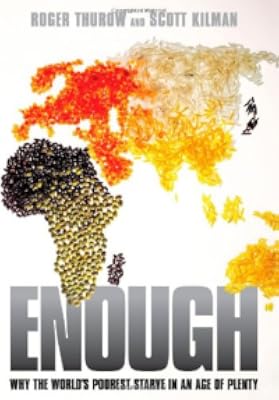
Enough: Why the World's Poorest Starve in an Age of Plenty.
by Roger Thurow, Scott Kilman
On This Page
Description
For more than thirty years, humankind has known how to grow enough food to end chronic hunger worldwide. Yet while the "Green Revolution" succeeded in South America and Asia, it never got to Africa. More than 9 million people die of hunger, malnutrition, and related diseases every year--most of them in Africa and most of them children. More die of hunger in Africa than from AIDS and malaria combined. Now, an impending global food crisis threatens to make things worse. In the west we think of show more famine as a natural disaster, brought about by drought, or as the legacy of brutal dictators. But in this powerful investigative narrative, Thurow & Kilman show exactly how, in the past few decades, American, British, and European policies conspired to keep Africa hungry and unable to feed itself.--From publisher description. show lessTags
Recommendations




Member Reviews
If I had my way, a well-thumbed copy of this book would rest on the desk of every US Senator and member of Congress, and they'd be thinking about the issues the authors raise while crafting their policies.
America loves to talk about free markets (it's one of the features of the current health care debate, for instance) -- except when it's not in the national interest, as in agriculture. So we subsidize our farmers, enabling them to produce so much grain that we then have a vested interest in dumping as 'free' food aid it in Africa to meet any short-term supply shortfalls, when a more appropriate response would be to support grassroots efforts to develop new farming techniques, seeds and agricultural markets that would enable Africa to show more become self-sustaining on a regional if not always a local basis. "It's not in the interest of others to help us become self-sufficient," pronounces one Ethiopian in this book -- a claim that Thurow and Kilman prove beyond any reasonable doubt, then hold up to scorn and mockery.
Some of the contents of this powerful and damning book are tough to read -- there are the depictions of famine on the one hand, and the details of how agricultural markets and seed development function, which can become dauntingly complex, on the other. But the authors mix up the technical details with more than enough encounters with real-life players, from farmers in the developed world as well as Africa, to aid officials, scientists and others trying to change the system. We meet a woman who launches a commodities exchange in Ethiopia, and a new breed of seed salesman who works miles away from the nearest town and thus makes it possible for farmers to buy the latest seeds, tools and fertilizers and improve their yields with his advice and guidance. They point us to the most damning examples of foreign interference or indifference, such as the US political support for Egypt that has made it hard for drought-stricken regions of Ethiopia to dam parts of the Blue Nile to irrigate their fields -- all the water must flow north to the Delta, so that an Egyptian farmer's calves can take showers. They draw the link between hunger and other problems -- lack of education, HIV/AIDS -- and point out how solving hunger often is needed before philanthropists tackle other laudable projects.
This is simply one of the most powerful and chilling books about global issues I've read in a while. The authors follow where the facts lead them, not any ideological agenda, and report what their research and reporting shows them. The story-telling is powerful and the logic impeccable. The consequences of the distorted system that is still functioning today are downright chilling, not just on a humanitarian but a geopolitical basis.
A must-read book -- six stars... show less
America loves to talk about free markets (it's one of the features of the current health care debate, for instance) -- except when it's not in the national interest, as in agriculture. So we subsidize our farmers, enabling them to produce so much grain that we then have a vested interest in dumping as 'free' food aid it in Africa to meet any short-term supply shortfalls, when a more appropriate response would be to support grassroots efforts to develop new farming techniques, seeds and agricultural markets that would enable Africa to show more become self-sustaining on a regional if not always a local basis. "It's not in the interest of others to help us become self-sufficient," pronounces one Ethiopian in this book -- a claim that Thurow and Kilman prove beyond any reasonable doubt, then hold up to scorn and mockery.
Some of the contents of this powerful and damning book are tough to read -- there are the depictions of famine on the one hand, and the details of how agricultural markets and seed development function, which can become dauntingly complex, on the other. But the authors mix up the technical details with more than enough encounters with real-life players, from farmers in the developed world as well as Africa, to aid officials, scientists and others trying to change the system. We meet a woman who launches a commodities exchange in Ethiopia, and a new breed of seed salesman who works miles away from the nearest town and thus makes it possible for farmers to buy the latest seeds, tools and fertilizers and improve their yields with his advice and guidance. They point us to the most damning examples of foreign interference or indifference, such as the US political support for Egypt that has made it hard for drought-stricken regions of Ethiopia to dam parts of the Blue Nile to irrigate their fields -- all the water must flow north to the Delta, so that an Egyptian farmer's calves can take showers. They draw the link between hunger and other problems -- lack of education, HIV/AIDS -- and point out how solving hunger often is needed before philanthropists tackle other laudable projects.
This is simply one of the most powerful and chilling books about global issues I've read in a while. The authors follow where the facts lead them, not any ideological agenda, and report what their research and reporting shows them. The story-telling is powerful and the logic impeccable. The consequences of the distorted system that is still functioning today are downright chilling, not just on a humanitarian but a geopolitical basis.
A must-read book -- six stars... show less
I read this book along with Dambisa Moyo's "Dead Aid." These two books express outrage and offer solutions to two parallel issues (lots of food and lots of starving people, lots of aid to Africa and no apparent benefit), but do so in very different ways,
"Enough" takes a journalistic look at both the problems with our food aid system (e.g., how, with the lobbying of the agricultural industry AND nonprofit food development organizations, it subsidizes US farmers to dump food in Africa instead of supporting African farmers and helping them produce and distribute more) and existing projects that could become solutions (e.g., bringing distributors of seeds, fertilizer, and harvested food closer to the farmers; changing water distribution show more systems; developing local commodities exchanges). The authors' depiction of the status quo is damning, and their point that for hungry people, food is the most important development issue, and connects to health, education, and productivity, compelling. show less
"Enough" takes a journalistic look at both the problems with our food aid system (e.g., how, with the lobbying of the agricultural industry AND nonprofit food development organizations, it subsidizes US farmers to dump food in Africa instead of supporting African farmers and helping them produce and distribute more) and existing projects that could become solutions (e.g., bringing distributors of seeds, fertilizer, and harvested food closer to the farmers; changing water distribution show more systems; developing local commodities exchanges). The authors' depiction of the status quo is damning, and their point that for hungry people, food is the most important development issue, and connects to health, education, and productivity, compelling. show less
I'd like to read this too. Luba
Ratings
Members
- Recently Added By
Lists

Really Good Narrative Non-Fiction
65 works; 24 members
Author Information
5 Works 299 Members
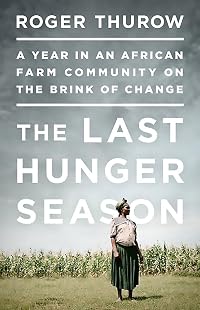
Roger Thurow is a senior fellow for global food and agriculture at the Chicago Council on Global Affairs. He was a reporter at the Wall Street Journal for 30 years. He is a coauthor of the award-winning Enough and the author of The Last Hunger Season.
2 Works 188 Members
Awards and Honors
Common Knowledge
- Original publication date
- 2009
- Dedication
- From Roger:
For Anne, Brian, and Aishling,
who nourish the vision and the spirit
From Scott:
For Trish, Helen, and Rosemary,
who show how individuals can make a difference in the world - Blurbers
- Bono; Yunus, Muhammad
Classifications
- Genres
- Economics, Nonfiction, Sociology, General Nonfiction, Politics and Government, Science & Nature
- DDC/MDS
- 363.8 — Society, government, & culture Social problems and social services Public Safety - Police, Crime Investigation Food supply
- LCC
- HC800 .Z9 .P6285 — Social sciences Economic history and conditions Economic history and conditions By region or country
- BISAC
Statistics
- Members
- 185
- Popularity
- 177,429
- Reviews
- 3
- Rating
- (4.23)
- Languages
- English
- Media
- Paper, Ebook
- ISBNs
- 4
- ASINs
- 1