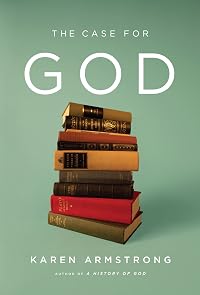
The Case for God
by Karen Armstrong
On This Page
Description
A nuanced exploration of the part that religion plays in human life, drawing on the insights of the past in order to build a faith that speaks to the needs of our dangerously polarized age. Moving from the Paleolithic age to the present, Karen Armstrong details the great lengths to which humankind has gone in order to experience a sacred reality that it called by many names, such as God, Brahman, Nirvana, Allah, or Dao. Focusing especially on Christianity but including Judaism, Islam, show more Buddhism, Hinduism, and Chinese spiritualities, Armstrong examines the diminished impulse toward religion in our own time, when a significant number of people either want nothing to do with God or question the efficacy of faith. Why has God become unbelievable? Why is it that atheists and theists alike now think and speak about God in a way that veers so profoundly from the thinking of our ancestors? Answering these questions with the same depth of knowledge and profound insight that have marked all her acclaimed books, Armstrong makes clear how the changing face of the world has necessarily changed the importance of religion at both the societal and the individual level. Yet she cautions us that religion was never supposed to provide answers that lie within the competence of human reason; that, she says, is the role of "logos." The task of religion is "to help us live creatively, peacefully, and even joyously with realities for which there are no easy explanations." She emphasizes, too, that religion will not work automatically. It is, she says, a practical discipline: its insights are derived not from abstract speculation but from "dedicated intellectual endeavor" and a "compassionate lifestyle that enables us to break out of the prism of selfhood." show lessTags
Recommendations








Member Reviews
I was expecting arguments on whether there was a God or not, and Karen Armstrong gave them to me. But what she gave me was the history of arguments for or against God, which was much more interesting than what I expected. I found the relationship between Protestant Christianity and science to be particularly interesting, and left the book feeling that my expectation that someone would prove to me, logically, that there was a God was itself an artifact of Enlightenment-era Protestantism's relationship to science. I also ended up feeling that yes, there should be reason in religion, but expecting scientific proof of God is expecting chocolate in your peanut butter. The Enlightenment may have felt that science and religion are two great show more tastes that taste great together, but not every jar of peanut butter is a Reese's cup. show less
I cannot overstate the impact this book has had on me. Armstrong describes a feeling I have had for years: a feeling that there is something wrong with the way we approach religion today, a feeling that this thing that is wrong is contributing to the disconnectedness and alienation that are so prevalent in late 20th and early 21st century culture.
She somehow manages to survey centuries of theological, philosophical, and scientific development in just a few hundred pages. And that makes it sound horribly dull, which it's not. You know that 'Ah-ha!' moment when you find the answer to a question that's been tormenting you, when everything finally clicks into place? This book is a whole series clicks, one after another.
The first half of the show more book took a bit of work to get through, but the second half really picked it up. And the last page: CLICK! show less
She somehow manages to survey centuries of theological, philosophical, and scientific development in just a few hundred pages. And that makes it sound horribly dull, which it's not. You know that 'Ah-ha!' moment when you find the answer to a question that's been tormenting you, when everything finally clicks into place? This book is a whole series clicks, one after another.
The first half of the show more book took a bit of work to get through, but the second half really picked it up. And the last page: CLICK! show less
In this work, Armstrong tries to directly address some of the "New Atheists" by claiming that the God they are attacking is basically a straw man. She argues that, historically, religious texts were not seen as something meant to be taken literally, that they were starting points from which we could contemplate the ineffable. She believes that religions only started insisting on the literal interpretation of their texts when science and rationalism began to be the way most humans engaged with the world. Some people reacted by trying to prove that their religions and religious texts were compatible with science. This, Armstrong believes, is the God that the New Atheists attack, while leaving alone the god/source/path that most religious show more people have engaged with over the centuries.
She makes a compelling argument, and this book could find readers on both sides of the God debate. If you agree with the New Atheists, you might be infuriated, but it would still be worth your while. If, on the other hand, the New Atheists infuriate you, even though you don't believe in religious texts literally, then this is definitely worth a read. show less
She makes a compelling argument, and this book could find readers on both sides of the God debate. If you agree with the New Atheists, you might be infuriated, but it would still be worth your while. If, on the other hand, the New Atheists infuriate you, even though you don't believe in religious texts literally, then this is definitely worth a read. show less
Karen Armstrong makes no case for God and only a weak, uneven, and confused case for "God." She clearly (and rightly) dismisses theology that treats God as merely the greatest power in existence, but ultimately fails to explain why the word or label "God" remains useful. In the final pages, where I hoped to see her "case" become clear, she only advocates what amounts to active engagement with life, mindfulness, and recognition of uncertainty. Why we need "to engage with a symbol [like "God"] imaginatively [and] become ritually and ethically involved with it" is not clear, except Armstrong claims that doing so will "allow it [the symbol] to effect a profound change in you." (See page 321.)
Armstrong rightly points out that "God" the show more symbol too easily becomes God the idol, which is "one of the pitfalls of monotheism" (page 321), so why should we bother putting a label on "religious experience," which she appears to define as "explor[ing] the normal workings of our minds and notic[ing] how frequently these propel us quite naturally into transcendence" (page 327)? And what is "transcendence" anyway? If putting words on these things creates a dangerous "pitfall," then Armstrong has fatally undercut her case. To portray her book and her argument as being a "case for God," she is only irresponsibly perpetuating the problem that she has spilled so much ink to reveal, not just in this book, but in several earlier ones.
It does seem quite "natural" or "normal"—perhaps a better word is "commonplace"—to recognize that we remain ignorant of the true nature of reality, but doing so while actively engaging with life and practicing mindfulness does not require having a label or a symbol like "God." Or Armstrong, at least, has not convincingly argued that it does, which is what I expected her to do, right from the beginning of the book.
Ultimately (and unfortunately), this book follows what now appears to this reader as a clear progression in her work: writing that increasingly looks less like history, or even history of ideas, and more like roughly chronological bibliography with connective glosses here and there. It is not an argument, but a guided tour through Karen Armstrong's reading. Taken on those terms, The Case for God is quite an interesting work. But taken on the terms by which it seems to present itself, it is a failure. show less
Armstrong rightly points out that "God" the show more symbol too easily becomes God the idol, which is "one of the pitfalls of monotheism" (page 321), so why should we bother putting a label on "religious experience," which she appears to define as "explor[ing] the normal workings of our minds and notic[ing] how frequently these propel us quite naturally into transcendence" (page 327)? And what is "transcendence" anyway? If putting words on these things creates a dangerous "pitfall," then Armstrong has fatally undercut her case. To portray her book and her argument as being a "case for God," she is only irresponsibly perpetuating the problem that she has spilled so much ink to reveal, not just in this book, but in several earlier ones.
It does seem quite "natural" or "normal"—perhaps a better word is "commonplace"—to recognize that we remain ignorant of the true nature of reality, but doing so while actively engaging with life and practicing mindfulness does not require having a label or a symbol like "God." Or Armstrong, at least, has not convincingly argued that it does, which is what I expected her to do, right from the beginning of the book.
Ultimately (and unfortunately), this book follows what now appears to this reader as a clear progression in her work: writing that increasingly looks less like history, or even history of ideas, and more like roughly chronological bibliography with connective glosses here and there. It is not an argument, but a guided tour through Karen Armstrong's reading. Taken on those terms, The Case for God is quite an interesting work. But taken on the terms by which it seems to present itself, it is a failure. show less
Superb historical account of the history of religious thought. There is a particular emphasis on Western Christian perspectives but not entirely limited to that. I found the conclusion to be surprising in that Armstrong doesn't argue for a 'God' that exists, rather she explores our need for significance, the need to acknowledge that there are aspects of our lives that go beyond the scientific (science can tell us we have cancer but is silent on how we can best deal with that) and that there are spaces beyond our imagining (why is there something, not nothing).
I felt she shone a light on a murky place.
I felt she shone a light on a murky place.
'The Case for God' is a case not made, from my Examiner column.Few religious thinkers have eased the consciences of spiritual liberals, anti-fundamentalist religious moderates, and functional nonbelievers unwilling to stake any affirmatively atheistic ground than Karen Armstrong. For years she has been making the assertion that her scholarship proves that the "great" monotheisms ought not be associated with the fear, xenophobia, irrational faith in the absurd, violence, or misogyny that so they so often encourage, but that they have their "true" foundations in love and tolerance--and anyone who doesn't think so hasn't been doing it right. As much as that assertion causes many skeptics to arch their eyebrows, it at least sounds like a show more good thing to which the faiths could aspire if they were so inclined. Alas.Her latest book, The Case for God, is not meant to explain the various faiths' dispositions or ideological foundations, but to convince the reader that the most commonly held notions of God, those of a being that created the universe and "exists," are false, and that in actuality, God is an unknowable, unfathomable concept for which the very term "existence" is too limited. If you think that sounds like a pretty weak basis for an argument when dealing with such a grand concept's veracity, you're right. And despite Armstrong's impressive breadth of knowledge and her nuanced grasp of various thinkers' positions throughout the generations, her case never adds up.Part of the trouble, of course, is that her book's premise is challenged by her own explanation of what God is. It is nigh impossible for me to understand how someone can build a case for God if the central thesis is that God is an unknowable pseudo-entity-but-not-really, something that mere humans are wholly incapable of defining. Where does that leave your book?[For the rest of this review, see my Examiner column here: http://www.examiner.com/examiner/x-4275-Secularism-Examiner~y2010m1d3-Book-revie... show less
The title of another book out last year excited me--The Evolution of God--but when I heard the author speak I was disappointed. (There was a lot of talk about zero sum game.) Armstrong's book is what I had hoped for from the other. It covers the changing ways people have viewed God and religion, from 30,000 BCE, when humans crawled deep into caves to cover their walls with paintings of animals and maybe shamans, to the present, when both fundamentalists and atheists insist on a strict literal interpretation of scriptures--a legacy of the modern scientific revolution that has left everyone, including the devout, looking for unambiguous, objective truth derived from some kind of logical deliberation. The modern way is simplistic; show more Armstrong believes religious life involves hard work, pushing finite hearts and minds to the edges of their understanding, toward the infinite.
I took a long time to read this book and as soon as I finished I started reading it again. There is a lot to absorb and a lot that challenged my unexamined beliefs, a mind-blowing experience that's my drug of choice. As an an agnostic leaning toward a non-belligerent atheism, reading is almost my religion, so when Armstrong wrote convincingly about the printing press's drawback of moving learning and religion in a depersonalized and inflexible direction, leading in religion's case to ridiculous disagreements over finer and finer dogmatic distinctions, I was shocked into a speechless, apophatic state. One of many I experienced while reading her book. Which is maybe, or maybe not, ironic because that apophatic experience I got from reading is the right place, Armstrong believes, to begin transcending our everyday world and experiencing God. Religion, Armstrong writes, historically has been and should be more about practice and experience and less about blind belief in particular doctrines. Sounds great to me. show less
I took a long time to read this book and as soon as I finished I started reading it again. There is a lot to absorb and a lot that challenged my unexamined beliefs, a mind-blowing experience that's my drug of choice. As an an agnostic leaning toward a non-belligerent atheism, reading is almost my religion, so when Armstrong wrote convincingly about the printing press's drawback of moving learning and religion in a depersonalized and inflexible direction, leading in religion's case to ridiculous disagreements over finer and finer dogmatic distinctions, I was shocked into a speechless, apophatic state. One of many I experienced while reading her book. Which is maybe, or maybe not, ironic because that apophatic experience I got from reading is the right place, Armstrong believes, to begin transcending our everyday world and experiencing God. Religion, Armstrong writes, historically has been and should be more about practice and experience and less about blind belief in particular doctrines. Sounds great to me. show less
Members
- Recently Added By
Published Reviews
ThingScore 56
"The Case for God" should be read slowly, and savored, for its moderating and moving exegesis on the human imperative to "find a transcendent meaning amid life's tragedies."
added by Shortride
added by Shortride
One comes away from reading Armstrong feeling bruised. The words arise with such force and profusion that the point she is trying to make seems to get lost amongst them. Indeed, it is hard to believe, after the pain of reading one of her books, that she has sold so many of them, for who would willingly submit themselves to such torment? As I said earlier, to some extent Karen Armstrong has but show more one book, and she has written it many times. This is not unusual. But what is unusual is that she should think the same thing worth saying again and again, when she did not succeed, the first time, to say it convincingly. Armstrong must actually argue for her position. She cannot simply assume that telling the history of it will prove her point. Indeed, what Armstrong needs to do is to develop a theology, not by telling the history of theology, but by doing it. If what she has to say is genuinely worthwhile, this is the next step she will take. If she does not do it, we can be assured that the theology she espouses is as thin as this book is thick. Theology is hard work, as she says, and she has yet to do it. show less
added by jimroberts
Lists

Mike's Theology Books
74 works; 2 members
Author Information

57+ Works 36,352 Members
Karen Armstrong is one of the foremost commentators on religious affairs in both Britain and the United States. She spent seven years as a Roman Catholic nun and received a degree at Oxford University. (Publisher Provided)
Some Editions
Awards and Honors
Common Knowledge
- Original title
- The case for God
- Original publication date
- 2009-09-22
- People/Characters
- God
- Dedication
- For Joan Brown Campbell
- First words
- We are talking far too much about God these days, and what we say is often facile.
- Quotations
- One of the first people to make it crystal clear that holiness was inseparable from altruism was the Chinese sage Confucius (551-479 BCE).
Jews and Christians both insisted that...the Bible...gives us no single, orthodox message and demands constant reinterpretation. - Last words
- (Click to show. Warning: May contain spoilers.)"Remember me," the Buddha told the curious priest, "as one who is awake."
- Publisher's editor
- Garrett, Jane; Ammerlaan, Robbert; Dennys, Louise; Sulkin, Will
- Original language
- English US
Classifications
- Genres
- Religion & Spirituality, Nonfiction, Philosophy, General Nonfiction, History
- DDC/MDS
- 211 — Religion Philosophy & theory of religion Concepts of God
- LCC
- BL473 .A76 — Philosophy, Psychology and Religion Religions. Mythology. Rationalism Religions. Mythology. Rationalism Religious doctrines (General) Other
- BISAC
Statistics
- Members
- 1,855
- Popularity
- 11,649
- Reviews
- 43
- Rating
- (3.89)
- Languages
- 6 — Dutch, English, German, Polish, Spanish, Swedish
- Media
- Paper, Audiobook, Ebook
- ISBNs
- 29
- ASINs
- 11