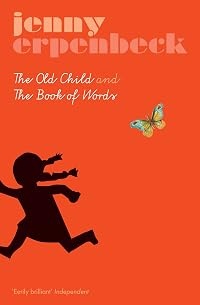
The Old Child and the Book of Words
by Jenny Erpenbeck
On This Page
Description
Brings together two imaginative tales in one volume.Tags
Recommendations


















Member Recommendations
rrmmff2000 Unsettling narratives and fantastic writing about teenaged girls growing up muffled from the world.
Member Reviews
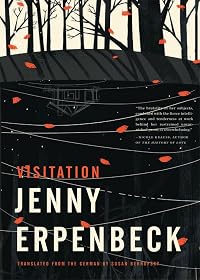
Jenny Erpenbeck is now better known for her more recent books The End of Days and Visitation. This edition contains two of her early novellas. They share certain similarities, they are centred on girls who are never named, and concern forms of loss and identity, and both must to some extent reflect Erpenbeck's childhood in East Germany.
The Old Child (3.5/5)
This is an austere and rather unsettling tale of a girl who appears to have lost her memory and taken into a children's home, where she effectively effaces all traces of her personality while obeying rules and the commands of her classmates rigidly.
The Book of Words (4.5/5)
This is much richer, darker and ultimately disturbing. Initially it appears to be the world as seen by a young show more child, trying to make sense of words and idioms, but it soon becomes clear that something is wrong.
Set in an unnamed South American country that is largely based on Argentina, much of what passed for normality starts to disappear - people, shops, railways, and though the various stories the girl is told are initially taken at face value, it eventually becomes clear that the girl's privileged parents are deeply involved in the disappearances and atrocities.
This is a dark allegorical fable whose anonymised setting and use of German nursery rhymes, folk sayings and other idioms suggest that it is as much about Germany as about Latin America. As in Visitation she also uses repetition very effectively. The folk material is so untranslatable that the translator felt it necessary to add a postscript explaining the contextual background.
PS One minor irritation is the font used in this book - it uses a hyphen that is almost diagonal and there are a lot of hyphenated words, so this is rather distracting... show less
The Old Child (3.5/5)
This is an austere and rather unsettling tale of a girl who appears to have lost her memory and taken into a children's home, where she effectively effaces all traces of her personality while obeying rules and the commands of her classmates rigidly.
The Book of Words (4.5/5)
This is much richer, darker and ultimately disturbing. Initially it appears to be the world as seen by a young show more child, trying to make sense of words and idioms, but it soon becomes clear that something is wrong.
Set in an unnamed South American country that is largely based on Argentina, much of what passed for normality starts to disappear - people, shops, railways, and though the various stories the girl is told are initially taken at face value, it eventually becomes clear that the girl's privileged parents are deeply involved in the disappearances and atrocities.
This is a dark allegorical fable whose anonymised setting and use of German nursery rhymes, folk sayings and other idioms suggest that it is as much about Germany as about Latin America. As in Visitation she also uses repetition very effectively. The folk material is so untranslatable that the translator felt it necessary to add a postscript explaining the contextual background.
PS One minor irritation is the font used in this book - it uses a hyphen that is almost diagonal and there are a lot of hyphenated words, so this is rather distracting... show less
The volume contains two novellas on simialr themes of girls growing up, memory and distancing from the society they live in. Both are unsettling, but compelling.
The Old Child has a girl found and then brought up in a "home" with other children.She has no memory, even of her name, and instinctively aims not to be noticed. She is muffled or blurred from the world around her, though gradually comes to learn its ways and how to get on. Later there is illness and accelerated aging. The book won't be pinned down, but certainly one reading is various societies' (including Germany's given the author's nationality) numbness and shock from their recent histories, and a painful letting go of innocence.
The Book of Words has a girl in an unnamed show more country among her small circle of family and friends, though it is never quite explained where they are. Unsettling things happen to both girl and reader as language and people shift or disappear. Again, deliberately set no particular place, the reader can overlay various or no interpretations upon it. For me it hints at living in oppresive societies, but with a self-distancing and denial, and there are of course numerous times and places this applies to.
This is strong writing and translation (by Susan Bernofsky), which makes the reader sit up and listen even if they don't like or fully understand what they are hearing. show less
The Old Child has a girl found and then brought up in a "home" with other children.She has no memory, even of her name, and instinctively aims not to be noticed. She is muffled or blurred from the world around her, though gradually comes to learn its ways and how to get on. Later there is illness and accelerated aging. The book won't be pinned down, but certainly one reading is various societies' (including Germany's given the author's nationality) numbness and shock from their recent histories, and a painful letting go of innocence.
The Book of Words has a girl in an unnamed show more country among her small circle of family and friends, though it is never quite explained where they are. Unsettling things happen to both girl and reader as language and people shift or disappear. Again, deliberately set no particular place, the reader can overlay various or no interpretations upon it. For me it hints at living in oppresive societies, but with a self-distancing and denial, and there are of course numerous times and places this applies to.
This is strong writing and translation (by Susan Bernofsky), which makes the reader sit up and listen even if they don't like or fully understand what they are hearing. show less
Two totally different stories under one cover - I assume they have always been published this way, rather than this being a small compilation of the author's work. Fittingly, there are two distinct possibilities here. One is that the book is an important and profound work of massive complexity and deep meaning which I am too much of a dullard to understand. The other is that this is a work of unrelenting tedium which sets its readers to climb a sheer cliff face without providing any of the traditional handholds (physical description, dialogue) that enable them to get a grip on the plot, and which requires a translator's note just to explain where the bloody thing is set. Yes, it's one of the two but I genuinely don't know which. What I show more do know for sure is that I didn't enjoy it. show less
This book is two novellas.
The Old Child - this novella engaged me most easily. This is a dark novel that has a simplicity that hides this darkness. Beautifully written, we meet a child, who is found standing alone with a bucket, and is sent to the children's home. She appears to be traumatised to the extent that she does little to socialise with her peers, obeys all the rules to the letter and literally keeps her head down to be unnoticed. Although only 107 pages Jenny Erpenbeck can pack more into those pages than other writers of less calibre. Although at first the story seems simple enough the horror of the girl's story unfolds. There are glimpses of kindness in the story, as well as horror but the girl is difficult to reach. This is show more a quiet and disturbing novel that deserves reading. I did however, find it very sad.
The Book of Words - I found this more difficult to understand and only after reading the translators note at the end did I really get what was going on. Again we are reading from a child's perspective and again horror is revealed as we read, although this is more in evidence from the start. From the beginning this novel of 120 or so pages is deliberately confusing and disturbing. People disappear and continue to haunt the young girl. The novel uses repetition to add to the disorientation the reader feels. There are references to fairy tales and rhymes as you would expect in a German novel. The horror is more graphically portrayed in this story and the reader has to face this head on. I was searching this novel for references of the geography of the story but didn't get from the saints name and the constant sun that we were in South America but with a community with a German heritage, this was the land where it snowed. Reading this at the end helped it to make more sense. show less
The Old Child - this novella engaged me most easily. This is a dark novel that has a simplicity that hides this darkness. Beautifully written, we meet a child, who is found standing alone with a bucket, and is sent to the children's home. She appears to be traumatised to the extent that she does little to socialise with her peers, obeys all the rules to the letter and literally keeps her head down to be unnoticed. Although only 107 pages Jenny Erpenbeck can pack more into those pages than other writers of less calibre. Although at first the story seems simple enough the horror of the girl's story unfolds. There are glimpses of kindness in the story, as well as horror but the girl is difficult to reach. This is show more a quiet and disturbing novel that deserves reading. I did however, find it very sad.
The Book of Words - I found this more difficult to understand and only after reading the translators note at the end did I really get what was going on. Again we are reading from a child's perspective and again horror is revealed as we read, although this is more in evidence from the start. From the beginning this novel of 120 or so pages is deliberately confusing and disturbing. People disappear and continue to haunt the young girl. The novel uses repetition to add to the disorientation the reader feels. There are references to fairy tales and rhymes as you would expect in a German novel. The horror is more graphically portrayed in this story and the reader has to face this head on. I was searching this novel for references of the geography of the story but didn't get from the saints name and the constant sun that we were in South America but with a community with a German heritage, this was the land where it snowed. Reading this at the end helped it to make more sense. show less
I have reviewed both books separately and they can be found at these two sites:
http://mewlhouse.hubpages.com/t/2ee1c2
http://hubpages.com/t/2daae9
http://mewlhouse.hubpages.com/t/2ee1c2
http://hubpages.com/t/2daae9
Ratings
Members
- Recently Added By
Published Reviews
A mixed review... good writing, but hard to handle
added by michalsuz
Author Information

23+ Works 4,117 Members
Jenny Erpenbeck was born on March 12, 1967 in East Berlin. She is a German director and writer. In Berlin she attended an Advanced High School, where she graduated in 1985. She then completed a two-year apprenticeship as a bookbinder before working at several theaters as props and wardrobe supervisor. From 1988 to 1990 Erpenbeck studied theatre at show more the Humboldt University of Berlin. In 1990 she changed her studies to Music Theater Director studying with Ruth Berghaus. After the completion of her studies in 1994 she spent some time as an assistant director at the opera house in Graz, where in 1997 she did her own productions of Schoenberg's Erwartung, Bartók's Duke Bluebeard's Castle and a world premiere of her own piece Cats Have Seven Lives. As a freelance director, she directed in 1998 different opera houses in Germany and Austria, including Monteverdi's L'Orfeo in Aachen, Acis and Galatea at the Berlin State Opera and Wolfgang Amadeus Mozart's Zaide in Nuremberg/Erlangen. In the 1990s Erpenbeck started a writing career in addition to her directing. She is author of narrative prose and plays: in 1999, History of the Old Child, her debut; in 2001, her collection of stories Trinkets; in 2004, the novella Dictionary; and in February 2008, the novel Visitation. In March 2007, Erpenbeck took over a column by Nicole Krauss in the Frankfurter Allgemeine Zeitung. In 2015 won the Independent Foreign Fiction Prize with her title The End of Days. (Bowker Author Biography) show less
Some Editions
Work Relationships
Contains
Classifications
Statistics
- Members
- 45
- Popularity
- 661,934
- Reviews
- 5
- Rating
- (3.50)
- Languages
- English
- Media
- Paper, Ebook
- ISBNs
- 1
- ASINs
- 1