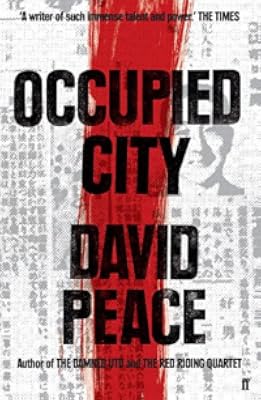
On This Page
Description
On January 26, 1948, a man identifying himself as a public health official arrives at a bank in Tokyo. He explains that there has been an outbreak of dysentery in the neighborhood, and he has been assigned by Occupation authorities to treat everyone who might have been exposed to the disease. Soon after drinking the medicine he administers, twelve employees are dead, four are unconscious, and the "official" has fled. Twelve voices tell the story of the murder from different perspectives. show more Each voice enlarges and deepens the portrait of a city and a people making their way out of a war-induced hell. show lessTags
Recommendations






Member Reviews
This book uses twelve different viewpoints to tell the story of the Teikoku Bank Massacre, which took place on 26 January 1948 in Tokyo. A man posing as a public health official played on fears of dysentery outbreaks to persuade 16 bank employees to drink poison. Of the 16 employees, 12 died, and the fake health official took advantage of their situation to steal money from the bank.
The story is told using the framing device of a ghost-story-telling session with “you” (the author) in a dark room lit only by 12 candles, while a medium introduces each of the different voices. As each story ends, another candle is blown out. Peace is known for this type of experimental storytelling, and he succeeds admirably in using this device to show more build a chilling atmosphere. I also like that he chose to shine the spotlight on a lesser-known event and a time and place that most people in the West don’t think of: post-WW2 Japan. Reading this makes me want to read more about the Pacific theatre in the war and about the country’s history after the war.
I must confess that I made it only to the eighth or ninth candle before I had to stop; not because the story was so scary, but because I felt I’d absorbed enough of the atmosphere and had sufficient viewpoints to appreciate the story. Peace is about the most experimental writer I read, and reading his work is always an interesting challenge, even if I don’t finish.
I would recommend this if you like challenge in your reading or want to read a story about post-war Japan. show less
The story is told using the framing device of a ghost-story-telling session with “you” (the author) in a dark room lit only by 12 candles, while a medium introduces each of the different voices. As each story ends, another candle is blown out. Peace is known for this type of experimental storytelling, and he succeeds admirably in using this device to show more build a chilling atmosphere. I also like that he chose to shine the spotlight on a lesser-known event and a time and place that most people in the West don’t think of: post-WW2 Japan. Reading this makes me want to read more about the Pacific theatre in the war and about the country’s history after the war.
I must confess that I made it only to the eighth or ninth candle before I had to stop; not because the story was so scary, but because I felt I’d absorbed enough of the atmosphere and had sufficient viewpoints to appreciate the story. Peace is about the most experimental writer I read, and reading his work is always an interesting challenge, even if I don’t finish.
I would recommend this if you like challenge in your reading or want to read a story about post-war Japan. show less
On January 26, 1948, someone posing as a health officer entered the Teikoku Bank in a Tokyo suburb and simultaneously poisoned 16 people, 12 of whom died. After an extensive police investigation, Hirasawa Sadamichi, a tempera painter, was arrested and convicted of the murders. His guilt was immediately called into question. While he was never executed for the murders, he did eventually die in prison at the age of ninety-five. Efforts to clear his name continue to this day.
The case forms the basis of David Peace's novel Occupied City, a crime-thriller unlike any I've ever read. Mr. Peace writes crime novels, but he is as interested in prose style as he is in crime. Occupied City is structured like the Japanese classic Rashomon, by show more Akutagawa Ryunosuke, a crime story told from multiple points of view. In Rashomon, each character, a witness, the suspects and the ghost of the victim, give their version of what happened, but each skews their account to make themself look good. The witness assures us that even the ghost of the victim lies to make herself look better.
Mr. Peace structures his novel as a series of opposing narratives. The victims speak with one collective voice. A police investigator gives his account. A survivor tells us what she saw. An occult investigator gives an account. But this is not where Mr. Peace's interest in prose style ends. Each chapter takes a different form as well. An American army doctor presents his version in a series of letters to his wife back home and to his superior officers. We are shown what details he erased through the use of strike through type. The police officers present their story in the form of notes in their log books. One character speaks through prose poetry. The resulting affect is that the reader must find a way to read each account.
Take this passage for example. How do you read this passage?
3. I stand in the Seibo Catholic Hospital, by the beds of the four survivors crawling out of hell, on their hands, on their knees THE CRIME SCENE IN MY MIND Nuns stick hoses down their throats, doctors pump out their stomachs down the bank's corridors, into the bank's genkan THE CASH ON THE DESKS, THE VAULT DOORS WIDE OPEN I watch them wretch, fluid and bile through the doors, into the street, the snow and the mud NOTHING OUT OF PLACE, NOTHING BUT THEIR BODIES I wait for them to wake, I wait for them to speak on their hands, on their knees THE SOUND OF RUNNING WATER, THE DIRTY CUPS BEING WASHED Beside their beds, beside their lips it was the drink, it was medicine, a doctor, dysentery THE CRIME SCENE CONTAMINATED
For the longest time I tried to read this chapter as it was, ignoring the use of differing type faces. If you try reading it that way, the effect is like the work of early 20th century Dadaist art, seemingly random groups of words arranged for an emotional impact. Halfway through this chapter I tried reading each type face seperately. Try it yourself now and see what you think.
It's not often that one finds a police procedural attempting experiments in form let alone in the use of prose. I wonder how this affects Mr. Peace's work. I imagine that many readers of police procedurals do not look kindly on prose experimentation. Many of my friends who read mysteries run screaming from the slightest ambiguity. Readers of literary fiction who seek out prose experimentation tend to avoid mystery novels altogether let alone forms as predictable as police procedurals. Where does this leave a book like Occupied City?
As a crime thriller/police procedural Occupied City presents a fascinating case, one made more interesting by its exotic setting--Tokyo in the aftermath of World War II. As a piece of prose experimentation, I enjoyed it. It's nice to find a piece of writing that I can't figure out right away even after 41 years of reading. show less
The case forms the basis of David Peace's novel Occupied City, a crime-thriller unlike any I've ever read. Mr. Peace writes crime novels, but he is as interested in prose style as he is in crime. Occupied City is structured like the Japanese classic Rashomon, by show more Akutagawa Ryunosuke, a crime story told from multiple points of view. In Rashomon, each character, a witness, the suspects and the ghost of the victim, give their version of what happened, but each skews their account to make themself look good. The witness assures us that even the ghost of the victim lies to make herself look better.
Mr. Peace structures his novel as a series of opposing narratives. The victims speak with one collective voice. A police investigator gives his account. A survivor tells us what she saw. An occult investigator gives an account. But this is not where Mr. Peace's interest in prose style ends. Each chapter takes a different form as well. An American army doctor presents his version in a series of letters to his wife back home and to his superior officers. We are shown what details he erased through the use of strike through type. The police officers present their story in the form of notes in their log books. One character speaks through prose poetry. The resulting affect is that the reader must find a way to read each account.
Take this passage for example. How do you read this passage?
3. I stand in the Seibo Catholic Hospital, by the beds of the four survivors crawling out of hell, on their hands, on their knees THE CRIME SCENE IN MY MIND Nuns stick hoses down their throats, doctors pump out their stomachs down the bank's corridors, into the bank's genkan THE CASH ON THE DESKS, THE VAULT DOORS WIDE OPEN I watch them wretch, fluid and bile through the doors, into the street, the snow and the mud NOTHING OUT OF PLACE, NOTHING BUT THEIR BODIES I wait for them to wake, I wait for them to speak on their hands, on their knees THE SOUND OF RUNNING WATER, THE DIRTY CUPS BEING WASHED Beside their beds, beside their lips it was the drink, it was medicine, a doctor, dysentery THE CRIME SCENE CONTAMINATED
For the longest time I tried to read this chapter as it was, ignoring the use of differing type faces. If you try reading it that way, the effect is like the work of early 20th century Dadaist art, seemingly random groups of words arranged for an emotional impact. Halfway through this chapter I tried reading each type face seperately. Try it yourself now and see what you think.
It's not often that one finds a police procedural attempting experiments in form let alone in the use of prose. I wonder how this affects Mr. Peace's work. I imagine that many readers of police procedurals do not look kindly on prose experimentation. Many of my friends who read mysteries run screaming from the slightest ambiguity. Readers of literary fiction who seek out prose experimentation tend to avoid mystery novels altogether let alone forms as predictable as police procedurals. Where does this leave a book like Occupied City?
As a crime thriller/police procedural Occupied City presents a fascinating case, one made more interesting by its exotic setting--Tokyo in the aftermath of World War II. As a piece of prose experimentation, I enjoyed it. It's nice to find a piece of writing that I can't figure out right away even after 41 years of reading. show less
Peace's books are a seriously hard read. It takes quite a while to get used to the idiosyncratic styles he adopts in his various books. But, they are worth every bit of effort you put into them. This story is about the post-war fall-out of the Japanese biological warfare experiments undertaken in China around Nanking mostly. A fascinating book that led me to read much more on this topic. It was particularly interesting given the sympathetic tone given to the Japanese and the post Hiroshima trauma he covered in his first novel in this series.
David Peace’s novels have been recognized for the somber grays and blacks in which he paints his characters and stories. He is certainly the noirest of today’s writers. With Occupied City, the second of a promised trilogy set in post-war Tokyo, he’s let the scene-setting and the grimness take over. Character development and plot are thrown overboard for the sake of the repetitive thrum of bleak phrases. On the cover, it says “a novel.” This is not accurate: a mood is not a novel.
The story, where it sticks through, is about a crime in which the employees of a bank branch are poisoned by a man posing as a government doctor. But none of the characters ever becomes real enough to engage the reader, who is too busy anyway fighting show more to get through the author’s experiments with text – for example, mixing multiple narrative threads by shifting among normal, ALL-CAPS, italics, andstrike-throughs. There are pages of repetitive boilerplate, like a school theme being padded out to the required length. In all, a lazy job -- I think it was a harder book to read than to write. For this reader, it was the second and last of the trilogy. show less
The story, where it sticks through, is about a crime in which the employees of a bank branch are poisoned by a man posing as a government doctor. But none of the characters ever becomes real enough to engage the reader, who is too busy anyway fighting show more to get through the author’s experiments with text – for example, mixing multiple narrative threads by shifting among normal, ALL-CAPS, italics, and
Essentially, a failure. In Occupied City, David Peace allows form to overwhelm content to the point the story becomes lost and uninteresting. Peace is not as daring and innovative as he seems to imagine; otherwise, he would have brought more control to this novel. I have seen this before in genre writers who simply can't let an initial insight go--it was common in science fiction writers in the late 1960s and 1970s. The obsession with an elliptical form to the point of indifference. I can see how this might appeal to first year graduate students in a literature program who have just discovered modern and post-modern challenges. But it really is imitative. And the tone is monotonous.
mmm, well what to say? I enjoyed Tokyo Year Zero a great deal - the experimentation with form helped add to the feeling of brooding and collapse that underpinned the whole story. With this one though, I thought the experimentation undermined the atmosphere. Whilst I appreciate the attempt to recreate the style of Rashomon, and understand that every character would have a different perspective, none the less I couldn't work out the point of some of the characters at all. The Russian who suddenly appears as Voice Seven. The unnamed boss - the same boss as from Tokyo Year Zero? It seemed so - all of these took me on not particularly rewarding flights of speculation.
And in the bridge sections between voices it seems as though Peace himself show more - if he is the writer referred to and presumably he is - seems to despair himself of properly tying the whole thing together
It held my attention - but ultimately left me unsatisfied. But a worthy attempt. show less
And in the bridge sections between voices it seems as though Peace himself show more - if he is the writer referred to and presumably he is - seems to despair himself of properly tying the whole thing together
It held my attention - but ultimately left me unsatisfied. But a worthy attempt. show less
This book is written in a really interesting and innovative way. A really good read for a book group there is a lot to discuss.
Members
- Recently Added By
Published Reviews
ThingScore 75
Occupied City is relentless with grief, giving us character after character broken by circumstance and cast adrift in a new order where all the allegiances and connections that once glued things together have been rendered meaningless. This is a novel as much about the sadness of the world as about the ugliness of the world—a specifically modern sadness, rooted as it is in a terrifying show more loneliness. show less
added by Shortride
Lists

Global Reads: Books Set in East Asia
139 works; 12 members
Author Information

19+ Works 5,478 Members
Awards and Honors
Distinctions
Series

Common Knowledge
- Canonical title
- Occupied City
- Original publication date
- 2009
- Important places*
- Tokyo, Japan
- Dedication*
- Voor mijn moeder
- First words*
- In de bezette stad ben je een schrijver en ren je weg -
- Last words*
- (Click to show. Warning: May contain spoilers.)En ze heeft je vastgebonden aan een stoel, vastgebonden aan een bureau, een pen aan je handen genageld, aan je vingers geketend,
en het leven lekt, de dood druppelt,
maar niet in inkt, in tranen,
in tranen en in waarheid,
eindelijk, eindelijk,
geen kostuums meer en geen maskers, geen acteurs meer en geen personages, geen verhalen meer en geen leugens, het boek altijd, allang geschreven,
geschreven en opgegeven,
in-censuur. - Disambiguation notice*
- original title: Occupied City
*Some information comes from Common Knowledge in other languages. Click "Edit" for more information.
Classifications
Statistics
- Members
- 350
- Popularity
- 90,196
- Reviews
- 9
- Rating
- (3.23)
- Languages
- 8 — Dutch, English, French, German, Italian, Portuguese, Spanish, Swedish
- Media
- Paper, Audiobook, Ebook
- ISBNs
- 27
- ASINs
- 3