Almost to Freedom
by Vaunda Micheaux Nelson
On This Page
Description
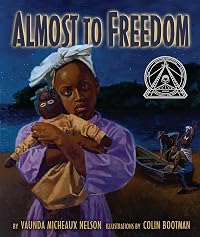
Tells the story of a young girl's dramatic escape from slavery via the Underground Railroad, from the perspective of her beloved rag doll.Tags
Recommendations
Member Reviews
Almost to Freedom is an imaginative story of the Underground Railroad told from the POV of a rag doll who becomes an observer to all the things that are happening to her little girl, Lindy, and her family. She sees Lindy’s father taken away for trying to escape, and then sees Lindy beaten by the plantation’s overseer. Then one night, Lindy and her mother steal away and are later reunited with her father, before taking a dangerous journey across the river and through the woods to a home where kind white people hide them in their cellar. But when slave catchers come searching, they, once again, run, leaving the little doll behind, wondering what’s next for her.
I’ve been searching for good diverse children’s literature that will show more teach kids about various aspects of history, and I can say that this would be a good book to help them learn about slavery and the Underground Railroad. It can be difficult to find a balance between a story being realistic but also appropriate for younger readers, and I think this one found that balance. It shows how slaves were mistreated and the dangerous reality of attempting escape, but manages to do so in a relatively gentle way that hopefully wouldn’t upset children. This is accomplished in part by telling the story from the doll’s POV, which is definitely an imaginative and different way to narrate. Colin Bootman’s illustrations won the Coretta Scott King Award and I can see why. They are extremely well-drawn and a beautiful complement to the story. My only issue with the book is that, because the little doll was dropped in their haste to leave, the reader never finds out what happened to Lindy and her family. After reading the author’s note at the end of the story, which explains her inspiration for writing it, I understood why she wrote it the way she did, but I still couldn’t help being just a little disappointed. Otherwise, Almost to Freedom is a good book that I would recommend to anyone who wants to teach kids about slavery and the Underground Railroad. show less
I’ve been searching for good diverse children’s literature that will show more teach kids about various aspects of history, and I can say that this would be a good book to help them learn about slavery and the Underground Railroad. It can be difficult to find a balance between a story being realistic but also appropriate for younger readers, and I think this one found that balance. It shows how slaves were mistreated and the dangerous reality of attempting escape, but manages to do so in a relatively gentle way that hopefully wouldn’t upset children. This is accomplished in part by telling the story from the doll’s POV, which is definitely an imaginative and different way to narrate. Colin Bootman’s illustrations won the Coretta Scott King Award and I can see why. They are extremely well-drawn and a beautiful complement to the story. My only issue with the book is that, because the little doll was dropped in their haste to leave, the reader never finds out what happened to Lindy and her family. After reading the author’s note at the end of the story, which explains her inspiration for writing it, I understood why she wrote it the way she did, but I still couldn’t help being just a little disappointed. Otherwise, Almost to Freedom is a good book that I would recommend to anyone who wants to teach kids about slavery and the Underground Railroad. show less
“Almost to Freedom” was an excellent book, unlike any that I have ever read before. I liked the book for the storyline but mostly I liked it for the way in which it was written. The story was written from the perspective of a little slave girl’s doll, named Sally. Sally recounts her life with her owner, named Lindy, and their journey to freedom. Sally describes Lindy’s life and the cruelty she faces as a slave. However, one day Lindy’s family escapes and finds refuge in the cellar of a white family who agrees to hide them before they journey to the Underground Railroad. When slave catchers raid the house Lindy’s family is staying in, they flee, mistakenly leaving Sally behind. Sally then lives many years alone and lonely in show more the white family’s cellar until a new family of slaves on the run appear, and a little girl adopts Sally as her own doll. Sally delights in this and says, “I’s mighty glad to be Willa’s doll baby. It’s a right important job.” Not only did I like that the story was written from the perspective of a doll, I also liked how Sally spoke. Sally’s dialect was exactly how slaves would have been during that time period. She said things like, “I started out no more’n a bunch of rags on a Virginia plantation. Lindy’s mama was my maker. Miz Rachel done a fine job puttin’ me together, takin’ extra time to sew my face on real careful with thread, embroidery they call it.” Because Sally spoke this way it made what she had to say very realistic, heightening the authenticity of the book. I believe the main idea of; “Almost to Freedom” was to give readers a very realistic recounting of the hardships and cruelties slaves faced from the perspective of a very unique narrator. In the author’s note the author describes her inspiration for writing, “Almost to Freedom.” She says that she was visiting the Museum of International Folk Art in Santa Fe, New Mexico and came across a display of black rag dolls from the 1800s and 1900s. She said the dolls immediately caught her attention and was told many of them were found in one of the hideouts of the Underground Railroad, suggesting their use by black children. Her husband told her that there was a story in that and she thought, “if only those dolls could talk.” This is exactly what the author did and how she created the main idea of her story. She gave life to an inanimate object that probably saw it all and comforted many scared children. Sally was the perfect narrator for such a heroic story and gave an honest and open portrayal of what the life of a slave might actually be like. show less
This book has earned the Coretta Scott King Award and I think it definitely deserved it. A little girl named Lindy is given a doll named Sally by her mother. Sally goes everywhere that Lindy goes. One night Sally joins Lindy and her mother in an adventure to escape for freedom. This detailed, informative, heartwarming story about Lindy and her moms courageous escape through the Underground Railroad is a great story for students to read. It shows the use of language used back in the day and how life was for African American families. It shows the freedom they had to fight for and the courage they showed throughout that process. If you are teaching your students about culture, the Underground Railroad, or freedom, this is the book to show more read. When I read this book I almost put myself in the dolls shoes. I wasn't experiencing what they went through, but it opened my eyes to their thoughts and feelings through this hard time. show less
This Coretta Scott King award-winning book teaches about the underground railroad. Told from the unique perspective of a hand-made doll, called Sally by her owner Lindy, Sally witnesses the beating of the young girl who is her owner. The doll also tells the tale of Lindy's father who is severely beaten when he tries to escape and find a way for his family to become connected to the underground railroad.
The story gives credit to white people who risked their property and lives by helping those who desperately need to flee from the brutal life of long days working in the fields picking cotton with no water and very little food, and the harsh treatment by those who claim to "own" those who work for them.
When the ability for the family to show more flee occurs, they are almost discovered in the cellar of those who are helping them. In rushing to escape, the doll is left behind. Later, another young girl whose family is also finding freedom by the help of kind people who run the "railroad" to freedom in the northern states. show less
The story gives credit to white people who risked their property and lives by helping those who desperately need to flee from the brutal life of long days working in the fields picking cotton with no water and very little food, and the harsh treatment by those who claim to "own" those who work for them.
When the ability for the family to show more flee occurs, they are almost discovered in the cellar of those who are helping them. In rushing to escape, the doll is left behind. Later, another young girl whose family is also finding freedom by the help of kind people who run the "railroad" to freedom in the northern states. show less
A story of the Underground Railroad, told from the perspectve of a child traveler's doll. The fact that this story is told through the eyes of the doll can make it more relatable to children. Perhaps they can’t imagine life as a slave, but they can relate to the love between a child and her toy. At the same time, though, this distances the reader from the danger occurring as she is not exposed to the young girl’s fear, just the doll’s fear, a step removed. At one point, it is mentioned that the girl’s father has been taken away. Normally, this would be anxiety-provoking, but because of this step removed approach, this is not so emotional. The different point of view also allows the glossing over of the entire plot. Because the show more doll does not directly experience slavery or the escape for freedom, the reader does not get the full experience of these events. The pictures, full of saturated colors and looking almost like paintings, do add to this, giving the story a depth that the text doesn’t. These images tell more than the words, showing the sadness and loneliness felt. However, they don’t completely make up for the lack. While the story has potential, in the end, it misses the mark. show less
Summary: Almost to Freedom by Vaunda Micheaux Nelson tells the story of how Lindy and her family live as slaves picking cotton on a Virginia plantation, and how they escape through the Underground Railroad. The story is told through the eyes of Lindy’s doll Sally. The doll tells of how she was made by Lindy’s mother “Miz Rachel”, given to Lindy, and how she was taken everywhere with Lindy. The doll tells of how they picked cotton, how the “Massa” treated them, and how they escape through the night and made their way to the Underground Railroad. Sally gets left behind in an escape from the safe house by accident, and later retrieved by another girl who names her Belinda. The author uses the language of African-American slaves show more to make the story more real. The dark vivid illustrations help tell the story. The author’s notes tell of her inspiration for the story, and what is fact and what is fiction. The book gives a historical account of the Underground Railroad.
Personal reaction: I thought it was really unique to tell the story from the doll’s point of view. I don’t recall ever reading anything told from this perspective. Although Sally doesn’t know what the people think and feel, you get it from the doll’s descriptions, and the books illustrations to know what is going on in the story. I would recommend this book not only for the content, but also the unique experience of the story being told by the doll.
Classroom extension: 1. I would use this book in a study about slavery. The students could tell about a time they had to escape from something. 2. This book could also be used during Black History Month. 3. Another use for this book could be agriculture, plantations, and the American South. show less
Personal reaction: I thought it was really unique to tell the story from the doll’s point of view. I don’t recall ever reading anything told from this perspective. Although Sally doesn’t know what the people think and feel, you get it from the doll’s descriptions, and the books illustrations to know what is going on in the story. I would recommend this book not only for the content, but also the unique experience of the story being told by the doll.
Classroom extension: 1. I would use this book in a study about slavery. The students could tell about a time they had to escape from something. 2. This book could also be used during Black History Month. 3. Another use for this book could be agriculture, plantations, and the American South. show less
Tells the story of a young girl's dramatic escape from slavery via the Underground Railroad, from the perspective of her beloved rag doll.
Genre: Historical Fiction
Critique:
1) This is a good example of historical fiction because it is definitely both a good story and good and accurate history. This story takes place over one hundred years ago and while it is about fictional people and events, they are completely based out of what actually happened with the Underground Railroad and could have actually happened.
2) The point of view in this story is from a rag doll that belonged to a slave girl named Lindy. While this is not necessarily realistic, this point of view is what makes this story interesting and enables it to follow multiple show more stories. A doll is something that never dies and is allows getting to observe (in theory) and therefore is a great witness and narrator. The doll is able to take the reader through one families move, then when it gets left at a Safe Home and found by another child, through their story. Because the doll gets left, it leaves the first families outcome (whether they were safe or not) uncertain, which adds to the true reality of the time that some died and others didn't (without being overly optimistic or morbid). show less
Genre: Historical Fiction
Critique:
1) This is a good example of historical fiction because it is definitely both a good story and good and accurate history. This story takes place over one hundred years ago and while it is about fictional people and events, they are completely based out of what actually happened with the Underground Railroad and could have actually happened.
2) The point of view in this story is from a rag doll that belonged to a slave girl named Lindy. While this is not necessarily realistic, this point of view is what makes this story interesting and enables it to follow multiple show more stories. A doll is something that never dies and is allows getting to observe (in theory) and therefore is a great witness and narrator. The doll is able to take the reader through one families move, then when it gets left at a Safe Home and found by another child, through their story. Because the doll gets left, it leaves the first families outcome (whether they were safe or not) uncertain, which adds to the true reality of the time that some died and others didn't (without being overly optimistic or morbid). show less
Members
- Recently Added By
Published Reviews
ThingScore 100
This story is set in the 1800s. It is about a girl named Lindy and her family’s Underground Railroad experience. The book is told through the eyes of Lindy’s beloved rag doll, Sally. Lindy’s mom, Miz Rachel, makes Sally, and she and Lindy instantly become best friends: they eat, sleep, and even pick cotton on the plantation together. Wherever Lindy goes, so does Sally. So, when Lindy’s show more family decides to escape to freedom, Sally goes along to. One night while hiding in a basement, slave catchers approach. In a haste to leave, Sally is left behind. Sally is alone in the dark basement, and she worries that she will never be found. But soon, another escaping family comes along. Sally becomes the new owner of Willa, who changes her name to Belinda. show less
added by CourtneyRice15
As she explains in an author's note, Nelson... was inspired to write this story by a folk art museum's exhibit of black rag dolls, a few of which were discovered in Underground Railroad hideouts. Narrating this touching tale is a doll named Sally.... Through Sally's perceptive eyes, readers catch a hard-hitting glimpse of slave life.... A captivating account of escape via the Underground show more Railroad includes many suspenseful moments, among them a hasty departure from a safehouse that results in Lindy's inadvertently leaving Sally behind. ... Nelson's writing is immediate and often lyrical. Yet it is Bootman's... realistic paintings, distinctive for their skillful use of light and darkness, that best convey the story's pathos and urgency. Ages 6-10. show less
added by CourtyardSchool
Author Information

All Editions
Awards and Honors
Common Knowledge
- Canonical title
- Almost to Freedom
- People/Characters
- Lindy; Miz Rachel; Sally (Doll); Mr. Henry
- Important places
- Virginia, USA
- Important events
- Underground Railroad
- Epigraph
- A doll is a witness who cannot die, with a doll you are never alone. --Margaret Atwood
- Dedication
- For Ashley -Vaun
For my best friend, Keith Anthony Jones, and Adjuda Thomas and her family. Also, special thanks to Yaneek Cambell and Ansel Pitcairn. This book would not have been possible without their help.
-Colin - First words
- I started out no more'n a bunch of rags on a Virginia plantation.
- Last words
- (Click to show. Warning: May contain spoilers.)It's a right important job.
- Original language
- English
Classifications
Statistics
- Members
- 579
- Popularity
- 50,776
- Reviews
- 34
- Rating
- (4.44)
- Languages
- English
- Media
- Paper, Ebook
- ISBNs
- 8
- ASINs
- 3