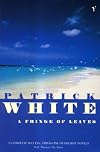
A Fringe of Leaves
by Patrick White
On This Page
Description
Returning home to England from Van Diemen's land, the Bristol Maid is shipwrecked on the Queensland coast and Mrs Roxburgh is taken prisoner by a tribe of Australian Aboriginals, along with the rest of the passengers and crew. In the course of her escape, she is torn by conflicting loyalties, to her dead husband, to her rescuer, to her own and to her adoptive class.Tags
Recommendations


















Member Reviews
10/10
10/10
It's been a week since I finished this book, and I still feel somewhat bloated: my mind, and not my innards, still distended by almost countless images that haunt me. I imagine my mind looks something like this right now:
I wonder if this particular (mental) cobra will ever be able to digest all that Patrick White packs in this novel. (I started by giving him a mere 8.5 -- but who am I kidding?)
It's an historical novel, on the surface of it, about a 19th century shipwreck (fact) and what happens to the crew and passengers after the ship runs aground on a coral reef of what is now Fraser Island, off the coast of Queensland. Based on the experiences of Eliza Fraser, who is the real-life model for the protagonist, Patrick White show more spins a tale of such overwhelming complexity that it will ever be impossible to separate fact from fiction after this.
After running aground on the isle that now bears her name, Eliza Fraser was "kidnapped" by an aboriginal tribe who, according to her narrative, tortured her, savaged her, almost beyond human endurance. She (again according to her testimony) only escaped with her life by the grace of an escaped convict who had been living on the island for some years, took pity on her, and led her to a white settlement. Her testimony led to the near-extermination of the tribe which had "captured" her, despite ample documentation by other wayfarers that this was a peaceable tribe which welcomed all who crossed their paths. The historical facts are so convoluted, and so sullied by multiple layers of liars that it will forever be impossible to know for certain what happened on the island. Still, what remains with a haunting vengeance is that Eliza Fraser knew how to land on her feet every step of the way, so it is more than likely that history will eventually speak against her.
While White takes us around and around the facts of Fraser's life, sometimes dancing very near to the facts, sometimes straying into wildest fiction, the story reveals itself to be even more complex than the historical figure upon whom the novel is based -- for this is not an exploration of Fraser's temporal existence, but an examination of her soul. Or, at least "a" soul of a gentlewoman -- any gentlewoman -- of the 19th century, who is asked to leave all her trappings at the shore, as it were, and step naked into her other self.
Stripped to her (literal) naked self, Ellen Roxburgh, the protagonist gentlewoman, reaches immediately for cover -- the proverbial fig leaf, as she stands, for the first time in her life, truly naked, in thought and in deed. She will be (re)shaped and (re)formed as she steps face-to-face with her primal self.
While she fashions a covering for her body, it is interesting and noteworthy that she hides her wedding ring among the fringe of leaves around her waist, the one element of civilization that she still retains. Holding it as a talisman, perhaps, but still holding it hidden.
On one level, it is a fine re-imagining of Genesis; on another, it is an equally provocative journey into a heart of darkness. Is the woman merely hiding, and ashamed of her nakedness -- of the self that is stripped of all accoutrement and pretension? Or is she afraid of her more repellent self -- the self that will stoop to any level, to survive? Is she simply mimicking primal behaviour in order to "get along" and survive -- or is she succumbing fully to her worst instincts and in so doing, becoming more savage than the "savages"?
White offers a provocative premise: it is exactly the cloak of civilization which elicits her worst possible instincts: those whose pretensions are well polished fall far lower, and degrade themselves more than those who have lived in rhythm with nature all their lives.
Painting by Sidney Nolan, "Mrs. Fraser"
Ellen Roxburgh is eventually "rescued" by a convict and returned to a white settlement, much in the manner that Eliza Fraser was; but unlike Fraser, Ellen seems to have grown spiritually -- for the official records show that Fraser's insistent complaints eventually led to the massacre of the aboriginal tribe. (She also returned to England, remarried and proceeded to extort funds from the government for her suffering, despite questionable proof whether she had indeed suffered at all.)
And that's what makes this novel especially difficult to digest properly: while encountering Ellen's transformative experiences on every page, it was difficult to forget Eliza Fraser, who was juxtaposed at an oblique angle, as a constant arbiter between truth and fiction, for Fraser's own story is as much fiction as is White's -- which leads to the ultimate circular argument that perhaps White got it right after all, and was somehow channelling Fraser's real story. What a conundrum!
This is a story that must be read a few times to bleed out all the nuances.
I leave this review half finished for now.
A Warning Buoy To All Gardeners
[In a rather sardonic tone, I note with some revulsion that there is an immense similarity between an opossum's tail and a dandelion root. I may never be able to look at a dandelion root again without feeling the urge to retch.] show less
10/10
It's been a week since I finished this book, and I still feel somewhat bloated: my mind, and not my innards, still distended by almost countless images that haunt me. I imagine my mind looks something like this right now:
I wonder if this particular (mental) cobra will ever be able to digest all that Patrick White packs in this novel. (I started by giving him a mere 8.5 -- but who am I kidding?)
It's an historical novel, on the surface of it, about a 19th century shipwreck (fact) and what happens to the crew and passengers after the ship runs aground on a coral reef of what is now Fraser Island, off the coast of Queensland. Based on the experiences of Eliza Fraser, who is the real-life model for the protagonist, Patrick White show more spins a tale of such overwhelming complexity that it will ever be impossible to separate fact from fiction after this.
After running aground on the isle that now bears her name, Eliza Fraser was "kidnapped" by an aboriginal tribe who, according to her narrative, tortured her, savaged her, almost beyond human endurance. She (again according to her testimony) only escaped with her life by the grace of an escaped convict who had been living on the island for some years, took pity on her, and led her to a white settlement. Her testimony led to the near-extermination of the tribe which had "captured" her, despite ample documentation by other wayfarers that this was a peaceable tribe which welcomed all who crossed their paths. The historical facts are so convoluted, and so sullied by multiple layers of liars that it will forever be impossible to know for certain what happened on the island. Still, what remains with a haunting vengeance is that Eliza Fraser knew how to land on her feet every step of the way, so it is more than likely that history will eventually speak against her.
While White takes us around and around the facts of Fraser's life, sometimes dancing very near to the facts, sometimes straying into wildest fiction, the story reveals itself to be even more complex than the historical figure upon whom the novel is based -- for this is not an exploration of Fraser's temporal existence, but an examination of her soul. Or, at least "a" soul of a gentlewoman -- any gentlewoman -- of the 19th century, who is asked to leave all her trappings at the shore, as it were, and step naked into her other self.
Stripped to her (literal) naked self, Ellen Roxburgh, the protagonist gentlewoman, reaches immediately for cover -- the proverbial fig leaf, as she stands, for the first time in her life, truly naked, in thought and in deed. She will be (re)shaped and (re)formed as she steps face-to-face with her primal self.
While she fashions a covering for her body, it is interesting and noteworthy that she hides her wedding ring among the fringe of leaves around her waist, the one element of civilization that she still retains. Holding it as a talisman, perhaps, but still holding it hidden.
On one level, it is a fine re-imagining of Genesis; on another, it is an equally provocative journey into a heart of darkness. Is the woman merely hiding, and ashamed of her nakedness -- of the self that is stripped of all accoutrement and pretension? Or is she afraid of her more repellent self -- the self that will stoop to any level, to survive? Is she simply mimicking primal behaviour in order to "get along" and survive -- or is she succumbing fully to her worst instincts and in so doing, becoming more savage than the "savages"?
White offers a provocative premise: it is exactly the cloak of civilization which elicits her worst possible instincts: those whose pretensions are well polished fall far lower, and degrade themselves more than those who have lived in rhythm with nature all their lives.
Painting by Sidney Nolan, "Mrs. Fraser"
Ellen Roxburgh is eventually "rescued" by a convict and returned to a white settlement, much in the manner that Eliza Fraser was; but unlike Fraser, Ellen seems to have grown spiritually -- for the official records show that Fraser's insistent complaints eventually led to the massacre of the aboriginal tribe. (She also returned to England, remarried and proceeded to extort funds from the government for her suffering, despite questionable proof whether she had indeed suffered at all.)
And that's what makes this novel especially difficult to digest properly: while encountering Ellen's transformative experiences on every page, it was difficult to forget Eliza Fraser, who was juxtaposed at an oblique angle, as a constant arbiter between truth and fiction, for Fraser's own story is as much fiction as is White's -- which leads to the ultimate circular argument that perhaps White got it right after all, and was somehow channelling Fraser's real story. What a conundrum!
This is a story that must be read a few times to bleed out all the nuances.
I leave this review half finished for now.
A Warning Buoy To All Gardeners
[In a rather sardonic tone, I note with some revulsion that there is an immense similarity between an opossum's tail and a dandelion root. I may never be able to look at a dandelion root again without feeling the urge to retch.] show less
The formal writing style of this book had me struggling through the first chapter, which was oh so very English drawing room. However, persistence paid off and once the narrative voice changed to Ellen Roxburgh, the story began to unfold. This is a marvellous imagining of an English woman of this period.
The account of her life with the aboriginal people was both grim and shocking to read and contrasted greatly with the lifestyle of the european settlers.
At times the language required more than one reading to obtain the meaning. This is a challenging and thought provoking book.
The account of her life with the aboriginal people was both grim and shocking to read and contrasted greatly with the lifestyle of the european settlers.
At times the language required more than one reading to obtain the meaning. This is a challenging and thought provoking book.
I have long been an admirer of Patrick White's novels and this has some of his finest mature writing style. Set in the 19th century it tells the story of Ellen; a woman who survives poverty, an unfulfilled marriage, a shipwreck, extreme conditions amongst an aboriginal tribe and finally a re-introduction to civilization. White uses a stream of conscious technique to great advantage to reveal the inner turmoils of characters facing extraordinary situations. This is particularly true of Ellen whose consciousness lurches from dream state to events from her past to her present ordeals.
The story takes a little time to get going as Ellen's backstory needs to be told in a lengthy flashback and as the author says:
"It seemed to Mrs Roxburgh show more that the whole of her uneventful life had been spent listening to men telling stories and smiling to encourage them"
How ironic this is as Ellens story becomes famous throughout Australia. The shipwreck and fight for survival amongst the aborigines is vividly told as the writing changes gear and propels the story forward.
Patrick White explores major themes in this story such as: womens place in society and in the real world, a civilization that permits slavery and criminal colonies, cannibalism, sexual desire and native communities amongst others.
A book to keep and to reread. show less
The story takes a little time to get going as Ellen's backstory needs to be told in a lengthy flashback and as the author says:
"It seemed to Mrs Roxburgh show more that the whole of her uneventful life had been spent listening to men telling stories and smiling to encourage them"
How ironic this is as Ellens story becomes famous throughout Australia. The shipwreck and fight for survival amongst the aborigines is vividly told as the writing changes gear and propels the story forward.
Patrick White explores major themes in this story such as: womens place in society and in the real world, a civilization that permits slavery and criminal colonies, cannibalism, sexual desire and native communities amongst others.
A book to keep and to reread. show less
Woman caught in shipwreck. You won’t believe what happens next!
That clickbait-style headline is the best way for me describe this book without too many spoilers, and I’m a bit hesitant to provide more details. Mentioning the shipwreck is kind of spoilery because after all, when the woman boards the ship you’ll know something about what lies ahead, But Ellen Roxburgh is the heart and soul of this book: who she is, and who she becomes; what she holds on to, and what she lets go. That the novel is based on a true story adds considerable interest. And while shipwreck survival stories have been told before, Patrick White combined a compelling character with an equally compelling Australian landscape into an enjoyable read.
That clickbait-style headline is the best way for me describe this book without too many spoilers, and I’m a bit hesitant to provide more details. Mentioning the shipwreck is kind of spoilery because after all, when the woman boards the ship you’ll know something about what lies ahead, But Ellen Roxburgh is the heart and soul of this book: who she is, and who she becomes; what she holds on to, and what she lets go. That the novel is based on a true story adds considerable interest. And while shipwreck survival stories have been told before, Patrick White combined a compelling character with an equally compelling Australian landscape into an enjoyable read.
The Roxburghs are on their way back to England from Van Diemen’s land when their ship is wrecked off the coast of Queensland. The frail hypochondriac, Austin Roxburgh, had made the perilous journey to Tasmania to see his younger brother, the brutal Garnet, who had left England many years before to escape the consequences of his criminal activities. Roxburgh is accompanied by his wife Ellen, a farmer’s daughter. Ellen now has a ladylike veneer, the result both of her mother-in-law’s training, and living with her fastidious husband.
A Fringe of Leaves takes as its starting point the true story of Eliza Fraser who was shipwrecked then saved by aborigines. In A Fringe of Leaves, this is Ellen’s fate, and the first half of the book is show more taken up with establishing her background. What was it about Ellen that enabled her to survive the harsh existence with the aborigines then convince an escaped convict to accompany her hundreds of miles through the bush, living off the land?
Other reviews of White have mentioned his wordiness. A Fringe of Leaves is full of descriptions of people and places, but they contribute to the narrative and the language is beautiful.
Highly recommended. show less
A Fringe of Leaves takes as its starting point the true story of Eliza Fraser who was shipwrecked then saved by aborigines. In A Fringe of Leaves, this is Ellen’s fate, and the first half of the book is show more taken up with establishing her background. What was it about Ellen that enabled her to survive the harsh existence with the aborigines then convince an escaped convict to accompany her hundreds of miles through the bush, living off the land?
Other reviews of White have mentioned his wordiness. A Fringe of Leaves is full of descriptions of people and places, but they contribute to the narrative and the language is beautiful.
Highly recommended. show less
My favorite White is still _Riders in the Chariot_, but this was interesting. I always get a bit antsy when things go as far astray as they do in this book. It's a harrowing tale and rather like a nightmare at times. I admire what White leaves out of his novels.
Captivating reading. Patrick White is incomparable as an artist. Wonderful understated prose is sustained throughout.
This is an enthralling story. At the moment White is apparently out of favour because of his "high modernist" style. More pity to those who think so.
This is an enthralling story. At the moment White is apparently out of favour because of his "high modernist" style. More pity to those who think so.
Members
- Recently Added By
Lists

Accidents in Fiction
22 works; 5 members
Harold Bloom - The Western Canon: D. The Chaotic Age
833 works; 24 members
Talk Discussions
Past Discussions
A Fringe of Leaves - discussion in Patrick White 100th Anniversary Challenge (March 2012)
Author Information

42+ Works 7,682 Members
Patrick White was born on May 28, 1912 in Knightsbridge, London, to Australian parents. He studied modern languages at King's College, Cambridge. During World War II, he served in the Royal Air Force. His first novel, Happy Valley, was published in 1939. His other works include The Tree of Man, Voss, Riders in the Chariot, The Solid Mandala, The show more Twyborn Affair, and The Hanging Garden. He also wrote several plays including The Season at Sarsaparilla, Night on Bald Mountain, and Signal Driver. They never met with the success his fiction had and have not been produced outside Australia. He won the Nobel Prize for Literature in 1973. He died on September 30, 1990. (Bowker Author Biography) show less
Some Editions
Common Knowledge
- Canonical title
- A Fringe of Leaves
- Original title
- A Fringe of Leaves
- Original publication date
- 1976
- Important places
- Australia; Queensland, Australia
- Original language
- English
Classifications
Statistics
- Members
- 548
- Popularity
- 54,424
- Reviews
- 14
- Rating
- (3.97)
- Languages
- 8 — Czech, Dutch, English, French, German, Hebrew, Polish, Swedish
- Media
- Paper, Audiobook, Ebook
- ISBNs
- 21
- ASINs
- 14