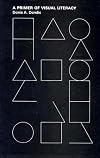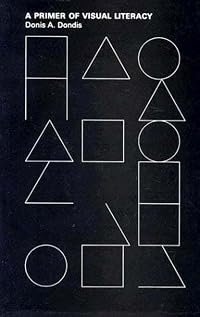
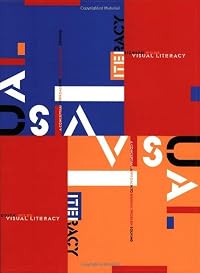
Primer of Visual Literacy
by Donis A. Dondis
On This Page
Description
This primer is designed to teach students the interconnected arts of visual communication. The subject is presented, not as a foreign language, but as a native one that the student "knows" but cannot yet "read." Responding to the need she so clearly perceives, Ms. Dondis, a designer and teacher of broad experience, has provided a beginning text for art and design students and a basic text for all other students; those who do not intend to become artists or designers but who need to acquire show more the essential skills of understanding visual communication at a time when so much information is being studied and transmitted in non-verbal modes, especially through photography and film. Understanding through seeing only seems to be an obviously intuitive process. Actually, developing the visual sense is something like learning a language, with its own special alphabet, lexicon, and syntax. People find it necessary to be verbally literate whether they are "writers": or not; they should find it equally necessary to be visually literate, "artists" or not. This primer is designed to teach students the interconnected arts of visual communication. The subject is presented, not as a foreign language, but as a native one that the student "knows" but cannot yet "read." The analogy provides a useful teaching method, in part because it is not overworked or too rigorously applied. This method of learning to see and read visual data has already been proved in practice, in settings ranging from Harlem to suburbia. Appropriately, the book makes some of its most telling points through visual means. Numerous illustrated examples are employed to clarify the basic elements of design (teach an alphabet), to show how they are used in simple syntactic combinations ("See Jane run."), and finally, to present the meaningful synthesis of visual information that is a finished work of art (the apprehension of poetry...). show lessTags
Recommendations











Member Reviews
Essential reading for those interested in art. The important aspects of being literate, in the visual sense, are covered in astounding detail and accuracy. It's a technical text, for the most part, but there are philosophical ramifications throughout that keep the balance between textbook and investigative inquiry.
Recommended.
Recommended.
So. I purchased this at the beginning of the year because it was one of the texts for the RGD Ontario test. When I had just started making my way through this text, the test requirements changed, as did some of the books that were recommended to be read, and this was no longer on the list. Le sigh.
I kept reading anyway. And I will admit that this was not the most entertaining read. It was educational and informative, yes. But it was rather like reading a text book, which explains why it took me more than two months to read a book that is less than 200 pages long. (I will admit that I kind of fell asleep in it a couple of times.)
The book begins with the very basics of visual images (dots, lines, colours, etc), gets into the history of show more design and visual literacy, and then into application as it is today. As the book was written in the 1970′s, I felt like this last portion was a bit out of date… I rather wish the book had been reissued with updates in that respect, especially for an inclusion of the Internet. This is such a huge factor in the way people communicate now that it is such a shame that it hasn’t been included.
I can see why this book was originally recommended for the RGD test. And not only did it refresh some things that I had already known and hadn’t thought much about in a few years, but it also taught me some new things. I didn’t really study art history in school, so I found the brief information of different art movements most interesting – and actually rather wish those portions had actually been more in depth.
The Bottom Line
There was good information here. There really was. It was just written in a very dry manner. Read it if you’re interested in the topic, but don’t expect to be entertained while learning. show less
I kept reading anyway. And I will admit that this was not the most entertaining read. It was educational and informative, yes. But it was rather like reading a text book, which explains why it took me more than two months to read a book that is less than 200 pages long. (I will admit that I kind of fell asleep in it a couple of times.)
The book begins with the very basics of visual images (dots, lines, colours, etc), gets into the history of show more design and visual literacy, and then into application as it is today. As the book was written in the 1970′s, I felt like this last portion was a bit out of date… I rather wish the book had been reissued with updates in that respect, especially for an inclusion of the Internet. This is such a huge factor in the way people communicate now that it is such a shame that it hasn’t been included.
I can see why this book was originally recommended for the RGD test. And not only did it refresh some things that I had already known and hadn’t thought much about in a few years, but it also taught me some new things. I didn’t really study art history in school, so I found the brief information of different art movements most interesting – and actually rather wish those portions had actually been more in depth.
The Bottom Line
There was good information here. There really was. It was just written in a very dry manner. Read it if you’re interested in the topic, but don’t expect to be entertained while learning. show less
This book helped me organize my way of thinking about visual art. It changed, updated my worldview.
Ratings
Members
- Recently Added By
Lists

The Great Courses: Visual Literacy Skills
53 works; 1 member
Author Information
1 Work 347 Members
Common Knowledge
- Original publication date
- 1973
Classifications
- Genres
- Art & Design, Nonfiction, General Nonfiction
- DDC/MDS
- 001.553 — Computer science, information & general works Computer science, knowledge & systems Knowledge and learning in general [Formerly: Communication] [formerly : Communication through records]
- LCC
- N7433 .D66 — Fine Arts Visual arts General works
- BISAC
Statistics
- Members
- 347
- Popularity
- 91,396
- Reviews
- 3
- Rating
- (4.00)
- Languages
- English, French, Portuguese (Portugal), Spanish
- Media
- Paper
- ISBNs
- 8
- UPCs
- 1
- ASINs
- 6