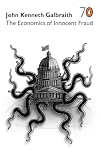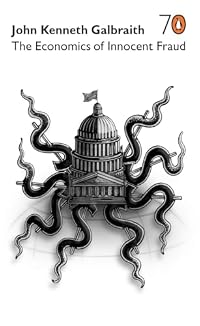
The Economics of Innocent Fraud (Pocket Penguins)
by John Kenneth Galbraith
On This Page
Description
John Kenneth Galbraith has long been at the center of American economics, in key positions of responsibility during the New Deal, World War II, and since, guiding policy and debate. His trenchant new book distills this lifetime of experience in the public and private sectors; it is a scathing critique of matters as they stand today. Sounding the alarm about the increasing gap between reality and "conventional wisdom" -- a phrase he coined -- Galbraith tells, along with much else, how we have show more reached a point where the private sector has unprecedented control over the public sector. We have given ourselves over to self-serving belief and "contrived nonsense" or, more simply, fraud. This has come at the expense of the economy, effective government, and the business world. Particularly noted is the central power of the corporation and the shift in authority from shareholders and board members to management. In an intense exercise of fraud, the pretense of shareholder power is still maintained, even with the immediate participants. In fact, because of the scale and complexity of the modern corporation, decisive power must go to management. From management and its own inevitable self-interest, power extends deeply into government -- the so-called public sector. This is particularly and dangerously the case in such matters as military policy, the environment, and, needless to say, taxation. Nevertheless, there remains the firm reference to the public sector. How can fraud be innocent? In his inimitable style, Galbraith offers the answer. His taut, wry, and severe comment is essential reading for everyone who cares about America's future. This book is especially relevant in an election year, but it deeply concerns the much longer future. show lessTags
Recommendations
























Member Reviews
Galbraith's standard, depressing, spiel on the corporate takeover of modern life, private and public.
Galbraith has a somewhat irritating way of writing, much like Martin Mayer, frequently referring to details that are unfamiliar, certainly to me, and probably to most readers, and that give the impression of a sort of name-dropping.
But that doesn't change the cogency, the power, and the sadness of his argument.
Galbraith has a somewhat irritating way of writing, much like Martin Mayer, frequently referring to details that are unfamiliar, certainly to me, and probably to most readers, and that give the impression of a sort of name-dropping.
But that doesn't change the cogency, the power, and the sadness of his argument.
In this very short book, Galbraith runs through a list of "innocent frauds" perpetrated by our sociopolitical system on a routine basis, from the rebranding of capitalism as a "market system" to the illusion of the division between public and private enterprise.
A very short read, but insightful and extremely compact. Galbraith lays out in overview a critique of the concepts taught in finance and economics, which are in reality, false, and that many of the high-minded ideas bandied about regarding management, financial, corporate and governmental, are simply self-serving beliefs with little merit. A few:
- Shareholder control of corporations
- Executive pay
- Separation of public and private
- Shareholder control of corporations
- Executive pay
- Separation of public and private
Brilliant distillation of the career thoughts of JK Galbraith. Excellent read, and an antidote to economic conventional wisdom.
John Kenneth Galbraith was a brilliant economist and a sprightly writer with a dry with that made his writings about the dismal science a delight to read. Unfortunately he has aged, and his style has become brittle and repetitious. The editing is atrocious and there are few new insights.
He should have stopped writing sooner.
He should have stopped writing sooner.
Great read. Nothing has changed in the corporate world. In fact, it has gotten worse.
Pros: Galbraith's death bed confession; enlightening
Cons: short as usual thus lack of examples and depth
Cons: short as usual thus lack of examples and depth
Members
- Recently Added By
Author Information

77+ Works 11,220 Members
John Kenneth Galbraith is a Canadian-born American economist who is perhaps the most widely read economist in the world. He taught at Harvard from 1934-1939 and then again from 1949-1975. An adviser to President John F. Kennedy, he served from 1961 to 1963 as U.S. ambassador to India. His style and wit in writing and his frequent media appearances show more have contributed greatly to his fame as an economist. Galbraith believes that it is not sufficient for government to manage the level of effective demand; government must manage the market itself. Galbraith stated in American Capitalism (1952) that the market is far from competitive, and governments and labor unions must serve as "countervailing power." He believes that ultimately "producer sovereignty" takes the place of consumer sovereignty and the producer - not the consumer - becomes ruler of the marketplace. (Bowker Author Biography) John Kenneth Galbraith, born in 1908, is the Paul M. Warburg Professor of Economics Emeritus at Harvard University and a past president of both the American Academy of Arts and Letters and the American Economic Association. He is the author of thirty-one books spanning five decades. He has received honorary degrees from, among others, Harvard University, Oxford University, the University of Paris, the University of Toronto, and Moscow State University. He is Commandeur de la Legion d'Honneur in France, and in 1997 he was inducted into the Order of Canada. In 2000, at a White House ceremony, he was given the Presidential Medal of Freedom. He lives in Cambridge, Massachusetts. (Publisher Provided) show less
Series
Belongs to Publisher Series
Work Relationships
Is contained in
Common Knowledge
- Original publication date
- 2004
- Dedication
- Signé
- First words
- For some seventy years my working life has been concerned with economics, along with not infrequent departures to public and political service that had an economic aspect and one tour in journalism.
Classifications
- Genres
- Economics, Nonfiction, General Nonfiction, Politics and Government, Business
- DDC/MDS
- 364.168 — Society, government, & culture Social problems and social services Crime Criminal offenses Crimes of property Business, financial, professional offenses
- LCC
- HV6768 .G36 — Social sciences Social pathology. Social and public welfare. Criminology Social pathology. Social and public welfare. Criminology Crimes and offenses
- BISAC
Statistics
- Members
- 359
- Popularity
- 87,432
- Reviews
- 10
- Rating
- (3.61)
- Languages
- 8 — English, French, German, Italian, Polish, Portuguese, Slovenian, Spanish
- Media
- Paper, Ebook
- ISBNs
- 14
- UPCs
- 1
- ASINs
- 4