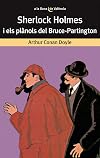
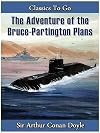
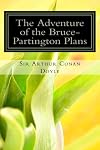
The Adventure of the Bruce-Partington Plans [Short Story]
by Arthur Conan Doyle 
His Last Bow - short stories 1908-1917 {Conan Doyle} (4)
On This Page
Description
The monotony of thick smog-shrouded London is broken by a sudden visit from Holmes's brother Mycroft. He has come about some missing, secret submarine plans. Seven of the ten pages -- three are still missing -- were found with Arthur Cadogan West's body. He was a young clerk in a government office at Royal Arsenal, Woolwich, whose body was found next to the Underground tracks near the Aldgate tube station, his head crushed. He had little money with him (although there appears to have been no show more robbery), theatre tickets, and curiously, no Underground ticket. The three missing pages by themselves could enable one of Britain's enemies to build a Bruce-Partington submarine...(Excerpt from Wikipedia) show lessTags
Recommendations

















Member Reviews
In this book, the monotony of thick smog-shrouded London is broken by a sudden visit from Holmes’s brother Mycroft. He has come about some missing, secret submarine plans. Seven of the ten pages — three are still missing — were found with Arthur Cadogan West’s body. He was a young clerk in a government office at Royal Arsenal, Woolwich, whose body was found next to the Underground tracks near the Aldgate tube station, his head crushed. He had little money with him (although there appears to have been no robbery), theater tickets, and curiously, no Underground ticket. The three missing pages by themselves could enable one of Britain’s enemies to build a Bruce-Partington submarine.
It seems clear that Cadogan West fell from a show more train and that he stole the plans meaning to sell them, but the mystery is truly complex:
How did Cadogan West meet his end?
If he was thrown off a train, what was he doing at Aldgate, well past the stop where he presumably would have gone?
If he had made an appointment with a foreign agent to sell the plans, would he not have kept his evening free instead of buying theater tickets for himself and his fiancée?
How did he get into the Underground without a ticket, or did someone take it?
Why can no evidence of violence be found in any Underground coach?
How is it that Cadogan’s head was crushed and yet there was very little bleeding by the track where he was found?
Inspector Lestrade tells Holmes that a passenger has seen fit to report hearing a thud at about the location in question, as though a body had fallen on the track. He could not see anything, however, owing to the thick fog.
After an examination of the track near Aldgate, Holmes reaches an astonishing and unusual conclusion: Cadogan West had been killed elsewhere, was deposited on the roof of an Underground train, and fell off when the jarring action of going over the points at Aldgate shook the coach.
Holmes decides to visit Sir James Walter, who was in charge of the papers. He has, however, died, apparently of a broken heart from the loss of his honor when the papers were stolen, according to his brother Colonel Valentine.
Cadogan West’s fiancée is a bit more informative. There was something on his mind for the last week or so of his life. He commented to her on how easily a traitor could get hold of “the secret” and how much a foreign agent would pay for it. Then, on the night in question, as the two of them were walking to the theater, near his office, he dashed off, never to be seen again.
Holmes next goes to the office from which the plans were stolen. Sidney Johnson, the senior clerk, tells Holmes that as always, he was the last man out of the office that night, and that he had put the papers in the safe himself. Anyone coming in afterwards to steal them would have needed three keys (for the building, the office, and the safe), but no duplicates were found on Cadogan West’s body, and only the late Sir James had all three keys. Johnson also mentions that one of the seven recovered pages might also be indispensable to a foreign agent. This will prove important later. Holmes also discovers that it is possible to see what is happening inside the office from outside even when the iron shutters are closed.
After leaving, Holmes finds that the clerk at the nearby Underground station remembers seeing Cadogan West on the evening in question. He was most shaken by something, and took a train to London Bridge.
Acting on information from Mycroft, and on what he has learnt thus far, Holmes identifies a person of interest, Hugo Oberstein, a known agent who left town shortly after Cadogan West’s murder. Some small reconnaissance shows Holmes that Oberstein’s house backs onto an above-ground Underground line, and that, owing to traffic at a nearby junction, trains often stop right under his windows. It seems clear now that Cadogan West’s body was laid on the train roof — the evidence shows that he was not dropped from a height — just there. The only remaining questions are about who killed him and why.
Holmes and Dr. Watson break into Oberstein’s empty house and examine the windows, finding that the grime has been smudged, and there is a bloodstain. An Underground train stops right under the window. It would be easy to lift a dead man onto a train roof, as was apparently done. Some messages from the Daily Telegraph agony column, all seeming to allude to a business deal, are also found, posted by “Pierrot”, and this gives Holmes an idea. He posts a similarly cryptic message in the Times demanding a meeting, signing it Pierrot, in the hopes that the thief — assuming it is not Cadogan West — might show up at Oberstein’s house.
It works. Colonel Valentine shows up and is stunned to find Holmes, Watson, Lestrade, and Mycroft all waiting for him. He confesses to the theft of the plans, but swears that it was Oberstein who killed Cadogan West. Cadogan had followed the Colonel to Oberstein’s and then, injudiciously, intervened. Oberstein beat his head in. Oberstein then decided, over the Colonel’s objections, that he had to keep three of the papers, because they could not be copied in a short time. He then got the idea of putting the other seven in Cadogan West’s pockets and then putting him on a train roof outside his window, reasoning that he would be blamed for the theft when his body was found, when actually, he had only seen the theft in progress and followed the thief.
Colonel Valentine Walter had been deep in debt and had acted out of a need for money. He redeems himself somewhat by agreeing to write to Oberstein, whose address on the Continent he knows, inviting him to come back to England for the fourth, vital page. This ruse also works, and Oberstein is sentenced to 15 years in prison, while the missing pages of the Bruce-Partington plans are recovered from his trunk. Colonel Valentine dies in prison, not long after starting his sentence. Holmes is given an emerald tie pin by Queen Victoria (she is not actually identified by name, but there is little doubt considering the dropped hints and given that the story is set in the year 1895, while she still reigned) for his efforts.
Excellent plot, I recommend this book to all readers that enjoy a well written mystery book, mainly featuring Sherlock Holmes and his friend Dr. Watson. show less
It seems clear that Cadogan West fell from a show more train and that he stole the plans meaning to sell them, but the mystery is truly complex:
How did Cadogan West meet his end?
If he was thrown off a train, what was he doing at Aldgate, well past the stop where he presumably would have gone?
If he had made an appointment with a foreign agent to sell the plans, would he not have kept his evening free instead of buying theater tickets for himself and his fiancée?
How did he get into the Underground without a ticket, or did someone take it?
Why can no evidence of violence be found in any Underground coach?
How is it that Cadogan’s head was crushed and yet there was very little bleeding by the track where he was found?
Inspector Lestrade tells Holmes that a passenger has seen fit to report hearing a thud at about the location in question, as though a body had fallen on the track. He could not see anything, however, owing to the thick fog.
After an examination of the track near Aldgate, Holmes reaches an astonishing and unusual conclusion: Cadogan West had been killed elsewhere, was deposited on the roof of an Underground train, and fell off when the jarring action of going over the points at Aldgate shook the coach.
Holmes decides to visit Sir James Walter, who was in charge of the papers. He has, however, died, apparently of a broken heart from the loss of his honor when the papers were stolen, according to his brother Colonel Valentine.
Cadogan West’s fiancée is a bit more informative. There was something on his mind for the last week or so of his life. He commented to her on how easily a traitor could get hold of “the secret” and how much a foreign agent would pay for it. Then, on the night in question, as the two of them were walking to the theater, near his office, he dashed off, never to be seen again.
Holmes next goes to the office from which the plans were stolen. Sidney Johnson, the senior clerk, tells Holmes that as always, he was the last man out of the office that night, and that he had put the papers in the safe himself. Anyone coming in afterwards to steal them would have needed three keys (for the building, the office, and the safe), but no duplicates were found on Cadogan West’s body, and only the late Sir James had all three keys. Johnson also mentions that one of the seven recovered pages might also be indispensable to a foreign agent. This will prove important later. Holmes also discovers that it is possible to see what is happening inside the office from outside even when the iron shutters are closed.
After leaving, Holmes finds that the clerk at the nearby Underground station remembers seeing Cadogan West on the evening in question. He was most shaken by something, and took a train to London Bridge.
Acting on information from Mycroft, and on what he has learnt thus far, Holmes identifies a person of interest, Hugo Oberstein, a known agent who left town shortly after Cadogan West’s murder. Some small reconnaissance shows Holmes that Oberstein’s house backs onto an above-ground Underground line, and that, owing to traffic at a nearby junction, trains often stop right under his windows. It seems clear now that Cadogan West’s body was laid on the train roof — the evidence shows that he was not dropped from a height — just there. The only remaining questions are about who killed him and why.
Holmes and Dr. Watson break into Oberstein’s empty house and examine the windows, finding that the grime has been smudged, and there is a bloodstain. An Underground train stops right under the window. It would be easy to lift a dead man onto a train roof, as was apparently done. Some messages from the Daily Telegraph agony column, all seeming to allude to a business deal, are also found, posted by “Pierrot”, and this gives Holmes an idea. He posts a similarly cryptic message in the Times demanding a meeting, signing it Pierrot, in the hopes that the thief — assuming it is not Cadogan West — might show up at Oberstein’s house.
It works. Colonel Valentine shows up and is stunned to find Holmes, Watson, Lestrade, and Mycroft all waiting for him. He confesses to the theft of the plans, but swears that it was Oberstein who killed Cadogan West. Cadogan had followed the Colonel to Oberstein’s and then, injudiciously, intervened. Oberstein beat his head in. Oberstein then decided, over the Colonel’s objections, that he had to keep three of the papers, because they could not be copied in a short time. He then got the idea of putting the other seven in Cadogan West’s pockets and then putting him on a train roof outside his window, reasoning that he would be blamed for the theft when his body was found, when actually, he had only seen the theft in progress and followed the thief.
Colonel Valentine Walter had been deep in debt and had acted out of a need for money. He redeems himself somewhat by agreeing to write to Oberstein, whose address on the Continent he knows, inviting him to come back to England for the fourth, vital page. This ruse also works, and Oberstein is sentenced to 15 years in prison, while the missing pages of the Bruce-Partington plans are recovered from his trunk. Colonel Valentine dies in prison, not long after starting his sentence. Holmes is given an emerald tie pin by Queen Victoria (she is not actually identified by name, but there is little doubt considering the dropped hints and given that the story is set in the year 1895, while she still reigned) for his efforts.
Excellent plot, I recommend this book to all readers that enjoy a well written mystery book, mainly featuring Sherlock Holmes and his friend Dr. Watson. show less
This Sherlock Holmes short story concerns the theft of some secret papers relating to construction of a submarine, and the discovery of the papers in the pocket of the supposed thief, a young Government clerk, Arthur Cadogan West, whose body is found on an Underground line, apparently thrown or fallen from a moving train. Holmes exposes the real thief and killer, with the help not only of Watson, but also of his own brother Mycroft, who makes one of hsi rare appearances here.
Ratings
Members
- Recently Added By
Author Information

4,006+ Works 169,855 Members
The most famous fictional detective in the world is Arthur Conan Doyle's Sherlock Holmes. However, Doyle was, at best, ambivalent about his immensely successful literary creation and, at worst, resentful that his more "serious" fiction was relatively ignored. Born in Edinburgh, Doyle studied medicine from 1876 to 1881 and received his M.D. in show more 1885. He worked as a military physician in South Africa during the Boer War and was knighted in 1902 for his exceptional service. Doyle was drawn to writing at an early age. Although he attempted to enter private practice in Southsea, Portsmouth, in 1882, he soon turned to writing in his spare time; it eventually became his profession. As a Liberal Unionist, Doyle ran, unsuccessfully, for Parliament in 1903. During his later years, Doyle became an avowed spiritualist. Doyle sold his first story, "The Mystery of the Sasassa Valley," to Chambers' Journal in 1879. When Doyle published the novel, A Study in Scarlet in 1887, Sherlock Holmes was introduced to an avid public. Doyle is reputed to have used one of his medical professors, Dr. Joseph Bell, as a model for Holmes's character. Eventually, Doyle wrote three additional Holmes novels and five collections of Holmes short stories. A brilliant, though somewhat eccentric, detective, Holmes employs scientific methods of observation and deduction to solve the mysteries that he investigates. Although an "amateur" private detective, he is frequently called upon by Scotland Yard for assistance. Holmes's assistant, the faithful Dr. Watson, provides a striking contrast to Holmes's brilliant intellect and, in Doyle's day at least, serves as a character with whom the reader can readily identify. Having tired of Holmes's popularity, Doyle even tried to kill the great detective in "The Final Problem" but was forced by an outraged public to resurrect him in 1903. Although Holmes remained Doyle's most popular literary creation, Doyle wrote prolifically in other genres, including historical adventure, science fiction, and supernatural fiction. Despite Doyle's sometimes careless writing, he was a superb storyteller. His great skill as a popular author lay in his technique of involving readers in his highly entertaining adventures. (Bowker Author Biography) show less
Arthur Conan Doyle has a Legacy Library. Legacy libraries are the personal libraries of famous readers, entered by LibraryThing members from the Legacy Libraries group.
Series

Work Relationships
Is contained in
Sherlock Holmes: Complete (56) Stories (Adventures, Memoirs, Return, His Last Bow, & The Case-Book) by Arthur Conan Doyle (indirect)
The Complete Sherlock Holmes: All 4 Novels and 56 Short Stories by Sir Arthur Conan Doyle (indirect)
Sherlock Holmes: The Complete Novels and Stories Volume II (of 2; Bantam) by Sir Arthur Conan Doyle (indirect)
Sherlock Holmes: The Complete Novels and Stories, Vol. 1 and 2 (Bantam) by Arthur Conan Doyle (indirect)
EL REGRESO DE SHERLOCK HOLMES - SU ÚLTIMO SALUDO - EL ARCHIVO DE SHERLOCK HOLMES by Arthur Conan Doyle (indirect)
Sherlock Holmes - Edição Completa Romances & Contos (Em Portuguese do Brasil) by Arthur Conan Doyle (indirect)
THE COMPLETE SHERLOCK HOLMES and THE COMPLETE TALES OF TERROR AND MYSTERY by Sir Arthur Conan Doyle (indirect)
British Mystery Megapack Volume 5 - The Sherlock Holmes Collection: 4 Novels and 43 Short Stories + Extras by Arthur Conan Doyle (indirect)
Sherlock Holmes - volume 2 : La Vallée de la peur ; Le Chien des Baskerville ; Les Archives de Sherlock Holmes ; Son dernier coup d'archet ; Les Exploits de Sherlock Holmes by Arthur Conan Doyle (indirect)
The Final Adventures of Sherlock Holmes (His Last Bow + The Valley of Fear + The Case-Book of Sherlock Holmes) by Sir Arthur Conan Doyle (indirect)
Doyle: O. completas. 3. Reaparición de Sherlock Holmes; Su último saludo en el escenario; El Valle by Arthur Conan Doyle (indirect)
Contains
Has the adaptation
Is abridged in
Common Knowledge
- Canonical title
- The Adventure of the Bruce-Partington Plans [Short Story]
- Original publication date
- 1908
- People/Characters
- Sherlock Holmes; John H. Watson; Mycroft Holmes; Arthur Cadogan West; Violet Westbury; Inspector G. Lestrade (show all 10); James Walter; Sidney Johnson; Valentine Walter; Hugo Oberstein
- Important places
- 221B Baker Street, London, England, UK; Aldgate, London, England, UK; Woolwich, London, England, UK; Woolwich Arsenal, Woolwich, London, England, UK; Gloucester Road, Kensington, London, England, UK
- Original language
- English
Classifications
Statistics
- Members
- 85
- Popularity
- 375,837
- Reviews
- 2
- Rating
- (3.67)
- Languages
- 5 — Catalan, Chinese, Dutch, English, German
- Media
- Paper, Audiobook, Ebook
- ISBNs
- 47
- ASINs
- 9