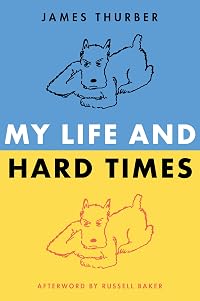
My Life and Hard Times
by James Thurber
On This Page
Description
A humorous memoir talking mostly about small matters and the incredible things people do when they think they're acting sensible.Tags
Recommendations























Member Reviews
This grew on me. I inevitably pick up a Thurber with great expectations due to the absolute genius hilarity of his, presumably self-written, back-cover 'biography'. It's a hard act to follow: an absolute cracker that never fails to leave me in tears of laughter, chock full of such deliciously absurd observations as "He has not worked as a cow-puncher, ranch-hand, stevedore, short-order cook, lumberjack, or preliminary prize fighter. Quick to arouse, he is very hard to quiet and people often just go away." You get the picture.
Thurber announces in introduction that he doesn't believe in over-working a composition/self-editing, preferring to let his writing flow. This technique clearly works extremely well in the very short context of the show more author blurb, but can become just a wee bit tiresome in the longer - although still reasonably bite-sized - chapters of 'reminiscence' (I put the word in quotation marks as the work is marked 'fiction' and, based on the 'biography' I would presume is merely loosely based on reality) which comprise this book.
My favourite sections are really the preface and end note, which, being reflections upon the work encompassed, presumably required a little more discipline than the author's usual style.
I wonder if I also compare this work with that of, for example, Garrison Keillor - a writer who is a self-avowed literary descendent from, and fervent admirer of, Thurber. Keillor's writing engages me on many more levels than that of Thurber through an intricate mix of pathos and slapstick. That said, Thurber's mildly fantastical and charmingly amusing wanderings are far from a bad way to pass the time. show less
Thurber announces in introduction that he doesn't believe in over-working a composition/self-editing, preferring to let his writing flow. This technique clearly works extremely well in the very short context of the show more author blurb, but can become just a wee bit tiresome in the longer - although still reasonably bite-sized - chapters of 'reminiscence' (I put the word in quotation marks as the work is marked 'fiction' and, based on the 'biography' I would presume is merely loosely based on reality) which comprise this book.
My favourite sections are really the preface and end note, which, being reflections upon the work encompassed, presumably required a little more discipline than the author's usual style.
I wonder if I also compare this work with that of, for example, Garrison Keillor - a writer who is a self-avowed literary descendent from, and fervent admirer of, Thurber. Keillor's writing engages me on many more levels than that of Thurber through an intricate mix of pathos and slapstick. That said, Thurber's mildly fantastical and charmingly amusing wanderings are far from a bad way to pass the time. show less
These are short and fantastical autobiographical sketches of Thurber's childhood. He has a style-- maybe it's better described as an attitude toward his characters-- that I don't think I've ever seen before. He's writing about crazy people doing ridiculous things. Somehow he manages to convey a disgust for these silly antics while maintaining a warmhearted affection for the people. It allows him to write a book of biting satire that is still, at bottom, tender. It's neat.
The whole short book is great, but my favorite moment came on the second page. When I read this on the bus Thursday morning, I made an ass of myself trying not to laugh out loud.
Thurber is cataloging the phobias of his family members. His cousin was terrified of show more suffocating in his sleep, and so kept a tin of camphor beside the bed to revive himself, should he wake up half-dead. His Aunt Grace kept shoes inside her bedroom door and, every night when she thought she heard burglars, would crack open the door and thrown shoes down the hall.
The one that made me snort and choke on the bus, though, was this bit:
Then there was Aunt Sarah Shoaf, who never went to bed at night without the fear that a burglar was going to get in and blow chloroform under her door through a tube. To avert this calamity-- for she was in greater dread of anesthetics than of losing her household goods-- she always piled her money, silverware, and other valuables in a neat stack just outside her bedroom, with a note reading: "This is all I have. Please take it and do not use your chloroform, as this is all I have." show less
The whole short book is great, but my favorite moment came on the second page. When I read this on the bus Thursday morning, I made an ass of myself trying not to laugh out loud.
Thurber is cataloging the phobias of his family members. His cousin was terrified of show more suffocating in his sleep, and so kept a tin of camphor beside the bed to revive himself, should he wake up half-dead. His Aunt Grace kept shoes inside her bedroom door and, every night when she thought she heard burglars, would crack open the door and thrown shoes down the hall.
The one that made me snort and choke on the bus, though, was this bit:
Then there was Aunt Sarah Shoaf, who never went to bed at night without the fear that a burglar was going to get in and blow chloroform under her door through a tube. To avert this calamity-- for she was in greater dread of anesthetics than of losing her household goods-- she always piled her money, silverware, and other valuables in a neat stack just outside her bedroom, with a note reading: "This is all I have. Please take it and do not use your chloroform, as this is all I have." show less
One might surmise that for writing "Running with scissors" Augusten Burroughs found inspiration in James Thurber's "My life and hard times", thinking particularly of the last short story in this collection, namely "A box to hide in" which call to mind Burrough's (autobiographical) character with a carton box -- a box too small to hide in -- on is head.
There are other parallels between the two books, for instance, the suggestion that both are autobiographical, and both use the technique of the hyperbole to create hilarious situations. But where Thurber's stories are exceedingly funny, Burroughs are essentially sad; where Thurber's stories are incredibly funny and very recognizable, Burroughs are weird and disgusting.
James Thurber's short show more story collection "My life and hard times" consists of six, mostly very short stories, illustrated with Thurber's cartoons. The first story "The dog that bit people" describes in hilarious fashion the life of one of his family's dogs. The story is great for dog lovers. The second story, "University days" describes the protagonists' time at university. In three episodes it portrays more than anything else the despair of teachers to educate some truly resilient students, such as the immensely funny botany class and the protagonist's inability to see through the microscope, the portrait of the block-head student Bolenciecwcz, who excels at sports but is extremely dim. The attempt of the teacher to make Bolenciecwcz answer simple question is recognizable to any student, and painfully realistic to any teacher, and above all uproariously funny. These two longer stories are followed by three relatively short stories, which all describe hilariously funny situations, set in the family circle of the protagonist.
"My life and hard times" is a very short, and very light read, but very rewarding, and truly very funny. Part of the fun lies in the very recognizable situations, and part of it rests with the (imagined) mimick of the characters, and their highly authentic speech, in which Thurber has caught some typical American expressions. Although descriptions clearly betray that these stories were written in the early Twentieth century, and the stories are set in the 1910s, their humour is timeless.
Not to be missed. show less
There are other parallels between the two books, for instance, the suggestion that both are autobiographical, and both use the technique of the hyperbole to create hilarious situations. But where Thurber's stories are exceedingly funny, Burroughs are essentially sad; where Thurber's stories are incredibly funny and very recognizable, Burroughs are weird and disgusting.
James Thurber's short show more story collection "My life and hard times" consists of six, mostly very short stories, illustrated with Thurber's cartoons. The first story "The dog that bit people" describes in hilarious fashion the life of one of his family's dogs. The story is great for dog lovers. The second story, "University days" describes the protagonists' time at university. In three episodes it portrays more than anything else the despair of teachers to educate some truly resilient students, such as the immensely funny botany class and the protagonist's inability to see through the microscope, the portrait of the block-head student Bolenciecwcz, who excels at sports but is extremely dim. The attempt of the teacher to make Bolenciecwcz answer simple question is recognizable to any student, and painfully realistic to any teacher, and above all uproariously funny. These two longer stories are followed by three relatively short stories, which all describe hilariously funny situations, set in the family circle of the protagonist.
"My life and hard times" is a very short, and very light read, but very rewarding, and truly very funny. Part of the fun lies in the very recognizable situations, and part of it rests with the (imagined) mimick of the characters, and their highly authentic speech, in which Thurber has caught some typical American expressions. Although descriptions clearly betray that these stories were written in the early Twentieth century, and the stories are set in the 1910s, their humour is timeless.
Not to be missed. show less
St. Barts 2020 #4 - Charming sweet little book that made me laugh out loud a few times. Humble, honest and spot on with descriptions of somewhat commonplace experiences he endured in his growing up period with his family. Clear sparse descriptions of his relatively slightly crazy family, but he merely sets the stage and tells the story....he leaves it up to you to discover the craziness. The opposite of In-your-face. I like that. And his simple cartoon drawings help tell the story. nice....
This is actually the first thing I've read by Thurber. Well, the first complete piece. I discovered halfway through that I had read a bit of this book as it was included in Eliot Aaronson's The Social Animal (excellent book). It's the bit from the "flood," where everybody starts running away from a completely non-existent flood. Aaronson used it as an example of conformity, as I recall.
Anyway, though, as I said, I'd never really read any Thurber. As I read this and talked to people about it, it seems that everyone I know has read quite a bit of his stuff. I can see why. It's funny, interesting, and light. Easy to read, gives you a little kick, and then you can move on. I'll probably read some of his other stuff at some point, I'd say. show more This one was fun. show less
Anyway, though, as I said, I'd never really read any Thurber. As I read this and talked to people about it, it seems that everyone I know has read quite a bit of his stuff. I can see why. It's funny, interesting, and light. Easy to read, gives you a little kick, and then you can move on. I'll probably read some of his other stuff at some point, I'd say. show more This one was fun. show less
Classic Thurber: part biography, part bedtime story. Includes some of the best known classics, such as the Night the Bed Fell, and the Night the Ghost Got In. As always, Thurber's dry wit and droll pictures tickle the funny bone and lighten the heart. Even though Thurber writes about a time seemingly long past, the people aren't really that different from ones we know, and it's easy to visualize the parade of kooky characters that animate his prose. This short collection is an easy read, and very rewarding.
Deducted 1/2 star for being too short. Otherwise an excellent example of midcentury, midwestern humor excellently written.
This slim volumes reads as a collection of short essays about the early part of Thurber's life and his eccentric family. I won't go so far as to say they are laugh-out-loud funny, but they are very humorous. I'll be looking at his other works in the future with a much more open mind.
This slim volumes reads as a collection of short essays about the early part of Thurber's life and his eccentric family. I won't go so far as to say they are laugh-out-loud funny, but they are very humorous. I'll be looking at his other works in the future with a much more open mind.
Members
- Recently Added By
Lists

NPR Readers Poll: 100 Favorite Funny Books
100 works; 5 members

Read This Next
120 works; 3 members

SomethingAwful TBB BOTM
66 works; 2 members

1930s
262 works; 5 members

Books Set in Ohio
30 works; 6 members
Author Information

Born in Columbus, Ohio, Thurber was blinded in one eye in a childhood accident. He attended Ohio State University but left without earning a degree. In 1925 he moved to New York City, where he joined the staff of the New Yorker in 1927 at the urging of his friend E. B. White. For the rest of his lifetime, Thurber contributed to the magazine his show more highly individual pieces and those strange, wry, and disturbing pen-and-ink drawings of "huge, resigned dogs, the determined and sometimes frightening women, the globular men who try so hard to think so unsuccessfully." The period from 1925, when the New Yorker was founded, until the death of its creator-editor, Harold Ross, in 1951, was described by Thurber in delicious and absorbing detail in The Years with Ross (1959). Of his two great talents, Thurber preferred to think of himself primarily as a writer, illustrating his own books. He published "fables" in the style of Aesop (see Vol. 2) and La Fontaine (see Vol. 2)---usually with a "barbed tip of contemporary significance"---children's books, several plays (two Broadway hits, one successful musical revue), and endless satires and parodies in short stories or full-length works. "The Secret Life of Walter Mitty," included in My World---and Welcome to It (1942), is probably his best-known story and continues to be frequently anthologized. T. S. Eliot described Thurber's work as "a form of humor which is also a way of saying something serious." (Bowker Author Biography) show less
All Editions
Awards and Honors
Work Relationships
Common Knowledge
- Canonical title
- My Life and Hard Times
- Original publication date
- 1933-11
- People/Characters
- James Thurber
- Important places
- Columbus, Ohio, USA; Ohio, USA
- Dedication
- For Mary A. Thurber
- First words
- Benvenuto Cellini said that a man should be at least forty years old before he undertakes so fine an enterprise as that of setting down the story of his life.
- Last words
- (Click to show. Warning: May contain spoilers.)And I found that somebody had stolen the pants to my dinner jacket.
Classifications
Statistics
- Members
- 1,255
- Popularity
- 19,559
- Reviews
- 22
- Rating
- (4.06)
- Languages
- English, French, German
- Media
- Paper, Ebook
- ISBNs
- 10
- ASINs
- 35