Reading and Writing
by Robertson Davies
On This Page
Tags
Recommendations





















Member Reviews
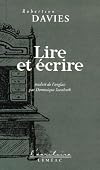
Robertson Davies, Canadian literary giant of the “Deptford Trilogy” fame, offers his perspective on the basics of the printed word, reading and writing. Originally two lectures given by Davies, the University of Utah Press reprinted the texts. So, reading the lecture feels very much like receiving a letter or engaging in a conversation with the author about his trade.
The first half of the book focuses on the consumer end of publishing, reading. Davies suggests more reading, slower reading, and reading purely for pleasure. While Davies’ advice sounds mundane, the implications are complicated. In making his point, Davies often sounds like a violent critic of an old-fashioned classical education, warning against the danger of show more “over-reading.” He describes one student who told him that she read “eight plays of Shakespeare, a play by Ben Johnson, all of Pamela, the whole eight volumes of Carissa, eight novels by Dickens, one by Thackeray, one by Trollope, a large wodge of Henry James, a substantial vegetarian mass of Bernard Shaw and God knows what else, and at the end of it all her mind was as flat as Holland. All she had gained were thick glasses and a bad breath, doubtless the result of literary constipation.” To follow Davies’ example would be “to read a great deal of varied material, including several newspapers,” which he describes as carrying the “great themes of the Bible, Homer, or Shakespeare, repeated again and again.” Davies complains only of mediocrity in consumption, and points to the ever growing population of new writers who have begun to take their place in the literary community alongside the already declared greats. The ultimate point of reading, for Davies, is to indulge in the art and “take pride in the pleasures of the intellect, enjoyed for their own sake, as adjuncts of the truly good, well-rounded life.”
On writing, Davies is squarely of the mind that art is not learned, that it is a part of the DNA . There is no formula in becoming a writer, no lists of tasks and experiences by which a burgeoning writer succeeds to the vocation. Writing is more a part of someone’s life, not a trade by which they live, and Davies, though he succeeded and was paid for his prose, dismisses the notion of writing solely as a profession. One of the primary reasons for his view on the subject is that Davies believes the best writers, the ones who have something to say to us all, are the ones who experience life firsthand, not those who would withdraw to create. Davies addresses narrative, technique, theme, and language. Of language he says, “It is extraordinary how few people have any real feeling for language, or any sense that it is one of the greatest and most inexhaustible playthings with which our human state has presented us. It is an unhappy truth that education, or partial education, which is all that most of us can claim as our own, seems to be destructive of the sense of language. It is often among simple people that truly effective and poetic expression is heard.”
The most dramatic conclusion Davies imparts deals with inspiration. “…I am convinced that this special quality is the product of the writer’s access to those deeper leavels of his mind that the depth-psychologists call the Unconscious. It is not a particular possession of the writer, this Unconscious, but the ability to invite it, to solicit its assistance, to hear what it has to say and impart it in the language that is peculiarly his own, is decidedly his gift and what defines him as an artist. He may not be – very probably is not – fishing up messages from the Unconscious that astonish and strike dumb his readers. It is much more likely that he is telling them things that they recognize as soon as they hear them … but which they have not been able to seize and hold and put in language for themselves.”
Davies is a difficult taskmaster, to be sure. After reading some passages, writers, successful and aspiring alike, may be doubtful of their own ability. But, at heart, Davies’ message is one of encouragement, of reading and writing for pleasure and to engage in the art, for its own sake.
Bottom Line: A beautiful essay on the art of reading and writing. Difficult but encouraging.
5 bones!!!!! show less
The first half of the book focuses on the consumer end of publishing, reading. Davies suggests more reading, slower reading, and reading purely for pleasure. While Davies’ advice sounds mundane, the implications are complicated. In making his point, Davies often sounds like a violent critic of an old-fashioned classical education, warning against the danger of show more “over-reading.” He describes one student who told him that she read “eight plays of Shakespeare, a play by Ben Johnson, all of Pamela, the whole eight volumes of Carissa, eight novels by Dickens, one by Thackeray, one by Trollope, a large wodge of Henry James, a substantial vegetarian mass of Bernard Shaw and God knows what else, and at the end of it all her mind was as flat as Holland. All she had gained were thick glasses and a bad breath, doubtless the result of literary constipation.” To follow Davies’ example would be “to read a great deal of varied material, including several newspapers,” which he describes as carrying the “great themes of the Bible, Homer, or Shakespeare, repeated again and again.” Davies complains only of mediocrity in consumption, and points to the ever growing population of new writers who have begun to take their place in the literary community alongside the already declared greats. The ultimate point of reading, for Davies, is to indulge in the art and “take pride in the pleasures of the intellect, enjoyed for their own sake, as adjuncts of the truly good, well-rounded life.”
On writing, Davies is squarely of the mind that art is not learned, that it is a part of the DNA . There is no formula in becoming a writer, no lists of tasks and experiences by which a burgeoning writer succeeds to the vocation. Writing is more a part of someone’s life, not a trade by which they live, and Davies, though he succeeded and was paid for his prose, dismisses the notion of writing solely as a profession. One of the primary reasons for his view on the subject is that Davies believes the best writers, the ones who have something to say to us all, are the ones who experience life firsthand, not those who would withdraw to create. Davies addresses narrative, technique, theme, and language. Of language he says, “It is extraordinary how few people have any real feeling for language, or any sense that it is one of the greatest and most inexhaustible playthings with which our human state has presented us. It is an unhappy truth that education, or partial education, which is all that most of us can claim as our own, seems to be destructive of the sense of language. It is often among simple people that truly effective and poetic expression is heard.”
The most dramatic conclusion Davies imparts deals with inspiration. “…I am convinced that this special quality is the product of the writer’s access to those deeper leavels of his mind that the depth-psychologists call the Unconscious. It is not a particular possession of the writer, this Unconscious, but the ability to invite it, to solicit its assistance, to hear what it has to say and impart it in the language that is peculiarly his own, is decidedly his gift and what defines him as an artist. He may not be – very probably is not – fishing up messages from the Unconscious that astonish and strike dumb his readers. It is much more likely that he is telling them things that they recognize as soon as they hear them … but which they have not been able to seize and hold and put in language for themselves.”
Davies is a difficult taskmaster, to be sure. After reading some passages, writers, successful and aspiring alike, may be doubtful of their own ability. But, at heart, Davies’ message is one of encouragement, of reading and writing for pleasure and to engage in the art, for its own sake.
Bottom Line: A beautiful essay on the art of reading and writing. Difficult but encouraging.
5 bones!!!!! show less
His strong opinions make for an interesting read.
A good old professorial lecture.
Ratings
Members
- Recently Added By
Author Information

89+ Works 24,723 Members
William Robertson Davies was born in Thamesville, Ontario in 1913. He taught English at the University of Toronto and was an actor, journalist, and newspaper editor before winning acclaim as a novelist with Tempest-Tost, the first of his Salterton trilogy. His most famous trilogy, The Deptford Trilogy--Fifth Business, The Manticore, and World of show more Wonders--develops the earlier Salterton novels. The locale is a fictitious Ontario city that prizes its English tradition, including the Anglican Church and the genealogy of the old families. Robertson's novels have been translated into approximately 20 languages. His masterful story-telling encompasses such issues as evil, love, fear, tradition, and magic as he brings his characters to life with wisdom and humor. Robertson Davies died in 1995. (Bowker Author Biography) Robertson Davies (1913-1995) had three successive careers during the time he became an internationally acclaimed author: first as an actor with the Old Vic Company in England; then as publisher of "The Peterborough Ontario Examiner"; & finally as professor & first master of Massey College at the University of Toronto. With twelve novels & several volumes of essays & plays to his credit, Davies was the first Canadian to be inducted to the American Academy & Institute of Arts & Letters. His last novel, "The Cunning Man" (Viking 1995), was a national bestseller. (Publisher Provided) show less
Series
Belongs to Publisher Series
Tanner Lectures (1990-1991, Yale)
Work Relationships
Common Knowledge
- Canonical title
- Reading and Writing
- Original publication date
- 1993
Classifications
Statistics
- Members
- 55
- Popularity
- 554,345
- Reviews
- 3
- Rating
- (4.00)
- Languages
- English, French
- Media
- Paper
- ISBNs
- 2