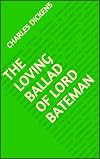
The Loving Ballad of Lord Bateman
by Charles Dickens, Charles Dickens, William Makepeace Thackeray
On This Page
Description
In some collection of old English Ballads there is an ancient ditty which I am told bears some remote and distant resemblance to the following Epic Poem. I beg to quote the emphatic language of my estimable friend (if he will allow me to call him so), the Black Bear in Piccadilly, and to assure all to whom these presents may come, that "I am the original." This affecting legend is given in the following pages precisely as I have frequently heard it sung on Saturday nights, outside a house of show more general refreshment (familiarly termed a wine vaults) at Battle-bridge. The singer is a young gentleman who can scarcely have numbered nineteen summers, and who before his last visit to the treadmill, where he was erroneously incarcerated for six months as a vagrant (being unfortunately mistaken for another gentleman), had a very melodious and plaintive tone of voice, which, though it is now somewhat impaired by gruel and such a getting up stairs for so long a period, I hope shortly to find restored. show lessTags
Recommendations



















Member Reviews
This is the nineteenth-century version of one of those bloated, soulless, overproduced rock dinosaur collaborations that were big in the 1980s: "Ebony and Ivory," or even better, David Bowie and Mick Jagger's version of "Dancing in the Street." Dickens, Thackeray, and Cruikshank got their usual table at the Black Bear in Piccadilly, did a bunch of blow, and rewrote a cute, picturesque and slightly picaresque traditional ballad and slapped each other on the back and thought they were just kings of comedy man, and everyone sitting nearby rolled their eyes like "fucking douchebag celebrities, let's go to the Prospect of Whitby." The ballad itself is hardly altered--a few smarmy touches of haw-haw upper-class eye-dialect (the lowest form of show more humour) added I assume by Thackeray, who was better at that sort of thing than Dickens (when the latter does it it always reads like a crutch, like a Robin Williamsesque way of making a character memorable, but Thack did at least have an ear); Dickens's "notes," which aspire to a parody of criticism (the joke being that ha ha can you imagine writing about this low trash like it were e.g. the exquisite lyrics of Thomas Gray), come across as insufferably self-satisfied; and I don't know much about Cruikshank but here he does not come off like the "modern Hogarth" of popular purport--this is more sub-Groo the Wanderer stuff. I give it credit for being an oddity and that is all. show less
Ratings
Members
- Recently Added By
Author Information

2,578+ Works 313,139 Members
Charles Dickens, perhaps the best British novelist of the Victorian era, was born in Portsmouth, Hampshire, England on February 7, 1812. His happy early childhood was interrupted when his father was sent to debtors' prison, and young Dickens had to go to work in a factory at age twelve. Later, he took jobs as an office boy and journalist before show more publishing essays and stories in the 1830s. His first novel, The Pickwick Papers, made him a famous and popular author at the age of twenty-five. Subsequent works were published serially in periodicals and cemented his reputation as a master of colorful characterization, and as a harsh critic of social evils and corrupt institutions. His many books include Oliver Twist, David Copperfield, Bleak House, Great Expectations, Little Dorrit, A Christmas Carol, and A Tale of Two Cities. Dickens married Catherine Hogarth in 1836, and the couple had nine children before separating in 1858 when he began a long affair with Ellen Ternan, a young actress. Despite the scandal, Dickens remained a public figure, appearing often to read his fiction. He died in 1870, leaving his final novel, The Mystery of Edwin Drood, unfinished. (Bowker Author Biography) show less
82+ Works 253 Members

719+ Works 24,502 Members
William Makepeace Thackeray was born in Calcutta, India, where his father was in service to the East India Company. After the death of his father in 1816, he was sent to England to attend school. Upon reaching college age, Thackeray attended Trinity College, Cambridge, but he left before completing his degree. Instead, he devoted his time to show more traveling and journalism. Generally considered the most effective satirist and humorist of the mid-nineteenth century, Thackeray moved from humorous journalism to successful fiction with a facility that was partially the result of a genial fictional persona and a graceful, relaxed style. At his best, he held up a mirror to Victorian manners and morals, gently satirizing, with a tone of sophisticated acceptance, the inevitable failure of the individual and of society. He took up the popular fictional situation of the young person of talent who must make his way in the world and dramatized it with satiric directness in The Luck of Barry Lyndon (1844), with the highest fictional skill and appreciation of complexities inherent within the satiric vision in his masterpiece, Vanity Fair (1847), and with a great subtlety of point of view and background in his one historical novel, Henry Esmond (1852). Vanity Fair, a complex interweaving in a vast historical panorama of a large number of characters, derives its title from John Bunyan's Pilgrim's Progress and attempts to invert for satirical purposes, the traditional Christian image of the City of God. Vanity Fair, the corrupt City of Man, remains Thackeray's most appreciated and widely read novel. It contrasts the lives of two boarding-school friends, Becky Sharp and Amelia Smedley. Constantly attuned to the demands of incidental journalism and his sense of professionalism in his relationship with his public, Thackeray wrote entertaining sketches and children's stories and published his humorous lectures on eighteenth-century life and literature. His own fiction shows the influence of his dedication to such eighteenth-century models as Henry Fielding, particularly in his satire, which accepts human nature rather than condemns it and takes quite seriously the applicability of the true English gentleman as a model for moral behavior. Thackeray requested that no authorized biography of him should ever be written, but members of his family did write about him, and these accounts were subsequently published. (Bowker Author Biography) show less

William Makepeace Thackeray has a Legacy Library. Legacy libraries are the personal libraries of famous readers, entered by LibraryThing members from the Legacy Libraries group.
All Editions
Classifications
Statistics
- Members
- 25
- Popularity
- 1,073,865
- Reviews
- 1
- Rating
- (3.25)
- Languages
- English, Italian
- Media
- Paper, Ebook
- ISBNs
- 5
- ASINs
- 4