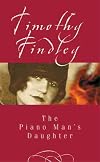
The Piano Man's Daughter
by Timothy Findley
On This Page
Description
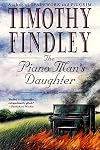
The Piano Man's Daughter is the tale of people who dream in songs -- two Irish immigrant families facing a new and uncertain future in turn-of-the-century Toronto. Narrated by Charlie Kilworth, whose birth is an echo of his mother's own illegitimate beginnings, The Piano Man's Daughter is the lyrical, multi-layered tale of Charlie's mother, Lily, his grandmother Ede, and their family. Lily is a woman pursued by her own demons, "making off with the matches just when the fire's caught hold," a show more beautiful, mad genius, first introduced as she sings in her mother's belly. Conceived when her mother falls in love with a musician, Lily is born in a field of flowers and grows into an odd, lonely child. As she matures, she becomes more and more alienated from real life, but this doesn't keep her from having a brief, mysterious affair while she's a student in wartime England. The result is Charlie, who has perfect pitch and a high tolerance for his mother's eccentricities. As Lily sinks deeper into madness, her once gentle nature is affected by the dark demons that inhabit her troubled mind. It is only after her death that Charlie, always Lily's protector and caretaker, is able to tell her story through loving but honest eyes, finding catharsis and hope in the painful but revealing process. show lessTags
Recommendations















Member Reviews
Beautiful Tale of a Mother's Madness: I've read very few books by Timothy Findley it's a bit hard to find his works here where I live. And have to rely much on Amazon or other online bookstores to find his works. However, the tale of Lily Kilworth is by far my favorite. His poignant narrative makes it very easy to imagine her life as it unfolds. Her brief moments of happiness are a joy just as the moments of torment are horrible to see. Very few books have brought me to tears yet with this one I found myself reaching for the tissue box as I turned the page. This book is truly a wonderful addition to those who appreciate good literature. My only complain is that like another reviewer here, I too think it has far too many Italics.
Findley writes so well that it is next to impossible to not be captivated from the beginning. This is a very well-written and powerful story, although I have to admit that the ending is a bit predictable. Nevertheless, one is drawn into the complex world of Lily Kilworth and her son Charlie, as Charlie searches to understand his mother, her illnesses and consequently both of their lives. Brilliant and wholly engaging.
What I found most intriguing about this book is it's narration. As a whole, it is narrated by the grandson of the "Piano Man" but he tells the story based on what he learned from his (grandson's) grandmother and mother (the title character) and his own observations. So the story really spans three generations.
I can't articulate what it was about this book that made me enjoy it. I chalk it up to a well-written and unique story with interesting characters. It's not difficult reading by any means, but it's not light and fluffy, either. It's literature! :)
I can't articulate what it was about this book that made me enjoy it. I chalk it up to a well-written and unique story with interesting characters. It's not difficult reading by any means, but it's not light and fluffy, either. It's literature! :)
While I love Timothy Findlay I had some trouble getting into this one. I think I had too many books on my plate and didn't give it my full attention. Findlay always did a superb job depicting instances of insanity as it appears in family stories.
There are a multitude of stories in this book, but the main story is that told by Charlie, the son of Lily, who is the Piano-Man's Daughter. He starts the story upon Lily's death in a mental asylum, and from page one the story carried me away so that I got absolutely nothing done all day but reading this novel.
Lily was conceived & born in the same field, in the late 1880s, raised on a farm in Canada and touched the lives of all of those around her. But Lily had an illness, seizures, not just the type coming from epilepsy, but a genetic defect that led to madness. All of her young life, her mother, Edith (Ede) had protected her and in so doing, denied herself, until the Piano Man's brother came along to claim her as his bride. While show more this was good for Ede, for Lily it meant the beginning of years of suffering.
Spanning the years from the 1880s through World War II, the novel is incredible. I can't even begin to describe it. The writing is beautiful, the characters are extremely vivid, wanting to leap off of the page. I highly highly recommend it. show less
Lily was conceived & born in the same field, in the late 1880s, raised on a farm in Canada and touched the lives of all of those around her. But Lily had an illness, seizures, not just the type coming from epilepsy, but a genetic defect that led to madness. All of her young life, her mother, Edith (Ede) had protected her and in so doing, denied herself, until the Piano Man's brother came along to claim her as his bride. While show more this was good for Ede, for Lily it meant the beginning of years of suffering.
Spanning the years from the 1880s through World War II, the novel is incredible. I can't even begin to describe it. The writing is beautiful, the characters are extremely vivid, wanting to leap off of the page. I highly highly recommend it. show less
What a heartbreakingly lovely novel. The characters were well-drawn, the plot moved forward gracefully - I enjoyed this very much. Will definitely look for more by this author. Recommended.
My husband picked up this freebie at a library conference at Jasper Park Lodge so I read it partly to read something of Findley's who was a Canadian author and as thanks to my husband for being so thoughtful. The book was a chore to read and will not be kept. It'll be dropped on the library give away table tomorrow.
Members
- Recently Added By
Published Reviews
ThingScore 75
Das Buch ist eine sentimentale, beinahe melancholische Familiensaga über vier Generationen, in der auf jeder Seite Wehmut über die verlorene Jugend und Sehnsucht nach Erfüllung unstillbarer Liebe mitschwingt. Mit der "Tochter des Klavierspielers" könnte es Findley diesmal gelingen, sich auch in Deutschland Gehör zu verschaffen.
added by Indy133
Lists

The Best of Canadian Literature
235 works; 33 members
Author Information

34+ Works 7,330 Members
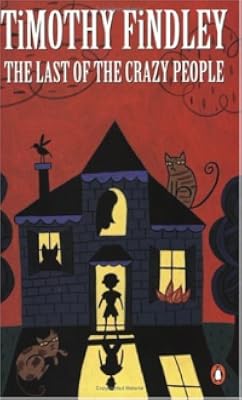
Timothy Findley was born in 1930. A native of Toronto, Canada, novelist and playwright Timothy Findley initially embarked upon an acting career. Findley worked for the Canadian Stratford Festival and later, after study at London's Central School of Speech and Drama, he toured Britain, Europe, and the United States as a contract player. While show more performing in The Matchmaker by Thornton Wilder, Findley was encouraged by the playwright to write fiction. Influenced by film techniques, Findley's first novel, The Last of the Crazy People (1967) is a penetrating look at a family of "emotional cripples" from a child's perspective. With his character Hooker, Findley captures the irrational logic of a child's mind without treating childhood sentimentally.The Butterfly Plague followed in 1969. The Wars (1978), Findley's most successful novel, has been translated into numerous languages and was made into a film. The Wars uses the device of a story-within-a-story to illustrate how a personality transcends elemental forces even while being destroyed by them. In 1981 Famous Last Words was published. This fictionalization of Hugh Selwyn Mauberley by Ezra Pound, a work that was already a "fictional fact," examines fascism. In Not Wanted on the Voyage (1984), Findley rewrites the story of Noah's Ark by giving voices to women, children, workers, animals, and folklore creatures, all of whom question Noah's authority. The novel turns into a parable that seems to challenge imperialism, eugenics, fascism, and any other force that endangers human survival. Again repeating an earlier text, Findley turns to Thomas Mann's Death in Venice to write The Telling of Lies (1986). This novel draws parallels between World War II atrocities and contemporary North America, which Findley sees as a metaphoric concentration camp. Findley died on June 20, 2002 in Provence, France (Bowker Author Biography) show less
Awards and Honors
Awards
Series
Belongs to Publisher Series
Gallimard, Folio (3522)
Common Knowledge
- Canonical title
- The Piano Man's Daughter
- Original title
- The Piano Man's Daughter
- Original publication date
- 1995
- Important places
- Toronto, Ontario, Canada
- Epigraph
- It is their fate to be isolated and thus original. Oliver Sacks
- Dedication
- For Margaret Gibson and for my cousin Isobelle Guthrie, in memory of my Aunt Ruth
- First words
- I had seen her just the day before—a day of pale blue skies and summer breezes.
- Last words
- (Click to show. Warning: May contain spoilers.)We were not—and we will never be—alone.
Classifications
Statistics
- Members
- 635
- Popularity
- 45,723
- Reviews
- 8
- Rating
- (3.88)
- Languages
- 5 — English, Finnish, French, German, Italian
- Media
- Paper, Audiobook
- ISBNs
- 18
- ASINs
- 8