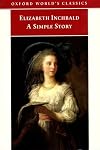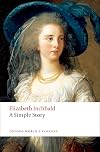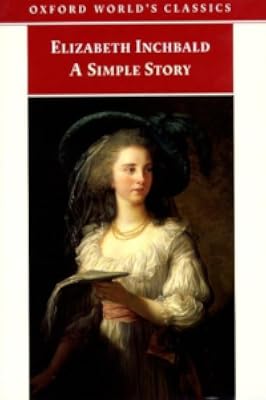
A Simple Story
by Elizabeth Inchbald
On This Page
Description
When Miss Milner announces her passion for her guardian, a Catholic priest, she breaks through the double barrier of religious vocation and society's standards of `proper' womanly behaviour. Her love is legitimized when Dorriforth is released from his vows, but she finds her own unorthodoxnature cannot conform to a marriage where her husband continues to be a stern moral guide. With a surenees of touch that prefigures Jane Austen, Elizabeth Inchbald shows that there is no simple answer to show more their predicament, and that their conflict can only be resolved in the next generation. show lessTags
Recommendations


















Member Reviews
"A Simple Story" reads as if it is a romantic drama presented as a novel. The dialogue often replicates a stage setting. The emotions of the characters verge on histrionic dramatics. Mrs. Inchbald was an accomplished actress and playwright, hence these effects.
This is nevertheless an intersting novel to read because of the novelty and daring of its subject matter. There is an emphasis on the differing outcomes for the two female leads; Miss Milner who is arch, sexually active (but blessedly glossed by the writer), witty and disruptive and her daughter, Lady Matilda who proves submissive, educated, feminine and faithful to her moody father. It cannot escape notice that the latter's outward success in romantic and worldly endeavours show more rounds out the narrative in order to satisfy a public's need for happy endings.
It has been gratifying to read a novel full of new perspectives on Eighteenth Century English life by someone I hadn't heard of before.
There is also a fine informative Introduction by Jane Spencer which can be read with equal satisfaction both before or/and after completion. show less
This is nevertheless an intersting novel to read because of the novelty and daring of its subject matter. There is an emphasis on the differing outcomes for the two female leads; Miss Milner who is arch, sexually active (but blessedly glossed by the writer), witty and disruptive and her daughter, Lady Matilda who proves submissive, educated, feminine and faithful to her moody father. It cannot escape notice that the latter's outward success in romantic and worldly endeavours show more rounds out the narrative in order to satisfy a public's need for happy endings.
It has been gratifying to read a novel full of new perspectives on Eighteenth Century English life by someone I hadn't heard of before.
There is also a fine informative Introduction by Jane Spencer which can be read with equal satisfaction both before or/and after completion. show less
I hadn't heard of Elizabeth Inchbald before- though had encountered one of her plays - 'Lovers' Vows' - mentioned in Jane Austen's 'Mansfield Park' , where it was deemed too risque for the young people's amateur theatricals.
Written shortly before Jane Austen's works (this was published in 1791), Inchbald has all the elegant turn of phrase of her later rival, but I didn't find any of the characters in the least credible. The whole felt more like a rather stagey, OTT ploay, where people faint, raise their eyes to heaven and behave in a generally unrealistic fashion.
[Spoiler alert] The story starts with wealthy Catholic priest, Mr Dorriforth, made guardian of the (Protestant) daughter of a late friend- Miss Milner. I found his ward a show more little too arch and duplicitous to engage with: her assumed romantic inclinations for a young nobleman later prove to have been subterfuge to cover her feelings for her guardian.
Yet even when Dorriforth happily comes into a title (the Vatican freeing him from his vows, so as to marry and further the Catholic cause) and the love can eventually be spoken, Miss Milner's general intractibility grates on the reader....
In the second part, we find a very different scenario. Years have passed, Miss Milner (now Lady Elmwood) has deceived her husband who has cast off both her and their daughter. He now lives an embittered and rather insane existence with his nephew and an elderly Catholic priest chum. Lady Matilda's name may not be spoken by anyone on pain of banishment...
It's perfectly readable and has an elegance and fluidity to the writing, but Jane Austen it is not! show less
Written shortly before Jane Austen's works (this was published in 1791), Inchbald has all the elegant turn of phrase of her later rival, but I didn't find any of the characters in the least credible. The whole felt more like a rather stagey, OTT ploay, where people faint, raise their eyes to heaven and behave in a generally unrealistic fashion.
[Spoiler alert] The story starts with wealthy Catholic priest, Mr Dorriforth, made guardian of the (Protestant) daughter of a late friend- Miss Milner. I found his ward a show more little too arch and duplicitous to engage with: her assumed romantic inclinations for a young nobleman later prove to have been subterfuge to cover her feelings for her guardian.
Yet even when Dorriforth happily comes into a title (the Vatican freeing him from his vows, so as to marry and further the Catholic cause) and the love can eventually be spoken, Miss Milner's general intractibility grates on the reader....
In the second part, we find a very different scenario. Years have passed, Miss Milner (now Lady Elmwood) has deceived her husband who has cast off both her and their daughter. He now lives an embittered and rather insane existence with his nephew and an elderly Catholic priest chum. Lady Matilda's name may not be spoken by anyone on pain of banishment...
It's perfectly readable and has an elegance and fluidity to the writing, but Jane Austen it is not! show less
I am a fan of books written WAY back in the day, especially if they are still easy to understand and shed light on the differences between modern and olden sensibilities. First published in 1791, this is a bit older than my usual 19th century favorites. But it is still a wonderful portal into the past.
The spelling, at least in the edition I read, at that time had yet to be standardized, and they used many words that no longer exist in the English language. But yu can still understand things perfectly, (except perhaps for the use of the word lovelace as an insult), and it's extreme sentimentality, the way that people are in danger of death from unrequited love, the fact that the priests take snuff (cocaine) and other such era related show more shockers were enough to keep me riotously entertained. To the people of this time, this was nothing surprising. Even the fact that incest (real and figurative- Miss Milner wishes to marry her father figure, while later her daughter marries her cousin) is a prominent theme would probably not have raised any eyebrows. Now though, the sentiments expressed, the injustices upheld, and the fact that everyone adheres to an archaic mode of thought make this book positively startling.
I for one, gained a lot of insight, and a great appreciation for living in a post feminism world. Plus, it made me laugh a LOT, though that was never the author's intention. show less
The spelling, at least in the edition I read, at that time had yet to be standardized, and they used many words that no longer exist in the English language. But yu can still understand things perfectly, (except perhaps for the use of the word lovelace as an insult), and it's extreme sentimentality, the way that people are in danger of death from unrequited love, the fact that the priests take snuff (cocaine) and other such era related show more shockers were enough to keep me riotously entertained. To the people of this time, this was nothing surprising. Even the fact that incest (real and figurative- Miss Milner wishes to marry her father figure, while later her daughter marries her cousin) is a prominent theme would probably not have raised any eyebrows. Now though, the sentiments expressed, the injustices upheld, and the fact that everyone adheres to an archaic mode of thought make this book positively startling.
I for one, gained a lot of insight, and a great appreciation for living in a post feminism world. Plus, it made me laugh a LOT, though that was never the author's intention. show less
Ratings
Members
- Recently Added By
Lists

Books Featured in Jane Austen's Bookshelf
37 works; 7 members
Author Information

24+ Works 549 Members
Some Editions
Series
Belongs to Publisher Series
Work Relationships
Is abridged in
Common Knowledge
- Canonical title
- A Simple Story
- Original publication date
- 1791
- People/Characters
- Miss Milner; Mr Dorriforth (Lord Elmwood); Mr Sandford; Miss Woodley; Lady Matilda Elmwood; Mr Rushbrook
- First words
- Dorriforth, bred at St Omer's in all the scholastic rigour of that college, was by education, and the solemn vows of his order, a Roman Catholic priest - but nicely discriminating between the philosophical and the superstitio... (show all)us part of that character, and adopting the former only, he possessed qualities not unworthy the first professors of Christianity- every virtue which it was his vocation to preach, it was his care to practise; nor was he in the class of those of the religious who, by secluding themselves from the world, fly the merit they might have in reforming mankind.
- Last words
- (Click to show. Warning: May contain spoilers.)And Mr milner, Matilda's grandfather, had better have given his fortune to a distant branch of his family - as Matilda's father once meant to do- so he had bestowed upon his daughter A PROPER EDUCATION.
Classifications
Statistics
- Members
- 433
- Popularity
- 70,718
- Reviews
- 4
- Rating
- (3.49)
- Languages
- English, French
- Media
- Paper, Audiobook, Ebook
- ISBNs
- 25
- ASINs
- 8