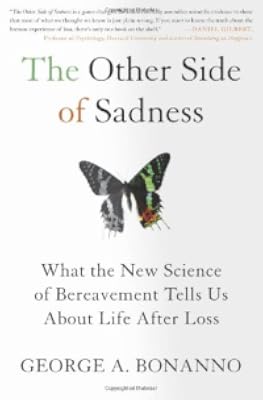
The Other Side of Sadness: What the New Science of Bereavement Tells Us About Life After Loss
by George A. Bonanno
On This Page
Description
In this thoroughly revised and updated classic, a renowned psychologist shows that mourning is far from predictable, and all of us share a surprising ability to be resilientThe conventional view of grieving—encapsulated by the famous five stages of grief: denial, anger, bargaining, depression, and acceptance—is defined by a mourning process that we can only hope to accept and endure.
In The Other Side of Sadness, psychologist and emotions expert George Bonanno argues otherwise. Our show more inborn emotions—anger and denial, but also relief and joy—help us deal effectively with loss. To expect or require only grief-stricken behavior from the bereaved does them harm. In fact, grieving goes beyond mere sadness, and it can actually deepen interpersonal connections and even lead to a new sense of meaning in life. show less
Tags
Recommendations
















Member Reviews
I really liked the approach of this book. I would never claim to be an expert on loss, but I’ve been devastated by the loss of my wife, and I’ve read many books on grieving … basically, I’ve been around the block. The heart of the book was using research data to argue against many long-held beliefs and thoughts. For example, many widows and widowers feel that their loved one is always around and maintain that “relationship” for years. Previously it was professionally thought that this actually retarded people’s shot at “coping.” The author compared a number of studies and found that these survivors who were holding onto their relationships, were doing quite well … nothing was retarded. It showed the power of facts show more against those old standard practices, practices that were based on very little.
Much of the book was straightforward and made sense, but just a few times I found myself wanting to give it a toss, which happens often with books offering me advice. I never react well when someone tells me how I should feel. Bringing science and data together is always good when there is enough of it to actually tell us something relevant. This is one of the better books on the subject. There are so many accepted and wrong-headed assumptions about loss that have held on for far too long. Anytime I see someone state that it takes “x” number of months or years to get over a loss I’m greatly irritated. Likewise, when anyone starts telling “how” and “when” survivors “should” handle a loss, I’m out of there.
My strongest feeling is that grief handles the survivor, and not the other way around. While many people have similar reactions to losing people, everyone handles events differently. In the same way that everyone loves very differently, people also grieve very differently. So often a friend’s advice is given with the best of intentions, but many times they just want their surviving friend to be back to their old self, to be normal, and they also seem to be thinking, “please don’t make me talk about loss and death again.” I would also like to rail against the term a “new normal” as it a stupid combination of words. Nobody who has lost someone near and dear will ever be the same, loss and death changes people in so many ways … forever.
To me, C.S. Lewis’s raw and unfiltered book A Grief Observed is still one of the strongest books about loss, and it was nice to see him quoted several times in this book. Much of what I liked about The Other Side of Sadness was that many readers suffering from a loss will not be made to feel that they’re odd and completely broken, they will see how many other people suffer from the same feelings, and having those feelings doesn’t make anyone a freak. To sum up, dealing with factual knowledge around a major life change is much better than silly, unproven theory and bromide from years past. show less
Much of the book was straightforward and made sense, but just a few times I found myself wanting to give it a toss, which happens often with books offering me advice. I never react well when someone tells me how I should feel. Bringing science and data together is always good when there is enough of it to actually tell us something relevant. This is one of the better books on the subject. There are so many accepted and wrong-headed assumptions about loss that have held on for far too long. Anytime I see someone state that it takes “x” number of months or years to get over a loss I’m greatly irritated. Likewise, when anyone starts telling “how” and “when” survivors “should” handle a loss, I’m out of there.
My strongest feeling is that grief handles the survivor, and not the other way around. While many people have similar reactions to losing people, everyone handles events differently. In the same way that everyone loves very differently, people also grieve very differently. So often a friend’s advice is given with the best of intentions, but many times they just want their surviving friend to be back to their old self, to be normal, and they also seem to be thinking, “please don’t make me talk about loss and death again.” I would also like to rail against the term a “new normal” as it a stupid combination of words. Nobody who has lost someone near and dear will ever be the same, loss and death changes people in so many ways … forever.
To me, C.S. Lewis’s raw and unfiltered book A Grief Observed is still one of the strongest books about loss, and it was nice to see him quoted several times in this book. Much of what I liked about The Other Side of Sadness was that many readers suffering from a loss will not be made to feel that they’re odd and completely broken, they will see how many other people suffer from the same feelings, and having those feelings doesn’t make anyone a freak. To sum up, dealing with factual knowledge around a major life change is much better than silly, unproven theory and bromide from years past. show less
Conventional wisdom holds that grief unfolds in a five-stage process: denial, anger, bargaining, depression, and acceptance. But in The Other Side of Sadness, psychologist George Bonanno overturns this theory of grief--one that we have relied on for over forty yeart--and shows us that it does not, in fact, represent what the majority of us go through when we lose a loved one.
An emotions expert and renowned authority on bereavement, Bonanno shows how the accepted model for mourning discounts our remarkable capacity for resilience. His research demonstrates that we are hardwired to deal with losses efficiently, and often without the help of a mental health professional. Grief, he explains, can actually deepen interpersonal connections show more and, in some cases, leads to a profound new sense of meaning in life.
In this paradigm-shifting new look at life and loss, Bonanno highlights cutting-edge studies on facial expressions, genuine smiles, and memory and personality tests to show how we effectively and naturally overcome sorrow. He travels to China in search of mourning rituals. And explores wide-ranging case studies, like a mother dealing with the death of her daughter on 9/11, a wife who perseveres after losing her devoted husband, and his own reflections on the death of his father.
Revealing a surprisingly positive perspective on this universal experience, The Other Side of Sadness is a must-read for anyone interested in our innate ability to thrive in the face of adversity. show less
An emotions expert and renowned authority on bereavement, Bonanno shows how the accepted model for mourning discounts our remarkable capacity for resilience. His research demonstrates that we are hardwired to deal with losses efficiently, and often without the help of a mental health professional. Grief, he explains, can actually deepen interpersonal connections show more and, in some cases, leads to a profound new sense of meaning in life.
In this paradigm-shifting new look at life and loss, Bonanno highlights cutting-edge studies on facial expressions, genuine smiles, and memory and personality tests to show how we effectively and naturally overcome sorrow. He travels to China in search of mourning rituals. And explores wide-ranging case studies, like a mother dealing with the death of her daughter on 9/11, a wife who perseveres after losing her devoted husband, and his own reflections on the death of his father.
Revealing a surprisingly positive perspective on this universal experience, The Other Side of Sadness is a must-read for anyone interested in our innate ability to thrive in the face of adversity. show less
Even though it says some obvious things, and veers off in tangents having to do with the author's personal history that don't seem to belong in a book that purports to be about the science of grieving, the good news is that people don't have to feel beholden to a schedule of bereavement such as the Kubler Ross' step system describes. Bonanno has new studies that show many many people are resilient after the death of an important person in their lives.
Nicely written. Makes one think about loss and grief in a more profound way.
Interesting research based coverage of grief. Not as easy reading as "On Grief and Grieving" and takes a totally different outlook on the grieving process. I find it worthwhile to provide anew perspective.
Ratings
Members
- Recently Added By
Lists

Deathreads
78 works; 2 members

Tom's Bookstore
346 works; 2 members
Author Information
5+ Works 241 Members
Classifications
- Genres
- Nonfiction, General Nonfiction
- DDC/MDS
- 155.937 — Philosophy & psychology Psychology Differential and developmental psychology Environmental psychology Influences of Traumatic Experiences and Bereavement Death and Dying
- LCC
- BF575 .D35 .B66 — Philosophy, Psychology and Religion Psychology Psychology Affection. Feeling. Emotion
- BISAC
Statistics
- Members
- 184
- Popularity
- 178,631
- Reviews
- 5
- Rating
- (3.90)
- Languages
- English
- Media
- Paper, Audiobook, Ebook
- ISBNs
- 12
- ASINs
- 6