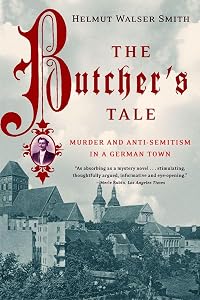
The Butcher's Tale: Murder and Anti-Semitism in a German Town
by Helmut Walser Smith
On This Page
Description
In 1900, the discovery of the dismembered body of an eighteen-year-old boy in a small Prussian town brought a charge of ritual-murder against the local Jewish community and sparked anti-Semetic riots. Smith examines the case and the history of the charge of ritual murder, also known as the blood libel.Tags
Recommendations













Member Reviews
The Butcher’s Tale is, at its core, an examination of how antisemitism operates—not in theory, but in practice—through the lens of a single 1900 murder in a small German town.
Smith opens with the crime: the death of the Winter boy, discovered dismembered by his father. From there, the narrative follows the investigation as suspicion quickly shifts toward a Jewish butcher, fueled by the long-standing myth of ritual murder—the belief that Jews kill Christian children for religious purposes. The victim, notably, was eighteen, already complicating the accusation from the start.
Where the book excels is in its dismantling of this accusation. Smith methodically traces the origins of antisemitism, the development of the blood libel show more myth, and its recurrence across European history. Each element of the accusation is taken apart and shown to be historically unfounded. In that sense, the book is rigorous, careful, and intellectually honest.
However, this strength is also where the structure becomes frustrating.
The book spends a significant portion of its middle repeating variations of the same pattern: accusation, historical precedent, debunking. While this likely serves to demonstrate how deeply embedded and persistent these beliefs were, it can feel repetitive to a reader who is already convinced early on. The argument is strong, but it is made again and again, rather than being synthesized into a clearer explanatory model.
By the time the narrative returns to the central crime, the expectations have shifted. After such a thorough and methodical dismantling of the antisemitic framework, there is a sense that the same clarity will be applied to the murder itself. Instead, the ending remains unresolved. Various possibilities are suggested—a sexual component, suspicion toward a teacher—but nothing is proven.
Historically, this is honest. But structurally, it creates an imbalance: the book rigorously proves what did not happen, while leaving what did happen uncertain. That contrast makes the conclusion feel less satisfying than it might otherwise have.
What lingers most is not the identity of the killer, but the damage done in the meantime. The Jewish community in the town suffered lasting consequences, with many forced to leave and rebuild their lives elsewhere. In that sense, the book succeeds in showing how belief—unsupported but widely repeated—can have real and irreversible effects.
Overall, The Butcher’s Tale is a well-written and important work, particularly for readers interested in the mechanics of antisemitism and how such narratives take hold. Its structure, however, may feel slow or repetitive to readers who are more interested in analysis than accumulation. It is less a clean argument than a layered reconstruction—and whether that approach works will depend on what the reader is looking for. show less
Smith opens with the crime: the death of the Winter boy, discovered dismembered by his father. From there, the narrative follows the investigation as suspicion quickly shifts toward a Jewish butcher, fueled by the long-standing myth of ritual murder—the belief that Jews kill Christian children for religious purposes. The victim, notably, was eighteen, already complicating the accusation from the start.
Where the book excels is in its dismantling of this accusation. Smith methodically traces the origins of antisemitism, the development of the blood libel show more myth, and its recurrence across European history. Each element of the accusation is taken apart and shown to be historically unfounded. In that sense, the book is rigorous, careful, and intellectually honest.
However, this strength is also where the structure becomes frustrating.
The book spends a significant portion of its middle repeating variations of the same pattern: accusation, historical precedent, debunking. While this likely serves to demonstrate how deeply embedded and persistent these beliefs were, it can feel repetitive to a reader who is already convinced early on. The argument is strong, but it is made again and again, rather than being synthesized into a clearer explanatory model.
By the time the narrative returns to the central crime, the expectations have shifted. After such a thorough and methodical dismantling of the antisemitic framework, there is a sense that the same clarity will be applied to the murder itself. Instead, the ending remains unresolved. Various possibilities are suggested—a sexual component, suspicion toward a teacher—but nothing is proven.
Historically, this is honest. But structurally, it creates an imbalance: the book rigorously proves what did not happen, while leaving what did happen uncertain. That contrast makes the conclusion feel less satisfying than it might otherwise have.
What lingers most is not the identity of the killer, but the damage done in the meantime. The Jewish community in the town suffered lasting consequences, with many forced to leave and rebuild their lives elsewhere. In that sense, the book succeeds in showing how belief—unsupported but widely repeated—can have real and irreversible effects.
Overall, The Butcher’s Tale is a well-written and important work, particularly for readers interested in the mechanics of antisemitism and how such narratives take hold. Its structure, however, may feel slow or repetitive to readers who are more interested in analysis than accumulation. It is less a clean argument than a layered reconstruction—and whether that approach works will depend on what the reader is looking for. show less
The Butcher's Tale is a very good, and very interesting book. The "Tale" centres on a particular event---the murder, and dismemberment, of a young man in the small town of Konitz in March, 1900 which turned into a huge anti-semitic protest because, in public opinion, the murder was attributed to a Jewish butcher as an example of the age-old libel about Jews killing Christians to get their blood. What makes the book particularly interesting is that Smith not only explores the event itself, and comes up with a well-reasoned theory as to who might actually have committed the murder, but he goes much further in exploring the meaning and the dynamic of the reaction to the murder and the strong anti-semitic element that it took on. He does so show more by drawing on historical analysis, sociology, anthropology, psychology, and communications and literary theories. The following sums up his approach:
"Process is what makes latent anti-Semitism manifest, transforming private enmity and neighborly disputes into the blood-stained canvases of persecutory landscapes. In one context, the whispers of rumor and the wages of private malice all on heedless ears; in another, they unleash a murderous dynamic. The preexistence of anti -Semitism, nationalism, or racism influences outcomes, but the outcome cannot be fully understood by a static measure of attitudes, anti-Semitic or otherwise. Looking at the process, we see historical forces converging: how local enmities become potent symbols resonating with larger antagonisms; how spiteful stories and tavern tales are elevated to public spectacle; and how these tales conform to a preexisting pattern of political and religious beliefs. We can also see how the accusations shift relations of power and support political agendas, and how people caught up in the resulting dynamic come to believe the objective truth of their own lies."
It is interesting to note that throughout the various events and investigations, the authorities never gave any credence to the accusation of ritual murder and they saw the wild and implausible accusations for what they were, and often punished those perpetrators for perjury. It was also the authorities who twice called in the army to make sure that demonstrations and high feelings did not get out of hand. This, as Smith points out, was a key point: "In 1900, imperial Germany safeguarded the rule of law and ensured the protection of its citizens, including Jews. Four decades later, the Third Reich attempted to annihilate the Jews...and encouraged violence. In this Hobbesian perspective, the state remains the only barrier between us and the hatchets of our neighbors, and, as a corollary, in 1900 only the Prussian army saved the Jews of Konitz from the clubs and axes of ‘ordinary Germans'".
Well documented, well researched, well written; a thoughtful and thought-provoking book. show less
"Process is what makes latent anti-Semitism manifest, transforming private enmity and neighborly disputes into the blood-stained canvases of persecutory landscapes. In one context, the whispers of rumor and the wages of private malice all on heedless ears; in another, they unleash a murderous dynamic. The preexistence of anti -Semitism, nationalism, or racism influences outcomes, but the outcome cannot be fully understood by a static measure of attitudes, anti-Semitic or otherwise. Looking at the process, we see historical forces converging: how local enmities become potent symbols resonating with larger antagonisms; how spiteful stories and tavern tales are elevated to public spectacle; and how these tales conform to a preexisting pattern of political and religious beliefs. We can also see how the accusations shift relations of power and support political agendas, and how people caught up in the resulting dynamic come to believe the objective truth of their own lies."
It is interesting to note that throughout the various events and investigations, the authorities never gave any credence to the accusation of ritual murder and they saw the wild and implausible accusations for what they were, and often punished those perpetrators for perjury. It was also the authorities who twice called in the army to make sure that demonstrations and high feelings did not get out of hand. This, as Smith points out, was a key point: "In 1900, imperial Germany safeguarded the rule of law and ensured the protection of its citizens, including Jews. Four decades later, the Third Reich attempted to annihilate the Jews...and encouraged violence. In this Hobbesian perspective, the state remains the only barrier between us and the hatchets of our neighbors, and, as a corollary, in 1900 only the Prussian army saved the Jews of Konitz from the clubs and axes of ‘ordinary Germans'".
Well documented, well researched, well written; a thoughtful and thought-provoking book. show less
A rather fascinating book about antisemitism and the myth of the blood ritual set in the small Prussian town of Konitz during the year 1900. The incident starts off when the torso of a local high school student Ernst Winter who had been missing was found. Quickly other parts were found and due and the autopsy that concluded, rather falsely that his blood had been drained before he was cut up. In addition, according to Hoffmann, Christian butcher in the town, whose family and newspaper connections would play a large part in whipping up the antisemitic frenzy identified the cuts as done by a Kosher butcher . This lead the public to believe that it was the Jewish community that had killed the boy so they could get his blood for the so show more called blood ritual that they believed Jews participated in. This view was then whipped into a frenzy by antisemitic newspapers that sent reporters to cover the case. Eventually it would get so bad that the mayor of the town had to call in the army to suppress rioters who had started to attack the Jewish people of the town and wanted to lynch the Jewish butch Adolf Lewy who was accused of committing the crime in his cellar. Once things started to cool investigates easily debunked the blood ritual charges however a large part of the community thought that they were shielding the Jews or had been paid off. At the end no one was ever charged for the crime but some people were sent to jail for perjury for lying about events during the case or in the case of Moritz Lewy, Adolfs son falsely sentenced for perjury because he couldn't remember if he had ever met Winter on the street.
Smith does a great job laying out the events of the crime and succeeding events as well as looking at all the people involved and analyzing their motives. My only real problem this the book was the chapter that accounts for the history and origin of the blood ritual charge. While it was interesting, I felt it took away from the main point of the book which was the Konitz Affair and the antisemitism during the event but could see why it was included so as to give the reader an idea why the people believed what they did. Although I think he makes up for it with the last chapter the presents some compelling cases as to who probably really killed Winter and why.
I also found it interesting that the authority throughout the affair never believed the Blood ritual charge and that it was mainly the poor and middle class who promoted it in what was for the most part settlements of old grudges. Another interesting point Smith makes is that it seemed that Germans of Catholic persuasion tended to be the majority of the persecutors during this time while the majority of blood ritual accusation happened predominantly in Protestant towns. It's rather sad that only 40 years later instead of protecting the Jewish people of Germany they would take part in their extinction allowing neighbors to turn on neighbor with no protection for the victims at all.
Overall if you're interested in cases of antisemitism prior to WW2 and/or are interested in trying to understand how you get to the outcome of the Holocaust this is a great book to pick up, as it show trends that might have been contributing factors. Furthermore, Smith as a nice writing style that at times makes you think you are reading a crime thriller and he as meticulously researched the event to create a very though provoking book on how easy it is for us to slide into our prejudges. show less
Smith does a great job laying out the events of the crime and succeeding events as well as looking at all the people involved and analyzing their motives. My only real problem this the book was the chapter that accounts for the history and origin of the blood ritual charge. While it was interesting, I felt it took away from the main point of the book which was the Konitz Affair and the antisemitism during the event but could see why it was included so as to give the reader an idea why the people believed what they did. Although I think he makes up for it with the last chapter the presents some compelling cases as to who probably really killed Winter and why.
I also found it interesting that the authority throughout the affair never believed the Blood ritual charge and that it was mainly the poor and middle class who promoted it in what was for the most part settlements of old grudges. Another interesting point Smith makes is that it seemed that Germans of Catholic persuasion tended to be the majority of the persecutors during this time while the majority of blood ritual accusation happened predominantly in Protestant towns. It's rather sad that only 40 years later instead of protecting the Jewish people of Germany they would take part in their extinction allowing neighbors to turn on neighbor with no protection for the victims at all.
Overall if you're interested in cases of antisemitism prior to WW2 and/or are interested in trying to understand how you get to the outcome of the Holocaust this is a great book to pick up, as it show trends that might have been contributing factors. Furthermore, Smith as a nice writing style that at times makes you think you are reading a crime thriller and he as meticulously researched the event to create a very though provoking book on how easy it is for us to slide into our prejudges. show less
Ratings
Members
- Recently Added By
Author Information

10 Works 450 Members
Helmut Walser Smith is the Martha Rivers Ingram Professor of History at Vanderbilt University, a recipient of a Guggenheim Fellowship, ad the author of the acclaimed the Butcher's Tale: Murder and Anti-Semitism in a German Town. He lives in Nashville, Tennessee.
Awards and Honors
Common Knowledge
- Canonical title*
- Het verhaal van de slager
- Original title
- Het verhaal van de slager : moord en antisemitisme in een Duitse stad
- Original publication date
- 2002
- People/Characters
- Ernst Winter; Friedrich Fiedler; Wolf Israelski; Heinrich von Treitschke; Johann Braun; Elise Freitag (show all 17); Gustav Hoffmann; Julius Lehmann; Theodor Knievel; Bernhard Masloff; Anna Ross; Paul Orda; Johann Winkelmann; Alex Prinz; Mathilde Rutz; Hermann Josefsohn; Adolph Lewy
- Important places
- Chojnice, Pomerania, Poland (as Konitz, West Prussia, Germany); Hammerstein, Neuwied, Rhineland-Palatinate, Germany
- Epigraph
- The greater part of historical and natural phenomena are not simple, or not simple in the way we would like. - Primo Levi
When all is said and done, a single word,... (show all) "understanding" is the beacon light of our studies - Marc Bloch - Dedication
- For Merke "Not until all the hills are flat..."
- First words
- A murder occured on a Sunday night, March 11, 1900, in Konitz, a small town on the eastern reaches of the German Empire in what is now Poland.
- Last words
- (Click to show. Warning: May contain spoilers.)Yet the house of Adolph Lewy still stands, three doors down from Hoffmann's, both in the shadows of the Catholic church, which for centuries nurtured the ritual-murder tale.
- Blurbers
- Gay, Peter
*Some information comes from Common Knowledge in other languages. Click "Edit" for more information.
Classifications
- Genres
- Nonfiction, History, Anthropology, General Nonfiction
- DDC/MDS
- 305.892 — Society, government, & culture Social sciences, sociology & anthropology Social group - Age, Gender, Ethnicity Ethnic and national groups Other ethnic and national groups Semites
- LCC
- DS146 .G4 .S57 — History of Europe, Asia, Africa and Oceania Asia History of Asia Israel (Palestine). The Jews Jews outside of Palestine
- BISAC
Statistics
- Members
- 215
- Popularity
- 152,551
- Reviews
- 3
- Rating
- (3.76)
- Languages
- Dutch, English, German
- Media
- Paper, Ebook
- ISBNs
- 6
- ASINs
- 3