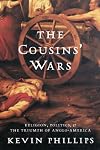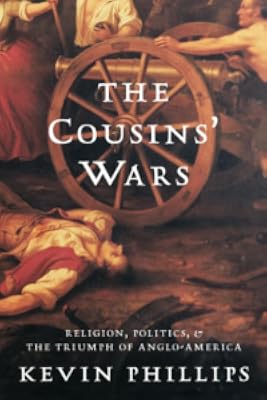
The Cousins' Wars: Religion, Politics, Civil Warfare, And The Triumph Of Anglo-America
by Kevin P. Phillips
On This Page
Description
The question at the heart of The Cousins' Wars is this: How did Anglo-America evolve over a mere three hundred years from a small Tudor kingdom into a global community with such a cultural and linguistic hegemonic grip on the world today, while the other European powers - from Spain to Germany - did not. The answer to this, according to Phillips, can be found in a close examination of the English-speaking people's three major internecine conflicts - the English Civil War, the American show more Revolution, and the American Civil War. These wars between cousins functioned as crucial anvils on which various religious, ethnic, and political alignments and successes were hammered out, setting Great Britain and America on a unique two-track path toward world leadership. show lessTags
Recommendations






Member Reviews
The Cousins' Wars considers the English Civil War (1642-49), the American Revolutionary War (1775-81) and the American Civil War (1861-65) as an evolutionary sequence of events, each successive war an outgrowth of its predecessor, during which the English-speaking peoples (what Phillips terms "Anglo-America") struggled to decide whether we would be defined by the religious and political ideals that set us apart from the rest of Europe--congregationalism, freedom of conscience, parliamentary democracy, individual liberty and a sense of mission in the world--or by the more mundane realities that have at times conflicted with those ideals--episcopacy, the Divine Right of Kings, Southern chattel slavery.
Author Kevin Phillips (one of the show more most important American political analysts of his generation) finds a remarkable demographic continuity in all areas--geography, religion and politics--between the two opposing sides in each of the three wars he considers. In the 1620s and 1630s, it was from the Puritan populations of East Anglia and Southwest England that the nascent settlements in Massachusetts, Connecticut and Rhode Island drew their populations; Oliver Cromwell himself at one point boarded a ship bound for Massachusetts Bay, but was prevented from setting sail by Royal officials. Those Puritans who remained behind--the brothers and fathers of the original New England settlers--became the backbone of the Long Parliament that stood against Charles I in the 1640s, made war against their Sovereign and ultimately took the step (unparalleled in British history) of ordering the execution of their monarch and establishing an English republic. Following the English Civil War, many of the veterans of the defeated Royalist armies fled England and settled in Virginia and the Carolinas--the University of Virginia's athletic teams are today nicknamed the Cavaliers because this was the name by which Royalist soldiers were known.
Come the American Revolutionary War, and in both Britain and the colonies the same divisions reassert themselves. In England, support for the Revolutionaries was strongest in East Anglia and the Southwest, the old stomping ground of the Puritans--and also by now the hotbed of the Whigs, the political party opposed to Royal influence in Parliament. Meanwhile, in the colonies themselves, the independence movement itself was really just a product of Puritan New England, and were it not for some skilful political manoeuvring by John Adams of Massachusetts and Benjamin Franklin (of Pennsylvania, but born and raised in Boston) at the Second Continental Congress, might possibly have never spread southward to the other colonies, just as it never spread northward into the Canadas. Conversely, the South, with its Cavalier heritage, was (along with New York and Philadelphia) precisely the area most opposed to the Revolutionary cause.
And these trends continue into the American Civil War. Again the impetus for both Unionism and abolition comes almost wholly from New England, and from a strip that extends horizontally across the map of the United States through upstate New York, Michigan and Wisconsin (Phillips calls this area "Greater Connecticut") that was settled by pioneers from southern New England. And I hardly have to say where the secessionist, anti-abolition sentiment arose (though I think its notable that, as with the Revolutionary War, the strongest antiwar sentiment in the North again came from New York City).
Looked at through Phillips's lens, we see each of these three wars as essentially the same conflict, albeit with the specifics tailored to their individual contexts. But at the root, each sees the conflict between the traditional English belief in a man's right to rule himself and a tendency towards absolutism--whether that absolutism is monarchy, imperialism or one human being owning another. show less
Author Kevin Phillips (one of the show more most important American political analysts of his generation) finds a remarkable demographic continuity in all areas--geography, religion and politics--between the two opposing sides in each of the three wars he considers. In the 1620s and 1630s, it was from the Puritan populations of East Anglia and Southwest England that the nascent settlements in Massachusetts, Connecticut and Rhode Island drew their populations; Oliver Cromwell himself at one point boarded a ship bound for Massachusetts Bay, but was prevented from setting sail by Royal officials. Those Puritans who remained behind--the brothers and fathers of the original New England settlers--became the backbone of the Long Parliament that stood against Charles I in the 1640s, made war against their Sovereign and ultimately took the step (unparalleled in British history) of ordering the execution of their monarch and establishing an English republic. Following the English Civil War, many of the veterans of the defeated Royalist armies fled England and settled in Virginia and the Carolinas--the University of Virginia's athletic teams are today nicknamed the Cavaliers because this was the name by which Royalist soldiers were known.
Come the American Revolutionary War, and in both Britain and the colonies the same divisions reassert themselves. In England, support for the Revolutionaries was strongest in East Anglia and the Southwest, the old stomping ground of the Puritans--and also by now the hotbed of the Whigs, the political party opposed to Royal influence in Parliament. Meanwhile, in the colonies themselves, the independence movement itself was really just a product of Puritan New England, and were it not for some skilful political manoeuvring by John Adams of Massachusetts and Benjamin Franklin (of Pennsylvania, but born and raised in Boston) at the Second Continental Congress, might possibly have never spread southward to the other colonies, just as it never spread northward into the Canadas. Conversely, the South, with its Cavalier heritage, was (along with New York and Philadelphia) precisely the area most opposed to the Revolutionary cause.
And these trends continue into the American Civil War. Again the impetus for both Unionism and abolition comes almost wholly from New England, and from a strip that extends horizontally across the map of the United States through upstate New York, Michigan and Wisconsin (Phillips calls this area "Greater Connecticut") that was settled by pioneers from southern New England. And I hardly have to say where the secessionist, anti-abolition sentiment arose (though I think its notable that, as with the Revolutionary War, the strongest antiwar sentiment in the North again came from New York City).
Looked at through Phillips's lens, we see each of these three wars as essentially the same conflict, albeit with the specifics tailored to their individual contexts. But at the root, each sees the conflict between the traditional English belief in a man's right to rule himself and a tendency towards absolutism--whether that absolutism is monarchy, imperialism or one human being owning another. show less
This is quite a book to pore through. I had never thought about the similarity of peoples fighting the English Civil War in the 17th century, the American Revolution in the 18th century, and the U.S. Civil War in the 19th. This is the divide between the landowning aristocracy that supports the crown, respects privileges, and holds slaves on the one hand; and the artisan/small land owner who believes in individual rights, the freedom to make political decisions, and equality of people on the other. Kevin Phillips supports his thesis with a torrent of words and really interesting maps and charts. The notes and index are quite thorough.
Dense as hell, but it does an excellent job of showing how divisions in 17th Century England led to a series of three war: English Civil War, American Revolution, and the American Civil War.
Very good, but deeper and denser than I would have liked.
Have read first 3 chapters. Good so far.
I have not yet read this book but I am very impressed that professor Edward Countryman gave it a very positive review in AHR:
http://www.historycooperative.org/cgi-bin/justtop.cgi?act=justtop&url=http:/...
http://www.historycooperative.org/cgi-bin/justtop.cgi?act=justtop&url=http:/...
American History
Members
- Recently Added By
Published Reviews
ThingScore 75
Phillips (Arrogant Capital) is one of the most influential political analysts in America. In 1969, his The Emerging Republican Majority correctly predicted that the Republicans would become the majority party by taking control of the then Democratic South. Now, turning to the past, he offers this ambitious account of how ""Anglo-America""--his term for the cultural and political axis and show more kinship of the U.S. and Britain--came to dominate the political, linguistic and economic shape of the world. show less
added by Richardrobert
Author Information

18+ Works 5,724 Members
Kevin Phillips is the editor-publisher of The American Political Report, a contributor to the Los Angeles Times and the Washington Post, and a regular commentator for National Public Radio. He was a commentator for CBS TV News at the 1984, 1988, and 1992 Democratic and Republican national conventions
Awards and Honors
Awards
Common Knowledge
- Original publication date
- 1999
- Important events
- English Civil War; American Revolution (1775 | 1783); American Civil War (1861 | 1865)
- Dedication
- To my father, William E. Phillips (1911-1983), whose own university days in England led him to take a young son to all of the 1940s and early 1950s movies about Elizabethan sea captains, Bengal lancers, Tories in the Mohawk V... (show all)alley, the fall of Fort William Henry, and the Highlanders' relief of Fort Pitt.
- First words
- Preface
This is a book about a famous trio of English-speaking civl wars—the English Civil War, the American Revolution, and the American Civil War. It is also a book about religion—about the interaction of... (show all) creed, politics, and war during three centuries when faith played a much larger role than now. - Blurbers
- Burnham, Walter Dean; Shafer, Byron E.; Fleming, Tom; Murrin, John M.
Classifications
Statistics
- Members
- 531
- Popularity
- 56,038
- Reviews
- 7
- Rating
- (3.74)
- Languages
- English
- Media
- Paper, Ebook
- ISBNs
- 3
- ASINs
- 5