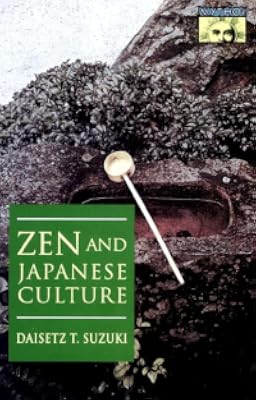
Zen and Japanese Culture
by Daisetz T. Suzuki
On This Page
Description
Zen and Japanese Culture is a classic that has influenced generations of readers and played a major role in shaping conceptions of Zen's influence on Japanese traditional arts. In simple and poetic language, Daisetz Suzuki describes Zen and its historical evolution. He connects Zen to the philosophy of the samurai, and subtly portrays the relationship between Zen and swordsmanship, haiku, tea ceremonies, and the Japanese love of nature. Suzuki uses anecdotes, poetry, and illustrations of show more silk screens, calligraphy, and architecture. The book features an introduction by Richard Jaffe that acquaints readers with Suzuki's life and career and analyzes the book's reception in light of contemporary criticism, especially by scholars of Japanese Buddhism. Zen and Japanese Culture is a valuable source for those wishing to understand Zen in the context of Japanese life and art, and remains one of the leading works on the subject. show lessTags
Recommendations

























Member Reviews
One of the leading twentieth-century works on Zen, this book is a valuable source for those wishing to understand Zen concepts in the context of Japanese life and art. In simple, often poetic, language, Daisetz Suzuki describes what Zen is, how it evolved, and how its emphasis on primitive simplicity and self-effacement have helped to shape an aesthetics found throughout Japanese culture. He explores the surprising role of Zen in the philosophy of the samurai, and subtly portrays the relationship between Zen and swordsmanship, haiku, tea ceremonies, and the Japanese love of nature. Suzuki's contemplative discussion is enhanced by anecdotes, poetry, and illustrations showing silk screens, calligraphy, and examples of architecture.
One of this century's leading works on Zen, this book is a valuable source for those wishing to understand its concepts in the context of Japanese life and art. In simple, often poetic, language, Daisetz Suzuki describes what Zen is, how it evolved, and how its emphasis on primitive simplicity and self-effacement have helped to shape an aesthetics found throughout Japanese culture. He explores the surprising role of Zen in the philosophy of the samurai, and subtly portrays the relationship between Zen and swordsmanship, haiku, tea ceremonies, and the Japanese love of nature. Suzuki's contemplative discussion is enhanced by anecdotes, poetry, and illustrations showing silk screens, calligraphy, and examples of architecture. Source: show more Princeton University Pr, 1970 edition show less
If there is one Suzuki to have on your shelf it is this one.
Zen Buddhism, Japanese Culture
from dust jacket
Zen is often difficult for westerners to grasp except superficially. Westerners tend to regard something as real only if it can be verbalized. Zen, as Skuzuki stresses, is above all a practical philosophy and way of life; it was not meant to stay on a page for academic contemplation. It is essentially beyond verbalization, but very real.
'Striclty speaking,' explains Suzuki, 'Zen has no philosophy of its own. Its teaching is concentrated on an intuitive experience, and the intellectual content of this experience can be supplied by a system of thought not necessarily Buddhistic.'
Therefore, rather than examine Zen abstractly, in Zen and Japanese Culture Suzuki explains it in the context of cultural matrix, with fruitful show more results. He examines Zen's relation to the art of swordsmanship, to the samuai's code of honor and conduct (bushido), to haiku poetry, to feeling for nature in visual art and architecture, and to the ceremony and art of tea. In this way, Zen and Japanese Culture goes a long way toward illuminating the mysteries and apparent paradoxes of Zen.
Zen is revealed more as a stance towards life than a set of propositions and rules-a stance involving a special relationship to life, death, one's body, and one's mind. Seeing Zen's effect on a whole culture helps us understand its real meaning in practical terms, and its power to inspire grace, dignity, and beauty.
Contents
Preface
List of Plates
Chronology
I What Is Zen?
II General Remarks on Japanese Art Culture
III Zen and the Study of Confucianism
IV Zen and the Samurai
V Zen and Swordsmanship I
VI Zen and Swordsmanship II
VII Zen and Haiku
VIII Zen and the Art of Tea I
IX Zen and the Art of Tea II
X Rikyu and Other Teamen
XI Love of Nature
Appendices
I Two Mondo from the 'Hekigan-shu'
II The Vimalakirti Sutra
III 'Yama-uba,' a No Play
IV The Swordsman and the Cat
V Chuang-tzu
Bibliography
Index show less
Zen is often difficult for westerners to grasp except superficially. Westerners tend to regard something as real only if it can be verbalized. Zen, as Skuzuki stresses, is above all a practical philosophy and way of life; it was not meant to stay on a page for academic contemplation. It is essentially beyond verbalization, but very real.
'Striclty speaking,' explains Suzuki, 'Zen has no philosophy of its own. Its teaching is concentrated on an intuitive experience, and the intellectual content of this experience can be supplied by a system of thought not necessarily Buddhistic.'
Therefore, rather than examine Zen abstractly, in Zen and Japanese Culture Suzuki explains it in the context of cultural matrix, with fruitful show more results. He examines Zen's relation to the art of swordsmanship, to the samuai's code of honor and conduct (bushido), to haiku poetry, to feeling for nature in visual art and architecture, and to the ceremony and art of tea. In this way, Zen and Japanese Culture goes a long way toward illuminating the mysteries and apparent paradoxes of Zen.
Zen is revealed more as a stance towards life than a set of propositions and rules-a stance involving a special relationship to life, death, one's body, and one's mind. Seeing Zen's effect on a whole culture helps us understand its real meaning in practical terms, and its power to inspire grace, dignity, and beauty.
Contents
Preface
List of Plates
Chronology
I What Is Zen?
II General Remarks on Japanese Art Culture
III Zen and the Study of Confucianism
IV Zen and the Samurai
V Zen and Swordsmanship I
VI Zen and Swordsmanship II
VII Zen and Haiku
VIII Zen and the Art of Tea I
IX Zen and the Art of Tea II
X Rikyu and Other Teamen
XI Love of Nature
Appendices
I Two Mondo from the 'Hekigan-shu'
II The Vimalakirti Sutra
III 'Yama-uba,' a No Play
IV The Swordsman and the Cat
V Chuang-tzu
Bibliography
Index show less
Todo un clásico en la materia, el presente libro, escrito en forma de delicioso ensayo, está entereamente dedicado a captar indicios reveladores de cómo y por qué ciertos aspectos del "espíritu del zen" se están dejando sentir en la actualidad, y de una manera tan contundente, en toda la civilización occidental. De este modo, y tras una breve exposición sobre el significado del zen, Suzuki se dedica a examinar de forma detallada diversos aspectos del arte y la vida japoneses influidos por esta disciplina budista -el culto a la esgrima, la ceremonia del té, la forma poética del haiku y el amor por la naturaleza-, analizando también la relación existente entre zen y confucianismo, el papel del zen en la tradición de los show more samurais y el arte japonés, etc., todo ello sintetizado en sesenta y nueve ilustraciones. Y así, en una cultura, la nuestra, en la que el acelerado ritmo de la vida cotidiana se da por supuesto como norma universal, en una civilización en la que el interés por la posesión de "cosas" ha llegado a un nivel nunca antes conocido, las viejas y bellas virtudes japonesas, tal como Suzuki las describe, acaban desprendiendo un aroma inefablemente tranquilizador. show less
Aug 26, 2011Spanish
Members
- Recently Added By
Published Reviews
Zasigurno najvažnije delo o zenu u dvadesetom veku, ova knjiga je vredan izvor za one koji žele da razumeju položaj i značaj zena u okviru japanskog načina života i japanske umetnosti.
Daisec Suzuki jednostavnim i poetičnim jezikom objašnjava šta je zen (i šta nije) i kako je pomagao uobličavanju estetičkih osnova japanske kulture. On razjašnjava čudnovatu ulogu zena u filozofiji show more samuraja, suptilno portretišuči odnose između zena i mačevalaštva, haiku poezije, čajne ceremonije, konfucijanizma i ljubavi prema prirodi. Daisec Teitaro Suzuki, najveći autoritet za zen budizam, autor je više od stotinu knjiga i radova na tu temu. Živeo je 95 godina, aktivan do poslednjeg časa. Prijateljevao je i sa takvim znamenitim ličnostima kao što su Karl Gustav Jung, Erih From, Martin Hajdeger, Karl Jaspers, Arnold Tojnbi, i veoma uticao na njih. Herbert Riđ ga je okarakterisao kao „spoj nevinosti deteta i svetosti sveca". show less
Daisec Suzuki jednostavnim i poetičnim jezikom objašnjava šta je zen (i šta nije) i kako je pomagao uobličavanju estetičkih osnova japanske kulture. On razjašnjava čudnovatu ulogu zena u filozofiji show more samuraja, suptilno portretišuči odnose između zena i mačevalaštva, haiku poezije, čajne ceremonije, konfucijanizma i ljubavi prema prirodi. Daisec Teitaro Suzuki, najveći autoritet za zen budizam, autor je više od stotinu knjiga i radova na tu temu. Živeo je 95 godina, aktivan do poslednjeg časa. Prijateljevao je i sa takvim znamenitim ličnostima kao što su Karl Gustav Jung, Erih From, Martin Hajdeger, Karl Jaspers, Arnold Tojnbi, i veoma uticao na njih. Herbert Riđ ga je okarakterisao kao „spoj nevinosti deteta i svetosti sveca". show less
added by Sensei-CRS
Author Information

152+ Works 7,010 Members
A student of the Zen master Shaku Soen, who addressed the 1893 World's Parliament of Religions held in Chicago, D. T. Suzuki did more to introduce Zen to Westerners than any other representative of that tradition. Shaku Soen sent the young Suzuki to America in 1897 to help Paul Carus translate the Chinese text the Dao De Jing. Suzuki remained in show more America for about a decade, working at Carus' Open Court Publishing Company outside Chicago. After Suzuki returned to Japan, he married an American woman, Beatrice Lane, in 1911, and they began publishing an English journal, The Eastern Buddhist, in 1921. During this time in Japan, Suzuki translated into Japanese a number of Swedenborgian texts. He traveled to China in 1934, and he went to London in 1936 to attend the World Congress of Faiths. Suzuki recognized that the West had much to offer the East, but like Swami Vivekananda, he was convinced that the East had much to offer the West in its religion and philosophy. On this basis he was motivated to write about Zen in English. Suzuki wrote about 30 books in English and many more in Japanese. Suzuki's first books in English were a translation of Ashvaghosha's Discourse on the Awakening of Faith in the Mahayana (1900) and Outlines of Mahayana Buddhism (1907). A practitioner of Rinzai Zen Buddhism, Suzuki, in his writings about the ultimate experience of satori and the meditative use of koans, made Zen terms almost household words in the United States. In the early part of the twentieth century, Suzuki devoted himself to the propagation of Zen via his writings. After World War II he became a noted lecturer on Zen at American and European universities. That Suzuki's work was effective can be seen in the fact that Zen was picked up in the 1950s by California beatniks, producing what was termed Beat Zen. From that time on, Americans increasingly began to go to Japan to study Zen, and more Zen masters began to come to the United States to teach. The earliest institutions devoted to the practice of Zen in America were established in San Francisco in 1928, in Los Angeles in 1929, and in New York City in 1931. Zen centers remain an important part of the American urban scene, and several of them have established rural Zen retreat centers. (Bowker Author Biography) show less
Some Editions
Series
Belongs to Publisher Series
Common Knowledge
- Canonical title*
- 禅と日本文化
- Original title
- Zen Buddhism and Its Influence on Japanese Culture (Japan) (Japan)
- Original publication date
- 1938 (Japan) (Japan); 1959 (United States) (United States)
- First words
- Before I proceed to write about the influence of Zen on Japanese culture, I must explain what Zen is, for it is possible that my present readers may not know anything about it.
- Last words
- (Click to show. Warning: May contain spoilers.)When at Yoshino the cherries are about to bloom, / My heart is anxiously drawn to the white clouds / Veiling the mountaintops these spring mornings. / SAKAWADA MASATOSHI (1580–1643)
*Some information comes from Common Knowledge in other languages. Click "Edit" for more information.
Classifications
- Genres
- Nonfiction, Religion & Spirituality, Philosophy, History
- DDC/MDS
- 294.3927 — Religion Other religions Dharmic religions Buddhism Buddhism - Branches and schools Mahayana Buddhism Zen Buddhism
- LCC
- BQ9262.9 .J3 .S9 — Philosophy, Psychology and Religion Buddhism Buddhism Modifications, schools, etc. Special modifications, sects, etc. Zen Buddhism
- BISAC
Statistics
- Members
- 790
- Popularity
- 35,335
- Reviews
- 8
- Rating
- (4.01)
- Languages
- 8 — Chinese, English, German, Japanese, Polish, Russian, Serbian, Spanish
- Media
- Paper, Audiobook, Ebook
- ISBNs
- 26
- ASINs
- 17