On This Page
Description
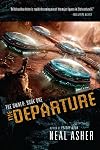
Fiction. Science Fiction. Visible in the night sky the Argus Station, its twin smelting plants like glowing eyes, looks down on nightmare Earth. From Argus the Committee keep an oppressive control: citizens are watched by cams systems and political officers, it's a world inhabited by shepherds, reader guns, razor birds and the brutal Inspectorate with its white tiled cells and pain inducers. Soon the Committee will have the power to edit human minds, but not yet, twelve billion human being show more need to die before Earth can be stabilized, but by turning large portions of Earth into concentration camps this is achievable, especially when the Argus satellite laser network comes fully online . . . This is the world Alan Saul wakes to in his crate on the conveyor to the Calais incinerator. How he got there he does not know, but he does remember the pain and the face of his interrogator. Informed by Janus, through the hardware implanted in his skull, about the world as it is now Saul is determined to destroy it, just as soon as he has found out who he was, and killed his interrogator . . . show lessTags
Recommendations



















Member Reviews
This review is written with a GPL 4.0 license and the rights contained therein shall supersede all TOS by any and all websites in regards to copying and sharing without proper authorization and permissions. Crossposted at WordPress, Blogspot & Librarything by Bookstooge’s Exalted Permission
Title: The Departure
Series: Owner Sequence #1
Author: Neal Asher
Rating: 4 of 5 Stars
Genre: SF
Pages: 569
Words: 154K
Synopsis:
Visible in the night sky the Argus Station, its twin smelting plants like glowing eyes, looks down on nightmare Earth. From Argus the Committee keep an oppressive control: citizens are watched by cams systems and political officers, it's a world inhabited by shepherds, reader guns, razor birds and the brutal Inspectorate with its show more white tiled cells and pain inducers. Soon the Committee will have the power to edit human minds, but not yet, twelve billion human being need to die before Earth can be stabilized, but by turning large portions of Earth into concentration camps this is achievable, especially when the Argus satellite laser network comes fully online . . . This is the world Alan Saul wakes to in his crate on the conveyor to the Calais incinerator. How he got there he does not know, but he does remember the pain and the face of his interrogator. Informed by Janus, through the hardware implanted in his skull, about the world as it is now Saul is determined to destroy it, just as soon as he has found out who he was, and killed his interrogator.
Saul infiltrates a soon to be shut down branch of the committee and takes the identity of one of the lower executives. This is the first step towards infiltrating a much higher branch where the woman who implanted the hardware in his head resides. After successfully performing this, he and Hannah are on the run. She performs the next level of surgery on him, basically turning him into a human/ai hybrid. By this time Saul realizes there is no way to save the billions on Earth and decides that he is better off without humanity.
He hooks up with some revolutionaries, the leader of which has a similar bit of implant in his head. They're goal is to get to the Argus Station. The Revoluionary's goal is to crash the satellites the Station controls and the station, into Earth and wipe out every Committee Stronghold. Saul realizes his goal is to take over the Station and turn it into a mobile space fortress, ie, a spaceship. What neither of them know is that the Committee Member in charge of the Station has upgraded himself and become a human/ai hybrid as well. Agent Smith, errr, Committee Executive Smith destroys the Revolutionary Leader and Saul finds out Smith is planning a coup to take over the Committee and only allow select Committee Members onto the station while causing a massive dieback on Earth among its citizens.
Saul and Smith fight while the current President of the Committee and his pet Executives fly to the station as well. After a 3 way fight, Saul ups his game and becomes fully integrated with his implant, turning him into something not quite human anymore. Saul wins control of the Station and begins preparations to fly to Mars.
While all of this has been happening, the small colony on Mars has found out that they have been abandoned by the Committee. The Committee Executive in charge plans on killing almost everyone so he and his minions can survive the years necessary until the Committee on Earth can come back to Mars. Saul's sister fights back and takes charge of the colony. The book ends with them seeing the Argus Space Station heading their way but without knowing it isn't under Committee control.
My Thoughts:
I liked this a LOT more this time around. Last time I was really confused with how things started out and the jumps in the timeline. This time I knew it was coming, was prepared and enjoyed the ride.
I think this was the most violent of Asher's books yet. It was gory and graphic AND the sheer body count was humongous. The Revolutionaries take out millions with nukes when they attack multiple Committee headquarters alone. Then you have Saul taking out people left and right or the Committee people committing atrocities to get at Saul. No matter how you slice it, or dice it, or blow it up, or generally kill it in some way or another, this was Violent, with a capital V.
While Asher's Polity books tend to be pretty optimistic, at least in terms of humanity bootstrapping itself to a better future, the Owner Sequence is pure dystopia. With 18 billion people on Earth and no way to support them, even Saul gives up of trying to save them. He goes so far as to blame them for existing and calls humanity the manswarm, like they were some sort of plague of locusts. I won't go so far as to say it was a refreshing change from Asher's outlook in the Polity books, but the change was more inline with my outlook on basic humanity, ie, broken by sin. However, unlike Saul, who pretty much says “Sucks to be you, have fun dying”, I don't give up on people, even if I don't like them.
I am thankful that Asher didn't try to write a series about the rise of the Committee but simply gave us the world with that as Fait Accompli. They were the perfect mix of Corrupted Power, Meddling Bureaucracy and Bumbling Idiot all rolled into one scary badguy mix. When a group is planning on killing 12 BILLION people with space lasers, you know they're great bad guys!
Saul is not a “connect with the main character” kind of guy and if you're looking for that, don't bother reading this. He's the gun AND the bullet that Asher uses to tell us the story. I wouldn't want to read characters like him all the time but every once in a while I like someone like that, ie, competent beyond belief, totally focused on their goal and not emoting like an Emo. Kind of like mixing John Wick and Spock! Saul Sprwock perhaps? Hmm, sounds like someone speaking with their mouth full of chocolate pudding. Why chocolate you ask? Because I LIKE chocolate pudding.
★★★★☆ show less
Title: The Departure
Series: Owner Sequence #1
Author: Neal Asher
Rating: 4 of 5 Stars
Genre: SF
Pages: 569
Words: 154K
Synopsis:
Visible in the night sky the Argus Station, its twin smelting plants like glowing eyes, looks down on nightmare Earth. From Argus the Committee keep an oppressive control: citizens are watched by cams systems and political officers, it's a world inhabited by shepherds, reader guns, razor birds and the brutal Inspectorate with its show more white tiled cells and pain inducers. Soon the Committee will have the power to edit human minds, but not yet, twelve billion human being need to die before Earth can be stabilized, but by turning large portions of Earth into concentration camps this is achievable, especially when the Argus satellite laser network comes fully online . . . This is the world Alan Saul wakes to in his crate on the conveyor to the Calais incinerator. How he got there he does not know, but he does remember the pain and the face of his interrogator. Informed by Janus, through the hardware implanted in his skull, about the world as it is now Saul is determined to destroy it, just as soon as he has found out who he was, and killed his interrogator.
Saul infiltrates a soon to be shut down branch of the committee and takes the identity of one of the lower executives. This is the first step towards infiltrating a much higher branch where the woman who implanted the hardware in his head resides. After successfully performing this, he and Hannah are on the run. She performs the next level of surgery on him, basically turning him into a human/ai hybrid. By this time Saul realizes there is no way to save the billions on Earth and decides that he is better off without humanity.
He hooks up with some revolutionaries, the leader of which has a similar bit of implant in his head. They're goal is to get to the Argus Station. The Revoluionary's goal is to crash the satellites the Station controls and the station, into Earth and wipe out every Committee Stronghold. Saul realizes his goal is to take over the Station and turn it into a mobile space fortress, ie, a spaceship. What neither of them know is that the Committee Member in charge of the Station has upgraded himself and become a human/ai hybrid as well. Agent Smith, errr, Committee Executive Smith destroys the Revolutionary Leader and Saul finds out Smith is planning a coup to take over the Committee and only allow select Committee Members onto the station while causing a massive dieback on Earth among its citizens.
Saul and Smith fight while the current President of the Committee and his pet Executives fly to the station as well. After a 3 way fight, Saul ups his game and becomes fully integrated with his implant, turning him into something not quite human anymore. Saul wins control of the Station and begins preparations to fly to Mars.
While all of this has been happening, the small colony on Mars has found out that they have been abandoned by the Committee. The Committee Executive in charge plans on killing almost everyone so he and his minions can survive the years necessary until the Committee on Earth can come back to Mars. Saul's sister fights back and takes charge of the colony. The book ends with them seeing the Argus Space Station heading their way but without knowing it isn't under Committee control.
My Thoughts:
I liked this a LOT more this time around. Last time I was really confused with how things started out and the jumps in the timeline. This time I knew it was coming, was prepared and enjoyed the ride.
I think this was the most violent of Asher's books yet. It was gory and graphic AND the sheer body count was humongous. The Revolutionaries take out millions with nukes when they attack multiple Committee headquarters alone. Then you have Saul taking out people left and right or the Committee people committing atrocities to get at Saul. No matter how you slice it, or dice it, or blow it up, or generally kill it in some way or another, this was Violent, with a capital V.
While Asher's Polity books tend to be pretty optimistic, at least in terms of humanity bootstrapping itself to a better future, the Owner Sequence is pure dystopia. With 18 billion people on Earth and no way to support them, even Saul gives up of trying to save them. He goes so far as to blame them for existing and calls humanity the manswarm, like they were some sort of plague of locusts. I won't go so far as to say it was a refreshing change from Asher's outlook in the Polity books, but the change was more inline with my outlook on basic humanity, ie, broken by sin. However, unlike Saul, who pretty much says “Sucks to be you, have fun dying”, I don't give up on people, even if I don't like them.
I am thankful that Asher didn't try to write a series about the rise of the Committee but simply gave us the world with that as Fait Accompli. They were the perfect mix of Corrupted Power, Meddling Bureaucracy and Bumbling Idiot all rolled into one scary badguy mix. When a group is planning on killing 12 BILLION people with space lasers, you know they're great bad guys!
Saul is not a “connect with the main character” kind of guy and if you're looking for that, don't bother reading this. He's the gun AND the bullet that Asher uses to tell us the story. I wouldn't want to read characters like him all the time but every once in a while I like someone like that, ie, competent beyond belief, totally focused on their goal and not emoting like an Emo. Kind of like mixing John Wick and Spock! Saul Sprwock perhaps? Hmm, sounds like someone speaking with their mouth full of chocolate pudding. Why chocolate you ask? Because I LIKE chocolate pudding.
★★★★☆ show less
Note: I received an Advance Reading Copy of this book through the You Review program of The American Book Centre.
The Departure by Neal Asher is the first installment of his new space opera series, Owner. It is the origin story of Alan Saul, Owner of Worlds and how he became what I assume he will be in the later parts of the series.
It is the twenty-second century, and earth is ruled by a Director and a Committee. The population has risen by billions to unsustainable levels, and to ensure their own survival, people have given up pretty much all their freedoms. The Committee is a ruthless, all knowing, all governing, all consuming structure, that determines who lives and who dies. In this world, Alan Saul wakes up, in a box on a conveyor show more belt, heading for an incinerator. He doesn't remember anything about the time before that, but he slowly figures out his potential when he is contacted by a com life living inside the successor to the Internet, GovNet. He can tap into the network using nothing but his mind, and uses this to regain his freedom.
I have mixed feelings about this book. On the one hand, I can see how Asher sets the scene for further parts in this series, and how this is just the beginning. The world Asher creates, with regard to technology and scientific development sounds realistic. On the other hand, the balance of this book was strange sometimes. A lot of time is spent explaining how the world is and how it came to be that way, either by sections at the start of each chapter, or by the characters reminding themselves. Especially that last way of describing it felt forced. Also, any deaths or attacks in the book were described pretty graphically, which wasn't always necessary for the story itself. Lastly, the characters were a bit lifeless. Saul, Var and Hannah felt more like a type than a real person, and that made me care less about the story.
This first part in the Owner series made me curious for the coming installments, but I do think it might need those other books to really come into its own. For me, this book is now three out of five stars. show less
The Departure by Neal Asher is the first installment of his new space opera series, Owner. It is the origin story of Alan Saul, Owner of Worlds and how he became what I assume he will be in the later parts of the series.
It is the twenty-second century, and earth is ruled by a Director and a Committee. The population has risen by billions to unsustainable levels, and to ensure their own survival, people have given up pretty much all their freedoms. The Committee is a ruthless, all knowing, all governing, all consuming structure, that determines who lives and who dies. In this world, Alan Saul wakes up, in a box on a conveyor show more belt, heading for an incinerator. He doesn't remember anything about the time before that, but he slowly figures out his potential when he is contacted by a com life living inside the successor to the Internet, GovNet. He can tap into the network using nothing but his mind, and uses this to regain his freedom.
I have mixed feelings about this book. On the one hand, I can see how Asher sets the scene for further parts in this series, and how this is just the beginning. The world Asher creates, with regard to technology and scientific development sounds realistic. On the other hand, the balance of this book was strange sometimes. A lot of time is spent explaining how the world is and how it came to be that way, either by sections at the start of each chapter, or by the characters reminding themselves. Especially that last way of describing it felt forced. Also, any deaths or attacks in the book were described pretty graphically, which wasn't always necessary for the story itself. Lastly, the characters were a bit lifeless. Saul, Var and Hannah felt more like a type than a real person, and that made me care less about the story.
This first part in the Owner series made me curious for the coming installments, but I do think it might need those other books to really come into its own. For me, this book is now three out of five stars. show less
No one can drive home the lethality of warfare in space like Asher; he seems to take a sadistic pleasure in the hyper-violent, extremely-detailed, slow-motion linguistic dissection of his fodder characters. And yet, we his readers will keep lining up for more! In this novel, the first of new series centering on a character who comes to call himself 'The Owner', Humanity has come under the tyranny of an elitist world government headed by 'The Committee', and we follow the stories of two individuals who stand up to that oppression. The Committee is an over-the-top caricature of every evil regime since Huxley's "Brave New World", complete with euphemistic propaganda machines, jack-booted secret police who institute casual genocide, show more near-complete population surveillance, and their own version of George Lucas' Death Star under construction. It is personified by two ruthless facility directors who separately come to be challenged by our two protagonists, and subsequently revealed to be pathologically murderers. It is frequently gratifying to read, in our heroes' march toward vengeance, the ensuing bloodletting and near-pornographic violence against persons and property, but only if one isn't expecting any profound themes or lessons behind it. The only one you'll find can probably be seen by page five: Oppression of the masses by the elite is bad. The story is at its strongest when its protagonists are at their weakest; nearly destroyed and facing certain defeat, and yet manage to cleverly outwit their predicament. For those readers who join me in a personal taste for more alien locales & life in their SF, I would instead point you to Asher's "Polity" series, but for those who are looking for some escapism set in a closer future and limited to strictly human cultures, you have no further to look! show less
We've done it! We've pushed earth beyond the brink. There are too many people and many have to die. Those deemed as useful live in a ectopia with all the benefits that advanced technology can offer while those who are seen as less essential are left behind.
The worldbuilding was really cool and the impacts of overpopulation on how life works are all too believable, but overall it was just okay. Some things felt like they were too convenient and I didn't care all that much about most of the characters. I know this is the start of a series though and the ending was interesting so I might give it another chance and pick up the next book.
The worldbuilding was really cool and the impacts of overpopulation on how life works are all too believable, but overall it was just okay. Some things felt like they were too convenient and I didn't care all that much about most of the characters. I know this is the start of a series though and the ending was interesting so I might give it another chance and pick up the next book.
first of a recent trilogy with a non-Polity setting, very dystopic in outlook, and occasionally reading like a tract. still, an interesting look at a near-future world in which a world government bureaucracy obsessed with the single goal of control uses fear as a weapon, and uses up all Earth's resources maintaining that goal, at which point it concludes all those outside its own inner circle are expendable. Asher goes over the top in describing bureaucratic politics and the elitist perspective, and also in crafting his one-man solution. but it's important to note that his starting point is clearly the world of today, so his reductio is not entirely ad absurdum. also, the point of view of a human in the process of becoming a cyborg, show more trying in a somewhat desultory way to retain the humanity he's losing, is kind of fascinating. but as his own power increases exponentially, it's intriguing to imagine what he will himself become as he heads into space with the books that follow (and the word he eventually chooses here to describe his place in the hierarchy is more than a bit chilling). show less
Honestly, this is like a 1.5 star review. Characters feel millimeters thin and the government is so over the top evil while also being laughably incompetent, and the protagonist is an unstoppable superman with no room for self-doubt. His companion on his journey is a brilliant scientist who's primary role seems to marvel at him and serve as an external conscience. Many of their conversations seem to revolve around him explaining to her that her her concerns are irrational given the realities of the situation, which has a whole other connotation that I'm equally unhappy with.
On the whole, it's a simplistic plot driven novel with delusions of ethical introspection.
This series came so highly recommended to me that I started the second show more book as well to see if things get better, but I abandoned it within the first few chapters. show less
On the whole, it's a simplistic plot driven novel with delusions of ethical introspection.
This series came so highly recommended to me that I started the second show more book as well to see if things get better, but I abandoned it within the first few chapters. show less
Another fantastic series opener from Asher. I am just a third through this first book in the series, and I can tell that I will really enjoy the full series. Lots of action, lots of future speculation, lots of high-end technology gone rogue. It is actually pretty scary, as I can see where the nasty future depicted could very well happen. Asher poses philosophical questions to stimulate the reader's interest beyond the story/plot itself. Can't put this one down. I am already ordering the next two books in the series.
I also thoroughly enjoy his Ian Cormac books and I will be diving into the Rise of the Jain series as well.
I also thoroughly enjoy his Ian Cormac books and I will be diving into the Rise of the Jain series as well.
Members
- Recently Added By
Lists

Library Fantasy/Science Fiction
162 works; 2 members
Author Information

95+ Works 14,674 Members

Neal Asher is a LibraryThing Author, an author who lists their personal library on LibraryThing.
Some Editions
Series

Common Knowledge
- Canonical title
- The Departure
- Original publication date
- 2011-09-02
- People/Characters
- Alan Saul; Varalia Delex; Hannah Neumann; Salem Smith
- Dedication
- For all the readers out there —
the silent ones, those who say on the internet,
and those who demand I write faster! - First words
- Throughout the early years of the twenty-first century, Internet blogs and news groups displaced the slow, moribund and politically tribal newspapers.
- Last words
- (Click to show. Warning: May contain spoilers.)"Whoever or whatever just trashed Earth is now coming here."
Classifications
Statistics
- Members
- 500
- Popularity
- 60,589
- Reviews
- 19
- Rating
- (3.60)
- Languages
- English, German
- Media
- Paper, Audiobook, Ebook
- ISBNs
- 13
- ASINs
- 11