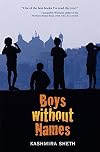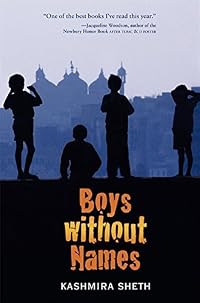
Boys without Names
by Kashmira Sheth
On This Page
Description
Eleven-year-old Gopal and his family leave their rural Indian village for life with his uncle in Mumbai, but when they arrive his father goes missing and Gopal ends up locked in a sweatshop from which there is no escape.Tags
Recommendations



































Member Recommendations

Member Reviews
This is a good story that will find interested readers if it's booktalked. I think just the plain fact that child slavery exists will grab young readers. This book challenges them to face what it's like to be a victim of poverty, to live on the streets, to be kidnapped and forced to work night and day far away from your family. It's very heavy stuff, but it's told in a way that children as young as 9 or 10 will be able to absorb.
The story centers on Gopal, a boy who loves his small village but is forced to sneak away with his family to Mumbai so his parents can escape crushing debt. Their experience in the gritty, stinky Mumbai slums would be harsh enough, but on top of that Gopal is kidnapped and sold into slavery. He and five other show more boys are locked into a small building where they toil night and day gluing beads onto frames. Gopal, a smart kid, dreams of escape but is dragged down by the hopelessness of his situation. Can he bring the other boys together to help escape?
I admire the author for making this kind of story accessible to young readers, but I thought her writing was a little clunky, particularly when she tried to thread Hindi and Marathi words into the English text. Also, I had trouble distinguishing the five boys Gopal meets in the sweat shop. At first, they have no names (hence the title) so Gopal makes up nicknames for them. Still, some of their personalities tended to blend together for me.
All in all, though, a very interesting book that may inspire activism and at the very least promote awareness. show less
The story centers on Gopal, a boy who loves his small village but is forced to sneak away with his family to Mumbai so his parents can escape crushing debt. Their experience in the gritty, stinky Mumbai slums would be harsh enough, but on top of that Gopal is kidnapped and sold into slavery. He and five other show more boys are locked into a small building where they toil night and day gluing beads onto frames. Gopal, a smart kid, dreams of escape but is dragged down by the hopelessness of his situation. Can he bring the other boys together to help escape?
I admire the author for making this kind of story accessible to young readers, but I thought her writing was a little clunky, particularly when she tried to thread Hindi and Marathi words into the English text. Also, I had trouble distinguishing the five boys Gopal meets in the sweat shop. At first, they have no names (hence the title) so Gopal makes up nicknames for them. Still, some of their personalities tended to blend together for me.
All in all, though, a very interesting book that may inspire activism and at the very least promote awareness. show less
"Boys Without Names" is the story of Gopal, a young Indian boy who is forced into labor gluing beads onto frames in a sweatshop somewhere in Mumbai. But his story starts as many do in impoverished nations. His family is prey for a loan shark when their onion farm continues to bear less and less fruit. After all, if their primary source of income and food is heavily diminished due to famine, what else are they gonna do? It's not like a failing farm on the receiving end of nature's middle finger is going to get credit from a bank.
Faced with this, his family pulls a Robert Irsay and relocates from their farm to Mumbai under cover of night. Still destitute, Gopal finds a seemingly too good to be true job from a random stranger. While his show more family tries to stop him, Gopal is eleven and, unfortunately, has not yet developed the gifts of intuitiveness and foresight. And in this case of a bustling city filled with poverty too good to be true does not mean sending a couple grand to a fictitious African prince, but forced slavery.
It is here when we get to the reason for the title. Gopal and his fellow child slaves are not allowed to use names, an exercise in stripping personal identity, as they are, for all intents and purposes, property. However, Gopal has a certain penchant for nicknames, like "Thick Fingers", "Dimple Chin", and "Scar." The last of which really connected me to the book in a weird way since the antagonist had the same name as in "The Lion King."
These nicknames, along with Gopal telling his kahanis - stories - help the children to reclaim a sort of idtneity, while they wait to escape from their imprisonment - which it really is on a base level.
And this is probably my favorite aspect of the novel. Sheth frequently uses authentic Hindi throughout her novel. This goes from the diminutives used for family members to food. There also tends to be just random uses of Hindi words in the text. On page 135, during a tense moment, Gopal states "I am not going to be bullied by Scar's chamcha, sidekick. This seems a bit unnecessary. It seems like this was the word in Sheth's head during the writing process, so she just went with it. This isn't really a complaint, though, as much as it is an observation. I like the use of Hindi words, but they just seemed a bit unnatural at times.
But the repeated use of the word "kahani" I did like a lot. "Kahani," means story, and in the context of "Boys Without Names" is how the children reclaim their identities - by telling their stories, letting others know who they are. It might be that I'm ascribing a lot more emotion and connection to the word than the actual linguistic context would imply, but for some reason, this use of authentic language really hit me harder than I think it would have if Sheth had just used the word "story." Sometimes, the English language just can't do something justice with a simplistic one or two word translation - "Schadenfreude" for example - and this is what I felt with "kahani" when I read. Though, again, this could be me making Everest in Ireland.
I also think I was hampered by my own personal context. I read "Boys Without Names" directly after reading "Iqbal." I was so recently shocked with the life of child laborers that the impact of the book was certainly dulled. Of course, I still sympathized with the characters, but likely not as much I would have if this was a fresh concept to me. show less
Faced with this, his family pulls a Robert Irsay and relocates from their farm to Mumbai under cover of night. Still destitute, Gopal finds a seemingly too good to be true job from a random stranger. While his show more family tries to stop him, Gopal is eleven and, unfortunately, has not yet developed the gifts of intuitiveness and foresight. And in this case of a bustling city filled with poverty too good to be true does not mean sending a couple grand to a fictitious African prince, but forced slavery.
It is here when we get to the reason for the title. Gopal and his fellow child slaves are not allowed to use names, an exercise in stripping personal identity, as they are, for all intents and purposes, property. However, Gopal has a certain penchant for nicknames, like "Thick Fingers", "Dimple Chin", and "Scar." The last of which really connected me to the book in a weird way since the antagonist had the same name as in "The Lion King."
These nicknames, along with Gopal telling his kahanis - stories - help the children to reclaim a sort of idtneity, while they wait to escape from their imprisonment - which it really is on a base level.
And this is probably my favorite aspect of the novel. Sheth frequently uses authentic Hindi throughout her novel. This goes from the diminutives used for family members to food. There also tends to be just random uses of Hindi words in the text. On page 135, during a tense moment, Gopal states "I am not going to be bullied by Scar's chamcha, sidekick. This seems a bit unnecessary. It seems like this was the word in Sheth's head during the writing process, so she just went with it. This isn't really a complaint, though, as much as it is an observation. I like the use of Hindi words, but they just seemed a bit unnatural at times.
But the repeated use of the word "kahani" I did like a lot. "Kahani," means story, and in the context of "Boys Without Names" is how the children reclaim their identities - by telling their stories, letting others know who they are. It might be that I'm ascribing a lot more emotion and connection to the word than the actual linguistic context would imply, but for some reason, this use of authentic language really hit me harder than I think it would have if Sheth had just used the word "story." Sometimes, the English language just can't do something justice with a simplistic one or two word translation - "Schadenfreude" for example - and this is what I felt with "kahani" when I read. Though, again, this could be me making Everest in Ireland.
I also think I was hampered by my own personal context. I read "Boys Without Names" directly after reading "Iqbal." I was so recently shocked with the life of child laborers that the impact of the book was certainly dulled. Of course, I still sympathized with the characters, but likely not as much I would have if this was a fresh concept to me. show less
Wow! Fascinating and touching look into contemporary child labor, set in Mumbai. Though it was hard to read, I couldn't put it down. Highly recommended.
Gopal and his family are desperate and destitute. Unable to pay back money they own, they decide to move to Mumbai to try to improve their fortunes. Gopal is desperate to help his family earn money, especially after his father disappears. Tempted by a job at a factory, Gopal soon finds himself working as a slave and unable to contact his family. A look at child labor and slavery in the modern world.
Recommended Ages: Gr. 5-9
Plot Summary: Gopal's parents make the decision to bring the family to Mumbai to try to escape the large debt Baba has in his name. It started when there were too many onions one year and they got so little money for them they couldn't afford to buy seeds for next year. Then one of the twins go sick and they needed to buy medicine so they sold their farm. Now they have no way to make money and pay off the moneylender, so they pack up and head to the train station very early in the morning. The fare went up and they can't afford to get all the way to Mumbai but they need to get out of town, so they head to Dadar. Once there, Baba leaves them on the sidewalk to take a bus to Mumbai where he will get Jama then come show more back to get his family. He is scared just to cross the busy street, but he goes anyways. For two days the family sleeps on the street, moving locations after a policeman kicked Gopal in the middle of the night telling him to leave, even though there were lots of other families sleeping there. Without money to bride the policeman, they change locations. Finally, when they are out of money, Gopal decides to try to make some. He tries to carry luggage for a woman into the train station, but he is not allowed in because he won't have a ticket to get out. The man working at the train station feels bad the woman didn't give him anything and gives him 20 rupees. It's enough to get the rest of the family to Mumbai.
When they arrive at Jama's house, they realize Baba never made it. Worried sick, Jama takes charge and tries to get Gopal enrolled in school. Since the school is full, he will have to wait until next term. Gopal wants to help his family until school starts so he tries to find Jatin on the streeet to tell him he will work in his father's factory until school starts. Jatin tells him he must leave immediately, but gives Gopal 5 minutes to run and tell him mom. When he sees Jatin a few minutes later, Jatin is calm and offers Gopal tea. The tea was drugged and it knocked Gopal out. When he wakes up, he finds himself in a small room with a ladder leading up to a loft space where 5 boys are putting beads on frames. They don't talk except to criticize Gopal because they are all afraid of the man in charge. He hits them, whips them, and threatens to sell them to a fireworks company which is much more dangerous. Gopal is only given a small amount of food and water, is told when he can go to the bathroom, and only is allowed a bath once a week.
Gopal misses his family so much and looks for a way to escape, but there is not way. The doors and windows are all locked, even when Scar is not there. On a surprise trip to get medicine for one of the boys, Gopal walks faster than GC but ends up going back. The boys finally connect through the stories that they share, usually about themselves. Gopal also shares stories about animals being kept captive and animals trying to escape. He's got all of the boys on his side except for GC. Sometimes he thinks GC is a friend, and sometimes he doesn't. He can't figure it out, but he knows when he is let out to go to the store to get sweets for a sick Scar on Diwali that he has to return back otherwise all his new friends will be punished, and maybe even his siblings who Scar calls by name to scare Gopal. He decides to write a note on the 50 rupee bill that he uses to pay and is hopeful the police will come save the boys. Will it work?
Setting: Matheran (rural India near resorts) to Mumbai, India
Characters:
Gopal - 11 y/o, likes to write, rips pages out of old notebooks so Jama's friend can make him a new notebook, writes stories but on his last day in the village writes about his village, smarter than the other boys working on the frames, knows math and is literate, works out a plan for how to get the other boys to turn against each other instead of ganging up on him
Aai - AKA Radha, Gopal's mother, doesn't want to move to Mumbai but knows she doesn't have a choice
Baba - Gopal's father, wants Gopal to get a good education so he doesn't have issues with debt as an adult
Sita - 6 y/o, girl twin, yells at Naren when he interrupts
Naren - 6 y/o, boy twin, likes to interrupt
Jama - Aai's brother, pays for their train fare to Mumbai, has a decent job at a Tool factory but still lives in a little place in the city with a tin roof and a public bathroom, owns a tv and is able to feed the family a healthy amount
Card-Man - man who takes Gopal's seat when Gopal gets up to open the window, insists he can sit there and is not friendly until Baba called him a term of affection, then he is nice, he is grateful for a piece of roti from Aai and buys the family tea, shows Gopal how to play solitaire then gives him the deck of cards when he leaves
Jatin - 15-16 y/o, boy with greased hair in Mumbai who tells Gopal he can get him a job at his uncle's factory
Scar - man in charge of the boys, has a scar on his face, not afraid to use physical punishment such as slap across the face or a rubber rope like a whip
Barish - AKA Thick Fingers, leader of the group when Gopal first arrives
Amar - AKA Dimpled Chin, around 6 y/o, reminds Gopal of his twin siblings, protected by Barish, father hit him when he was drunk, has mean stepmother who told him he was always bad
Roshan - AKA Night Chatterer, doesn't talk much except at night, has a stutter, has 8 siblings,, lived on the edge of the forest but then it was chopped down
Sahil - AKA Rocking Boy, lived in desert, lost family in earthquake and dust storm
Kabir - AKA GC (Gray Cloud), hates the stories, turns against Gopal and is hard to trust because of it, becomes a leader, was a partner in crime to Barish at first until Gopal tried to get them to turn against each other
Recurring Themes: child labor, slavery, debt, poverty, farming, India, friendship, family, stories, education, physical punishment, freedom, escape
Controversial Issues:
pg 12 - "I think of Shiva's baba, who killed himself last year because he couldn't pay his debt."
physical punishment such as whip
Personal Thoughts: Overall I thought this book was fantastic. It made me think about child labor, it put me in the shoes of someone living in poverty, and it sparked my thankfulness for what I have. My only complaint is that some of the writing is short, choppy sentences, almost like the author was trying to hard to put it in a child's perspective and that's what she thought an 11 year old would do. I don't agree, and for that reason only, I don't think the characters voice is authentic to the age level. But everything else matches up. The boy is jealous his younger siblings don't have to worry about the stress, that they get rock candy and he doesn't, and more.
Genre: Realistic Fiction, Multicultural (India), Drama
Pacing: slow-medium (things happen but sometimes they wait for days, lots of description of Gopal's home village
Characters: many but each their own person
Frame: everything about child labor explained
Storyline:
Activity: Play solitaire like card-man
Discussion Questions:
Could easily lead to a LOT of questions, would be great as class novel show less
Plot Summary: Gopal's parents make the decision to bring the family to Mumbai to try to escape the large debt Baba has in his name. It started when there were too many onions one year and they got so little money for them they couldn't afford to buy seeds for next year. Then one of the twins go sick and they needed to buy medicine so they sold their farm. Now they have no way to make money and pay off the moneylender, so they pack up and head to the train station very early in the morning. The fare went up and they can't afford to get all the way to Mumbai but they need to get out of town, so they head to Dadar. Once there, Baba leaves them on the sidewalk to take a bus to Mumbai where he will get Jama then come show more back to get his family. He is scared just to cross the busy street, but he goes anyways. For two days the family sleeps on the street, moving locations after a policeman kicked Gopal in the middle of the night telling him to leave, even though there were lots of other families sleeping there. Without money to bride the policeman, they change locations. Finally, when they are out of money, Gopal decides to try to make some. He tries to carry luggage for a woman into the train station, but he is not allowed in because he won't have a ticket to get out. The man working at the train station feels bad the woman didn't give him anything and gives him 20 rupees. It's enough to get the rest of the family to Mumbai.
When they arrive at Jama's house, they realize Baba never made it. Worried sick, Jama takes charge and tries to get Gopal enrolled in school. Since the school is full, he will have to wait until next term. Gopal wants to help his family until school starts so he tries to find Jatin on the streeet to tell him he will work in his father's factory until school starts. Jatin tells him he must leave immediately, but gives Gopal 5 minutes to run and tell him mom. When he sees Jatin a few minutes later, Jatin is calm and offers Gopal tea. The tea was drugged and it knocked Gopal out. When he wakes up, he finds himself in a small room with a ladder leading up to a loft space where 5 boys are putting beads on frames. They don't talk except to criticize Gopal because they are all afraid of the man in charge. He hits them, whips them, and threatens to sell them to a fireworks company which is much more dangerous. Gopal is only given a small amount of food and water, is told when he can go to the bathroom, and only is allowed a bath once a week.
Gopal misses his family so much and looks for a way to escape, but there is not way. The doors and windows are all locked, even when Scar is not there. On a surprise trip to get medicine for one of the boys, Gopal walks faster than GC but ends up going back. The boys finally connect through the stories that they share, usually about themselves. Gopal also shares stories about animals being kept captive and animals trying to escape. He's got all of the boys on his side except for GC. Sometimes he thinks GC is a friend, and sometimes he doesn't. He can't figure it out, but he knows when he is let out to go to the store to get sweets for a sick Scar on Diwali that he has to return back otherwise all his new friends will be punished, and maybe even his siblings who Scar calls by name to scare Gopal. He decides to write a note on the 50 rupee bill that he uses to pay and is hopeful the police will come save the boys. Will it work?
Setting: Matheran (rural India near resorts) to Mumbai, India
Characters:
Gopal - 11 y/o, likes to write, rips pages out of old notebooks so Jama's friend can make him a new notebook, writes stories but on his last day in the village writes about his village, smarter than the other boys working on the frames, knows math and is literate, works out a plan for how to get the other boys to turn against each other instead of ganging up on him
Aai - AKA Radha, Gopal's mother, doesn't want to move to Mumbai but knows she doesn't have a choice
Baba - Gopal's father, wants Gopal to get a good education so he doesn't have issues with debt as an adult
Sita - 6 y/o, girl twin, yells at Naren when he interrupts
Naren - 6 y/o, boy twin, likes to interrupt
Jama - Aai's brother, pays for their train fare to Mumbai, has a decent job at a Tool factory but still lives in a little place in the city with a tin roof and a public bathroom, owns a tv and is able to feed the family a healthy amount
Card-Man - man who takes Gopal's seat when Gopal gets up to open the window, insists he can sit there and is not friendly until Baba called him a term of affection, then he is nice, he is grateful for a piece of roti from Aai and buys the family tea, shows Gopal how to play solitaire then gives him the deck of cards when he leaves
Jatin - 15-16 y/o, boy with greased hair in Mumbai who tells Gopal he can get him a job at his uncle's factory
Scar - man in charge of the boys, has a scar on his face, not afraid to use physical punishment such as slap across the face or a rubber rope like a whip
Barish - AKA Thick Fingers, leader of the group when Gopal first arrives
Amar - AKA Dimpled Chin, around 6 y/o, reminds Gopal of his twin siblings, protected by Barish, father hit him when he was drunk, has mean stepmother who told him he was always bad
Roshan - AKA Night Chatterer, doesn't talk much except at night, has a stutter, has 8 siblings,, lived on the edge of the forest but then it was chopped down
Sahil - AKA Rocking Boy, lived in desert, lost family in earthquake and dust storm
Kabir - AKA GC (Gray Cloud), hates the stories, turns against Gopal and is hard to trust because of it, becomes a leader, was a partner in crime to Barish at first until Gopal tried to get them to turn against each other
Recurring Themes: child labor, slavery, debt, poverty, farming, India, friendship, family, stories, education, physical punishment, freedom, escape
Controversial Issues:
pg 12 - "I think of Shiva's baba, who killed himself last year because he couldn't pay his debt."
physical punishment such as whip
Personal Thoughts: Overall I thought this book was fantastic. It made me think about child labor, it put me in the shoes of someone living in poverty, and it sparked my thankfulness for what I have. My only complaint is that some of the writing is short, choppy sentences, almost like the author was trying to hard to put it in a child's perspective and that's what she thought an 11 year old would do. I don't agree, and for that reason only, I don't think the characters voice is authentic to the age level. But everything else matches up. The boy is jealous his younger siblings don't have to worry about the stress, that they get rock candy and he doesn't, and more.
Genre: Realistic Fiction, Multicultural (India), Drama
Pacing: slow-medium (things happen but sometimes they wait for days, lots of description of Gopal's home village
Characters: many but each their own person
Frame: everything about child labor explained
Storyline:
Activity: Play solitaire like card-man
Discussion Questions:
Could easily lead to a LOT of questions, would be great as class novel show less
This is a story of the amazing strength of a young boy who is thrown into an unimaginably horrific situation. It is hard to read, but I would recommend it because it is certainly a story worth reading and caring about. Even with all the sorrow, fear and pain that Gopal, Thick Fingers, Rocking Boy, Dimpled Chin, Night Chatterer and Gray Cloud endure, it was hard to put down. I needed to know if the boys would be helped and whether they had hope for a future.
Sheth does a great job in showing us what family means in another culture. The love and loyalty is palpable. Life is hard for poor farmers in Indian, they live on the edge of poverty even in the best of times, yet they know how to enjoy themselves and appreciate what they have. Sheth show more who is Indian has done a good job in drawing us life in rural India.
Ms Sheth has also done her homework in giving us graphic description of children who must endure the horror of forced labor. Gopal and the other boys who labor with little food and water, horrific living conditions and no access to medical help and an overseer who enjoys punishing the boys for any infraction.
Gopal has a strength of character and will that is almost unbelievable. He is a survivor and cannot even think about giving up. He is also capable of a great depth of compassion and desire to help others, especially when he starts seeing them as family. Gopal's bravery and resourcefulness are a force to be reckoned with. The reader, young or old, has to admire Gopal and hope right along with him that he and his fellow inmates will be rescued.
It was hard to read and know that this kind of situation in fact exists in too many parts of the world. It made me angry and it made me cry, but I had to celebrate Gopal's triumph of spirit. Sheth gives us some very good and useful information in the back for those who would like to find out more and perhaps become involved in fighting these horrendous practices and freeing children who should never have experienced anything as monstrous as this. show less
Sheth does a great job in showing us what family means in another culture. The love and loyalty is palpable. Life is hard for poor farmers in Indian, they live on the edge of poverty even in the best of times, yet they know how to enjoy themselves and appreciate what they have. Sheth show more who is Indian has done a good job in drawing us life in rural India.
Ms Sheth has also done her homework in giving us graphic description of children who must endure the horror of forced labor. Gopal and the other boys who labor with little food and water, horrific living conditions and no access to medical help and an overseer who enjoys punishing the boys for any infraction.
Gopal has a strength of character and will that is almost unbelievable. He is a survivor and cannot even think about giving up. He is also capable of a great depth of compassion and desire to help others, especially when he starts seeing them as family. Gopal's bravery and resourcefulness are a force to be reckoned with. The reader, young or old, has to admire Gopal and hope right along with him that he and his fellow inmates will be rescued.
It was hard to read and know that this kind of situation in fact exists in too many parts of the world. It made me angry and it made me cry, but I had to celebrate Gopal's triumph of spirit. Sheth gives us some very good and useful information in the back for those who would like to find out more and perhaps become involved in fighting these horrendous practices and freeing children who should never have experienced anything as monstrous as this. show less
Another one of the best books I've read in a long time. Boys without Names is a novel about a sweatshop and turns into a sweet, though sometimes harrowing, novel about survival. The characters, from Gopal (the main character) and his family to the boys he's forced to work with at the sweatshop, are described in almost loving detail. Gopal must tell stories to survive, and embrace a courage he didn't know he had in order to help himself -- and the other boys. Highly, highly recommended.
Members
- Recently Added By
Author Information

19 Works 2,251 Members
Awards and Honors
Awards
Common Knowledge
- Original publication date
- 2010-01-19
Classifications
Statistics
- Members
- 407
- Popularity
- 75,519
- Reviews
- 28
- Rating
- (3.98)
- Languages
- English, French
- Media
- Paper, Audiobook, Ebook
- ISBNs
- 12
- ASINs
- 1