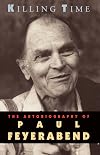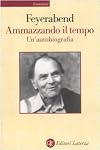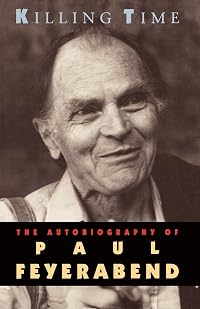
Killing Time: The Autobiography of Paul Feyerabend
by Paul Feyerabend
On This Page
Description
Killing Time is the story of Paul Feyerabend's life. Finished only weeks before his death in 1994, it is the self-portrait of one of this century's most original and influential intellectuals. Trained in physics and astronomy, Feyerabend was best known as a philosopher of science. But he emphatically was not a builder of theories or a writer of rules. Rather, his fame was in powerful, plain-spoken critiques of "big" science and "big" philosophy. Feyerabend gave voice to a radically show more democratic "epistemological anarchism:" he argued forcefully that there is not one way to knowledge, but many principled paths; not one truth or one rationality but different, competing pictures of the workings of the world. "Anything goes," he said about the ways of science in his most famous book, Against Method. And he meant it. Here, for the first time, Feyerabend traces the trajectory that led him from an isolated, lower-middle-class childhood in Vienna to the height of international academic success. He writes of his experience in the German army on the Russian front, where three bullets left him crippled, impotent, and in lifelong pain. He recalls his promising talent as an operatic tenor (a lifelong passion), his encounters with everyone from Martin Buber to Bertolt Brecht, innumerable love affairs, four marriages, and a career so rich he once held tenured positions at four universities at the same time. Although not written as an intellectual autobiography, Killing Time sketches the people, ideas, and conflicts of sixty years. Feyerabend writes frankly of complicated relationships with his mentor Karl Popper and his friend and frequent opponent Imre Lakatos, and his reactions to a growing reputation as the "worst enemy of science." show lessTags
Recommendations







Member Reviews
Not really an autobiography you would expect from a philosopher.
This is not a dense academic book but a relaxed and honest confession. Unlike Rousseau though, Feyerabend is funny too. It is difficult to summarize the book as it is something like a collage, like Feyerabend himself characterizes some of his other books. He goes through the plays and operas he has seen, intellectuals he has met, women he has loved and of course books and articles he has written, but nothing in a systematic way. There are also many great anecdotes.
Even though Killing Time is not a heavy book, Feyerabend shares some reflections as well. In particular I found the chapter on Against Method interesting.
This is not a dense academic book but a relaxed and honest confession. Unlike Rousseau though, Feyerabend is funny too. It is difficult to summarize the book as it is something like a collage, like Feyerabend himself characterizes some of his other books. He goes through the plays and operas he has seen, intellectuals he has met, women he has loved and of course books and articles he has written, but nothing in a systematic way. There are also many great anecdotes.
Even though Killing Time is not a heavy book, Feyerabend shares some reflections as well. In particular I found the chapter on Against Method interesting.
Much has been written about Feyerabend. My two cents' worth.
A striking aspect of this book is that philosophers and scientists, even (or perhaps specially?) the greatest of them walked hand in hand. They listened to each other. Am I incorrect to say that now there is a complete schism? It's all very well to blame the philosophers who generally avoid science because it's too hard.
But an equally fair generalisation is that scientists now are culturally ignorant. They don't read, they don't go to theatre or engage in philosophical argument. They don't even do science. They have tiny fragmented parts to play in something which might or might not have a big picture. They refuse to be engaged on some other tiny bit even if it sits right next show more to theirs, or to the small big picture. That, at any rate, is my overall impression and needless to say there are obvious exceptions, at least on the goodreads site. Clearly if they believe that they can do a good job of being a scientist with nothing even remotely approaching a world view, they are scarcely going to see any advantage in an interdisciplinary education or way of engaging with the world.
Feyerabend is enormously well-read and seems to read anything. I suspect if he seems like an odd thinker it is partly because he takes from so many places. Not much, I'd say, from feminism. I note that he mentions many lays in this book, none of them are attributed with a surname. Why? If it were to protect their anonymity, he could at least have given his wives surnames since they are no chance to remain unknown.
rest here: https://alittleteaalittlechat.wordpress.com/2017/07/14/killing-time-by-paul-feye... show less
A striking aspect of this book is that philosophers and scientists, even (or perhaps specially?) the greatest of them walked hand in hand. They listened to each other. Am I incorrect to say that now there is a complete schism? It's all very well to blame the philosophers who generally avoid science because it's too hard.
But an equally fair generalisation is that scientists now are culturally ignorant. They don't read, they don't go to theatre or engage in philosophical argument. They don't even do science. They have tiny fragmented parts to play in something which might or might not have a big picture. They refuse to be engaged on some other tiny bit even if it sits right next show more to theirs, or to the small big picture. That, at any rate, is my overall impression and needless to say there are obvious exceptions, at least on the goodreads site. Clearly if they believe that they can do a good job of being a scientist with nothing even remotely approaching a world view, they are scarcely going to see any advantage in an interdisciplinary education or way of engaging with the world.
Feyerabend is enormously well-read and seems to read anything. I suspect if he seems like an odd thinker it is partly because he takes from so many places. Not much, I'd say, from feminism. I note that he mentions many lays in this book, none of them are attributed with a surname. Why? If it were to protect their anonymity, he could at least have given his wives surnames since they are no chance to remain unknown.
rest here: https://alittleteaalittlechat.wordpress.com/2017/07/14/killing-time-by-paul-feye... show less
Much has been written about Feyerabend. My two cents' worth.
A striking aspect of this book is that philosophers and scientists, even (or perhaps specially?) the greatest of them walked hand in hand. They listened to each other. Am I incorrect to say that now there is a complete schism? It's all very well to blame the philosophers who generally avoid science because it's too hard.
But an equally fair generalisation is that scientists now are culturally ignorant. They don't read, they don't go to theatre or engage in philosophical argument. They don't even do science. They have tiny fragmented parts to play in something which might or might not have a big picture. They refuse to be engaged on some other tiny bit even if it sits right next show more to theirs, or to the small big picture. That, at any rate, is my overall impression and needless to say there are obvious exceptions, at least on the goodreads site. Clearly if they believe that they can do a good job of being a scientist with nothing even remotely approaching a world view, they are scarcely going to see any advantage in an interdisciplinary education or way of engaging with the world.
Feyerabend is enormously well-read and seems to read anything. I suspect if he seems like an odd thinker it is partly because he takes from so many places. Not much, I'd say, from feminism. I note that he mentions many lays in this book, none of them are attributed with a surname. Why? If it were to protect their anonymity, he could at least have given his wives surnames since they are no chance to remain unknown.
rest here: https://alittleteaalittlechat.wordpress.com/2017/07/14/killing-time-by-paul-feye... show less
A striking aspect of this book is that philosophers and scientists, even (or perhaps specially?) the greatest of them walked hand in hand. They listened to each other. Am I incorrect to say that now there is a complete schism? It's all very well to blame the philosophers who generally avoid science because it's too hard.
But an equally fair generalisation is that scientists now are culturally ignorant. They don't read, they don't go to theatre or engage in philosophical argument. They don't even do science. They have tiny fragmented parts to play in something which might or might not have a big picture. They refuse to be engaged on some other tiny bit even if it sits right next show more to theirs, or to the small big picture. That, at any rate, is my overall impression and needless to say there are obvious exceptions, at least on the goodreads site. Clearly if they believe that they can do a good job of being a scientist with nothing even remotely approaching a world view, they are scarcely going to see any advantage in an interdisciplinary education or way of engaging with the world.
Feyerabend is enormously well-read and seems to read anything. I suspect if he seems like an odd thinker it is partly because he takes from so many places. Not much, I'd say, from feminism. I note that he mentions many lays in this book, none of them are attributed with a surname. Why? If it were to protect their anonymity, he could at least have given his wives surnames since they are no chance to remain unknown.
rest here: https://alittleteaalittlechat.wordpress.com/2017/07/14/killing-time-by-paul-feye... show less
Ratings
Members
- Recently Added By
Author Information

64+ Works 3,296 Members
A controversial and influential voice in the philosophy of science, Paul K. Feyerabend was born and educated in Vienna. After military service during World War II and further study at the University of London, he returned to Vienna as a lecturer at the university. In 1959, having taught for several years at Bristol University in England, he came show more to the United States to join the faculty of the University of California at Berkeley, from which, after numerous visiting appointments elsewhere, he retired in 1990. Since the 1970s, Feyerabend has devoted much of his career to arguing that science as practiced cannot be described, let alone regulated, by any coherent methodology, whether understood historically, as in Thomas Kuhn's use of paradigms, or epistemologically, as in classical positivism and its offspring. He illustrates this stance on the dust jacket of one of his books, Against Method (1975), by publishing his horoscope in the place usually reserved for a biographical sketch of the author. In his entry in the Supplement to Who's Who in America, he is quoted as saying, "Leading intellectuals with their zeal for objectivity are criminals, not the liberators of mankind." (Bowker Author Biography) show less
Series
Belongs to Publisher Series
Classifications
- Genres
- Philosophy, Biography & Memoir, Nonfiction, Science & Nature, General Nonfiction, History
- DDC/MDS
- 193 — Philosophy & psychology Modern western philosophy Philosophy of Germany and Austria
- LCC
- B3240 .F484 .A3 — Philosophy, Psychology and Religion Philosophy (General) By period Modern By region or country
- BISAC
Statistics
- Members
- 209
- Popularity
- 156,356
- Reviews
- 3
- Rating
- (4.03)
- Languages
- 8 — Dutch, English, French, German, Italian, Polish, Portuguese, Spanish
- Media
- Paper
- ISBNs
- 11
- UPCs
- 1
- ASINs
- 2