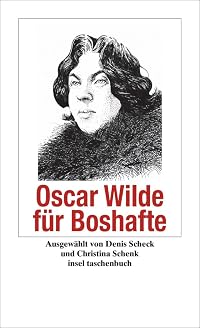
Oscar Wilde für Boshafte (insel taschenbuch)
by Oscar Wilde 
On This Page
Description
"Bosheit ist ein Mythos, den gute Menschen erfunden haben, um die seltsame Anziehungskraft der anderen zu erklären." Oscar Wilde Oscar (Fingal O'Flahertie Wills) Wilde wurde am 16. Oktober 1854 in Dublin als Sohn des Arztes William Wilde und der Dichterin Jane Francesca Elgee geboren. Er studierte klassische Literatur am Trinity College in Dublin und am Magdalen College in Oxford. 1879 ging er nach London, wo er sich bald durch seinen extravaganten Lebensstil und seine rhetorische show more Gewandtheit einen Namen machte. Nach Reisen in die USA, nach Kanada und Frankreich arbeitete Wilde zunächst für verschiedene Zeitungen als Lektor und Herausgeber. Seit 1884 mit Constance Lloyd verheiratet, schrieb und veröffentlichte er 1888 für seine eigenen Kinder die Märchensammlung TheHappy Prince and Other Tales. In den folgenden Jahren entstanden weitere Erzählungen (wie The Picture of Dorian Gray,1891) und zahlreiche Bühnenstücke (wie The Importance of Being Earnest, 1895), die außerordentliches literarisches und gesellschaftliches Aufsehen erregten. Auf dem Höhepunkt seines Erfolges stürzte ihn dann jedoch der Skandal um das langjährige Verhältnis mit Lord Alfred Douglas in den Ruin. Wilde verlor eine Verleumdungsklage gegen Douglas Vater, der ihn der Sodomie bezichtigt hatte, und wurde selbst in einem Strafprozeß wegen Unzucht zu einer zweijährigen Haftstrafe verurteilt. Nach seiner Entlassung aus dem Gefängnis in Reading floh er vor der gesellschaftlichen Ächtung unter falschem Namen nach Paris. Völlig mittellos starb er hier am 30. November 1900. show lessMembers
- Recently Added By
Author Information

1,762+ Works 120,771 Members
Flamboyant man-about-town, Oscar Wilde had a reputation that preceded him, especially in his early career. He was born to a middle-class Irish family (his father was a surgeon) and was trained as a scholarship boy at Trinity College, Dublin. He subsequently won a scholarship to Magdalen College, Oxford, where he was heavily influenced by John show more Ruskin and Walter Pater, whose aestheticism was taken to its radical extreme in Wilde's work. By 1879 he was already known as a wit and a dandy; soon after, in fact, he was satirized in Gilbert and Sullivan's Patience. Largely on the strength of his public persona, Wilde undertook a lecture tour to the United States in 1882, where he saw his play Vera open---unsuccessfully---in New York. His first published volume, Poems, which met with some degree of approbation, appeared at this time. In 1884 he married Constance Lloyd, the daughter of an Irish lawyer, and within two years they had two sons. During this period he wrote, among others, The Picture of Dorian Gray (1891), his only novel, which scandalized many readers and was widely denounced as immoral. Wilde simultaneously dismissed and encouraged such criticism with his statement in the preface, "There is no such thing as a moral or an immoral book. Books are well written or badly written. That is all." In 1891 Wilde published A House of Pomegranates, a collection of fantasy tales, and in 1892 gained commercial and critical success with his play, Lady Windermere's Fan He followed this comedy with A Woman of No Importance (1893), An Ideal Husband (1895), and his most famous play, The Importance of Being Earnest (1895). During this period he also wrote Salome, in French, but was unable to obtain a license for it in England. Performed in Paris in 1896, the play was translated and published in England in 1894 by Lord Alfred Douglas and was illustrated by Aubrey Beardsley. Lord Alfred was the son of the Marquess of Queensbury, who objected to his son's spending so much time with Wilde because of Wilde's flamboyant behavior and homosexual relationships. In 1895, after being publicly insulted by the marquess, Wilde brought an unsuccessful slander suit against the peer. The result of his inability to prove slander was his own trial on charges of sodomy, of which he was found guilty and sentenced to two years of hard labor. During his time in prison, he wrote a scathing rebuke to Lord Alfred, published in 1905 as De Profundis. In it he argues that his conduct was a result of his standing "in symbolic relations to the art and culture" of his time. After his release, Wilde left England for Paris, where he wrote what may be his most famous poem, The Ballad of Reading Gaol (1898), drawn from his prison experiences. Among his other notable writing is The Soul of Man under Socialism (1891), which argues for individualism and freedom of artistic expression. There has been a revived interest in Wilde's work; among the best recent volumes are Richard Ellmann's, Oscar Wilde and Regenia Gagnier's Idylls of the Marketplace , two works that vary widely in their critical assumptions and approach to Wilde but that offer rich insights into his complex character. (Bowker Author Biography) show less
Oscar Wilde has a Legacy Library. Legacy libraries are the personal libraries of famous readers, entered by LibraryThing members from the Legacy Libraries group.
Statistics
- Members
- 1
- Popularity
- 8,796,892
- Languages
- English
- Media
- Paper
- ISBNs
- 1