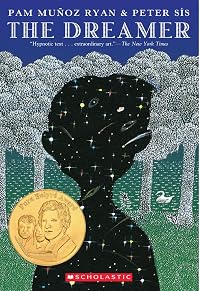
The Dreamer
by Pam Muñoz Ryan
On This Page
Description
A fictionalized biography of the Nobel Prize-winning Chilean poet Pablo Neruda, who grew up a painfully shy child, ridiculed by his overbearing father, but who became one of the most widely-read poets in the world.Tags
Recommendations










Member Recommendations
by kaledrina
Member Reviews
Pretty dreamy...this title seems to be in search of an audience. I wanted to like it and found that, while Ryan's fine prose depiction of Neruda's childhood highlights some interesting facets of Neruda's not easy childhood, the story, which includes some of Neruda's poetry at the end, does depict a pained, haunting childhood & adolescence, but not one that I can imagine recommending to a child. I'll try it and see what happens.
This title was donated to the Library by a huge fan of Ryan's who loved it. It was read by other Ryan fans who shared this love, so it seems to pass muster with its intended audience. I've been pairing it with Monica Brown's beautifully illustrated "Pablo Neruda: Poet of the People."
This title was donated to the Library by a huge fan of Ryan's who loved it. It was read by other Ryan fans who shared this love, so it seems to pass muster with its intended audience. I've been pairing it with Monica Brown's beautifully illustrated "Pablo Neruda: Poet of the People."
Maybe my craziness shows when I say this book seemed like it would be nearly impossible to do well, but I am going to be completely honest. The idea of a fictionalized biography sounds like just about the worst type of book in history. It is hard to make an interesting story that can basically be described like this: "He wanted to be a writer, so after long years of torment and disapproval, he did." (I know that book after book after book follows that same pattern, but work with me here.) And to reduce the great Pablo Neruda to formula like that? Sacrilege, some would say. Fear not, those with a similar mindset: "The Dreamer" is an amazing book.
How amazing, you ask? Well, in my review of "Mockingbird" I said I would most likely not be show more able to find a book that would affect me more strongly and touch me right down to the very core of my emotional being. If "The Dreamer" doesn't top it, it at least matches "Mockingbird" for me. This is, and will remain, without a doubt one of the best books of 2010.
This is a book lover's book, through and through. Though I am one of those unfortunate souls who never encountered a book by Pam Munoz Ryan before this one came along, I have no reason to doubt the many, many laudatory things said about it. When I read this book, I was THERE, in that world. Everything was brighter and more acutely observed that I may have noticed in the real world, in real nature. That, my friend, is the sign of a good writer.
Also a sign of a good writer: characters that, for better or worse, are distinctive and memorable. What young, book-loving, daydreaming, sensitive child (or teen, or adult) wouldn't be able to relate to young Neftali, even on a basic level? This is a kid who the reader will undoubtedly be rooting for from the very beginning, and not just because his home life is just shy of torture more often than not. The character of the father, a horribly strict and insensitive man, is ferocious and terrifyingly real, if portrayed as one-dimensionally evil at first. I am forever grateful that my parents, whatever their faults, were never any less than totally supporting of my goals in life, and this book cements that idea in my mind. As for the other characters, they're definitely likable and real and all, but the only memorable presence aside from Neftali and the Father, is Uncle Orlando. It is unsurprising that he fueled the young future poet's goal to use words in a way that would make people listen.
It is hard to think of an immediate flaw in this book, which I suppose is a good thing but does not suit me for this review. Frankly, the only problem that I can think of is that it may be TOO much of a book lover's book for everyone. If your love of the written word does not rival that of Neftali, you may not be as enamored of it as I was. Still, a book like this one should probably have that as its flaw; Pam Munoz is clearly in love with the written word and it shows on every page. This is, quite simply, an outstanding work of literary art, and it deserves to be read and reread by young and old for many years to come.
(Note: I didn't mention the illustrations, by Peter Sis, and I am aware of that. I didn't think I could write a whole big chunk about them, and I think that the words here are more important than the drawings. Regardless, they are lovely, as expected from the master illustrator, and they definitely add something to the book.) show less
How amazing, you ask? Well, in my review of "Mockingbird" I said I would most likely not be show more able to find a book that would affect me more strongly and touch me right down to the very core of my emotional being. If "The Dreamer" doesn't top it, it at least matches "Mockingbird" for me. This is, and will remain, without a doubt one of the best books of 2010.
This is a book lover's book, through and through. Though I am one of those unfortunate souls who never encountered a book by Pam Munoz Ryan before this one came along, I have no reason to doubt the many, many laudatory things said about it. When I read this book, I was THERE, in that world. Everything was brighter and more acutely observed that I may have noticed in the real world, in real nature. That, my friend, is the sign of a good writer.
Also a sign of a good writer: characters that, for better or worse, are distinctive and memorable. What young, book-loving, daydreaming, sensitive child (or teen, or adult) wouldn't be able to relate to young Neftali, even on a basic level? This is a kid who the reader will undoubtedly be rooting for from the very beginning, and not just because his home life is just shy of torture more often than not. The character of the father, a horribly strict and insensitive man, is ferocious and terrifyingly real, if portrayed as one-dimensionally evil at first. I am forever grateful that my parents, whatever their faults, were never any less than totally supporting of my goals in life, and this book cements that idea in my mind. As for the other characters, they're definitely likable and real and all, but the only memorable presence aside from Neftali and the Father, is Uncle Orlando. It is unsurprising that he fueled the young future poet's goal to use words in a way that would make people listen.
It is hard to think of an immediate flaw in this book, which I suppose is a good thing but does not suit me for this review. Frankly, the only problem that I can think of is that it may be TOO much of a book lover's book for everyone. If your love of the written word does not rival that of Neftali, you may not be as enamored of it as I was. Still, a book like this one should probably have that as its flaw; Pam Munoz is clearly in love with the written word and it shows on every page. This is, quite simply, an outstanding work of literary art, and it deserves to be read and reread by young and old for many years to come.
(Note: I didn't mention the illustrations, by Peter Sis, and I am aware of that. I didn't think I could write a whole big chunk about them, and I think that the words here are more important than the drawings. Regardless, they are lovely, as expected from the master illustrator, and they definitely add something to the book.) show less
It took me two false starts to finally get into this book. It's dressed up as a sort of children's story, but it needs to be about half as many words and twice as many illustrations, in my mind. The book is a sort of retelling of Pablo Neruda's childhood and adolescence, using some anecdotes from Neruda's own letters and interviews, with some fiction thrown in. But it takes way too long to get where it's going. There were some beautiful snippets of Neruda's poetry scattered here and there but the book didn't feel like it held together very well. I think only die-hard fans of Neruda's poetry will appreciate it and everyone one else will be bored.
When you see The Dreamer sitting on a shelf, you will want to pick it up and hold it in your hands. From the shimmering cover that invites you into the universe of Neftalí’s head, to the thick paper that feels perfect under your fingers, to the calm green color of the ink, to the tiny illustration of an acorn that greets you on the title page, this is a book full of small treasures. In a story that is about taking delight in the smallest details, kudos to the designers who made the physical object of this book reflect the subject matter so beautifully.
Neftalí’s family lives under the shadow of his domineering father, a railroad man. Happy family moments are stopped cold by the sound of the train whistle that announces Father’s show more impending return. Rodolfo, Neftalí’s older brother, has already abandoned his dreams of studying music and becoming a singer, and Father is doing his best to railroad Neftalí onto the same path of leaving dreams behind and pursuing the future of Father’s choosing. But while Neftalí appears to be a weak, vulnerable child, he has hidden reserves of strength and stubbornness.
Munoz-Ryan does a wonderful job of capturing the nuances of Neftalí’s character. His compassion and curiosity are almost overwhelming, and they often get the better of Neftalí’s desire to please his authoritarian father. His fascination with words is woven into the text as he plays with their sound and meaning. The story is episodic, and the scenes are well chosen to crystallize the moments that made Neftalí into Neruda, but they also hang together well to tell a story of a shy young man with a highly developed sense of wonder. One of this book’s greatest strengths, in terms of getting it into the hands of children, is that it easily stands on its own as a novel. There is no need to know anything about Pablo Neruda to appreciate this book – in fact, there is no need for a reader to even know that it is based on a true story. While being aware of Neruda’s life certainly adds layers of resonance to this book, the story will be enjoyed by anyone who can appreciate Neftalí’s struggles and his unique outlook. The selection of poetry in the back of the book, which includes several of Neruda’s poems that directly address some of the pivotal moments in the book, is expertly chosen to appeal to young readers and may convince some young readers to seek out more.
While Munoz-Ryan’s telling of Neftalí’s childhood is wonderful, the collaboration with Peter Sis makes the story sing. Each chapter begins with three small pictures on a single page, each picture showing some scene, feeling, or object that will be important to the text. These tiny drawings echo the small treasures that Neftalí collects, and they evoke the fascination with the world around him and the attention to detail that define Neftalí. Larger drawings, all in Sís’ characteristic stippled style, illustrate the fantastical ways in which Neftalí sees his world while also working in relevant lines from Neruda’s poetry (edited to add – please see Pam Munoz-Ryan’s correction in the comments – these lines of poetry were written by her, not Pablo Neruda.). These drawings are full of wonder, but also very evocative of Neftalí’s feelings in that moment – whether that is fear of his father looming up above the sea, sadness and protectiveness of a hurt swan, or the excitement of traveling and making new friends. Sís’ drawings do with ink lines what Neruda’s poetry does with words – they crystallize feelings and experiences down to their essence, conveying them in briefly but completely. They complement the story, and the poetry, beautifully. Asking Peter Sís to turn Pablo Neruda’s imagination into visual form was a stroke of genius, and one that will give young readers an additional window into the world of his words. show less
Neftalí’s family lives under the shadow of his domineering father, a railroad man. Happy family moments are stopped cold by the sound of the train whistle that announces Father’s show more impending return. Rodolfo, Neftalí’s older brother, has already abandoned his dreams of studying music and becoming a singer, and Father is doing his best to railroad Neftalí onto the same path of leaving dreams behind and pursuing the future of Father’s choosing. But while Neftalí appears to be a weak, vulnerable child, he has hidden reserves of strength and stubbornness.
Munoz-Ryan does a wonderful job of capturing the nuances of Neftalí’s character. His compassion and curiosity are almost overwhelming, and they often get the better of Neftalí’s desire to please his authoritarian father. His fascination with words is woven into the text as he plays with their sound and meaning. The story is episodic, and the scenes are well chosen to crystallize the moments that made Neftalí into Neruda, but they also hang together well to tell a story of a shy young man with a highly developed sense of wonder. One of this book’s greatest strengths, in terms of getting it into the hands of children, is that it easily stands on its own as a novel. There is no need to know anything about Pablo Neruda to appreciate this book – in fact, there is no need for a reader to even know that it is based on a true story. While being aware of Neruda’s life certainly adds layers of resonance to this book, the story will be enjoyed by anyone who can appreciate Neftalí’s struggles and his unique outlook. The selection of poetry in the back of the book, which includes several of Neruda’s poems that directly address some of the pivotal moments in the book, is expertly chosen to appeal to young readers and may convince some young readers to seek out more.
While Munoz-Ryan’s telling of Neftalí’s childhood is wonderful, the collaboration with Peter Sis makes the story sing. Each chapter begins with three small pictures on a single page, each picture showing some scene, feeling, or object that will be important to the text. These tiny drawings echo the small treasures that Neftalí collects, and they evoke the fascination with the world around him and the attention to detail that define Neftalí. Larger drawings, all in Sís’ characteristic stippled style, illustrate the fantastical ways in which Neftalí sees his world while also working in relevant lines from Neruda’s poetry (edited to add – please see Pam Munoz-Ryan’s correction in the comments – these lines of poetry were written by her, not Pablo Neruda.). These drawings are full of wonder, but also very evocative of Neftalí’s feelings in that moment – whether that is fear of his father looming up above the sea, sadness and protectiveness of a hurt swan, or the excitement of traveling and making new friends. Sís’ drawings do with ink lines what Neruda’s poetry does with words – they crystallize feelings and experiences down to their essence, conveying them in briefly but completely. They complement the story, and the poetry, beautifully. Asking Peter Sís to turn Pablo Neruda’s imagination into visual form was a stroke of genius, and one that will give young readers an additional window into the world of his words. show less
This is the story of Neftali Reyes Known to the world as thepoet Pablo Neruda. As a young boy, Neftali's mind wandered and he questioned everything around him. His domineering father considered him "absentminded", "dim-witted", and "idiot" He dictated what he expected his sons to become. Somehow Neftali finds his own way. As he grows older he takes on, through his writing the cause of the Mapuche people. The Indigenous people of Chile. The words flow throughout this book creating an image in the mind that is enhanced by the drawings by Pepter Sis. This is a book that you not only read, you feel it.
The moment I finished reading The Dreamer, written by Pam Muñoz Ryan and illustrated by Peter Sís (2010), I wanted to throw open my window and announce to the world to stop what they are doing and read this book right away! Granted the Pura Belpré Award in 2010, The Dreamer tells the tale of young Neftalí Reyes who perseveres through a difficult childhood and finds his love for words, eventually transforming into Pablo Neruda. Magic realism infused throughout the story allows us glimpses into the brilliance of this famous poet, and Peter Sis's fantastical drawings take us even deeper into his thoughts and experiences.
In the classroom, I would use this book to teach magic realism, biography, and poetry. Grades 4 and up.
In the classroom, I would use this book to teach magic realism, biography, and poetry. Grades 4 and up.
Ryan's poetic text truly gives the feel for Neruda, Chile's most famous poet. I love that his poetry is interspersed through the story. She has captured the voice of the young Neftali in constant wonder of the natural world. She also reveals the pain inflicted on himself and his two siblings by the very dominant father.
Members
- Recently Added By
Lists

Geek Dad Read to Your Kids Additions List
66 works; 4 members

Authors from the United States
245 works; 3 members

Books Read in 2024
4,623 works; 124 members
Author Information

63+ Works 37,126 Members
Author Pam Muñoz Ryan was born in Bakersfield, California on December 25, 1951. She received a B. A. in child development and a M. A. in education from San Diego State University. Before becoming a full-time author, she worked as a bilingual Head Start teacher and as an early childhood program administrator. At first, she wrote adult books about show more child development, but soon switched to writing children's books. She has written over twenty-five picture books, novels, and nonfiction books for young readers. The novel Esperanza Rising, winner of the Pura Belpre Medal, the Jane Addams Peace Award, an ALA Top Ten Best Book for Young Adults, and the Americas Award Honor Book, is based on her own grandmother's immigration from Mexico to California. Riding Freedom has also won many awards including the national Willa Cather Award and the California Young Reader Medal. When Marian Sang, a picture book about singer Marian Anderson, won numerous awards including the ALA Sibert Honor and NCTE's Orbis Pictus Award. In 2015 her title Echo made The New York Times Best Seller List. She also won a Kirkus Prize in the children's literature category with her title 'Echo'. (Bowker Author Biography) show less
All Editions
Awards and Honors
Awards
Distinctions
Notable Lists
Common Knowledge
- Canonical title
- The Dreamer
- Original title
- The dreamer
- Original publication date
- 2010-04-01
- People/Characters
- Neftali Reyes; Mamadre; Father; Orlando; Laurita Reyes; Rodolfo Reyes (show all 8); Blanca; Guillermo
- Important places
- Chile; Temuco, Chile
- Dedication
- To my reader, this book is for you. Wander into the infinite space between soul and star. I am waiting for you there. ~ PMR To our family house Nerudova 19 Prague ~ PS
- First words
- On a continent of many songs, in a country shaped like the arm of a tall guitarrista, the rain drummed down on the town of Temuco.
- Last words
- (Click to show. Warning: May contain spoilers.)...Their wings beating with the same pulse, their hearts eager to feel all that he could dream. Tin, tin, tin, tin, tin
Classifications
Statistics
- Members
- 1,540
- Popularity
- 14,880
- Reviews
- 91
- Rating
- (4.07)
- Languages
- 5 — English, French, German, Italian, Spanish
- Media
- Paper, Audiobook, Ebook
- ISBNs
- 26
- ASINs
- 5