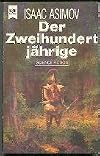
The Bicentennial Man [novelette]
by Isaac Asimov
On This Page
Tags
Recommendations


















Member Reviews
I was expecting to like this more, but maybe my memory of the movie with Robin Williams is more foggy than I thought. Definitely going to watch it this month after I get home from holiday.
This is a short story about a robot that becomes human, and tbh I didn't like the contents of the story or the direction it went in or the concept, lmao. It's premised on the idea that one robot made by this company is uniquely creative and has emotional capacity, and then only through the kindness of his owners, he was graciously granted emancipation and freedom, and he used his freedom to start a business and save up money. He got harassed for being a robot, so he started replacing more and more of himself with humanlike parts so he could assimilate show more into society, and by the end of the story, he decided to make himself mortal, and only on his deathbed did humans finally give him the legal distiction of a human person.
I think this story is overly individualistic, way too kind to his human owners, putting the agency in their hands rather than his with humans granting him freedom rather than him taking what he's owed for himself. There are no other robots there for him to help emancipate with him, so the whole story is focused on this robot's singular goal to assimilate and become human. By the end, he kills himself just to be treated like a human. He dies and that's literally the end, and honestly, it's depressing.
The story never really deals with the loneliness of his existence, many aspects of the human condition he missed out because he read all about it in books, and I think it limited itself by focusing so heavily on a single robot that by the constraints of the story, the conclusion is that no robot will ever be sapient again, and the world carries on as if he was never there.
Maybe for robot fiction this is just a product of his time, idk, but there are better robot works out there that deal with this stuff. show less
This is a short story about a robot that becomes human, and tbh I didn't like the contents of the story or the direction it went in or the concept, lmao. It's premised on the idea that one robot made by this company is uniquely creative and has emotional capacity, and then only through the kindness of his owners, he was graciously granted emancipation and freedom, and he used his freedom to start a business and save up money. He got harassed for being a robot, so he started replacing more and more of himself with humanlike parts so he could assimilate show more into society, and by the end of the story, he decided to make himself mortal, and only on his deathbed did humans finally give him the legal distiction of a human person.
I think this story is overly individualistic, way too kind to his human owners, putting the agency in their hands rather than his with humans granting him freedom rather than him taking what he's owed for himself. There are no other robots there for him to help emancipate with him, so the whole story is focused on this robot's singular goal to assimilate and become human. By the end, he kills himself just to be treated like a human. He dies and that's literally the end, and honestly, it's depressing.
The story never really deals with the loneliness of his existence, many aspects of the human condition he missed out because he read all about it in books, and I think it limited itself by focusing so heavily on a single robot that by the constraints of the story, the conclusion is that no robot will ever be sapient again, and the world carries on as if he was never there.
Maybe for robot fiction this is just a product of his time, idk, but there are better robot works out there that deal with this stuff. show less
Ratings
Members
- Recently Added By
Lists

Nebula Award
111 works; 14 members

KayStJ's to-read list
1,616 works; 11 members
Author Information

2,398+ Works 293,527 Members
Isaac Asimov was born in Petrovichi, Russia, on January 2, 1920. His family emigrated to the United States in 1923 and settled in Brooklyn, New York, where they owned and operated a candy store. Asimov became a naturalized U.S. citizen at the age of eight. As a youngster he discovered his talent for writing, producing his first original fiction at show more the age of eleven. He went on to become one of the world's most prolific writers, publishing nearly 500 books in his lifetime. Asimov was not only a writer; he also was a biochemist and an educator. He studied chemistry at Columbia University, earning a B.S., M.A. and Ph.D. In 1951, Asimov accepted a position as an instructor of biochemistry at Boston University's School of Medicine even though he had no practical experience in the field. His exceptional intelligence enabled him to master new systems rapidly, and he soon became a successful and distinguished professor at Columbia and even co-authored a biochemistry textbook within a few years. Asimov won numerous awards and honors for his books and stories, and he is considered to be a leading writer of the Golden Age of science fiction. While he did not invent science fiction, he helped to legitimize it by adding the narrative structure that had been missing from the traditional science fiction books of the period. He also introduced several innovative concepts, including the thematic concern for technological progress and its impact on humanity. Asimov is probably best known for his Foundation series, which includes Foundation, Foundation and Empire, and Second Foundation. In 1966, this trilogy won the Hugo award for best all-time science fiction series. In 1983, Asimov wrote an additional Foundation novel, Foundation's Edge, which won the Hugo for best novel of that year. Asimov also wrote a series of robot books that included I, Robot, and eventually he tied the two series together. He won three additional Hugos, including one awarded posthumously for the best non-fiction book of 1995, I. Asimov. "Nightfall" was chosen the best science fiction story of all time by the Science Fiction Writers of America. In 1979, Asimov wrote his autobiography, In Memory Yet Green. He continued writing until just a few years before his death from heart and kidney failure on April 6, 1992. (Bowker Author Biography) show less
Awards and Honors
Awards
Notable Lists
Series
Belongs to Publisher Series
Work Relationships
Is contained in
Has the adaptation
Is expanded in
Common Knowledge
- Canonical title
- The Bicentennial Man [novelette]
- Original title
- The Bicentennial Man
- Original publication date
- 1976
- People/Characters
- Andrew Martin; Gerald Martin; "Little Miss" Mandy Martin; George Martin; Paul Martin
- Epigraph*
- Die Drei Grundregeln der Robotik:
- Ein Robot darf kein menschliches Wesen verletzen oder durch Untätigkeit gestatten, daß einem menschlichen Wesen Schaden zugefügt wird.
- Ein Robot muß den ih... (show all)m von einem Menschen gegebenen Befehlen gehorchen, es sei denn, ein solcher Befehl würde mit Regel Eins kollidieren.
- Ein Robot muß seine Existenz beschützen, solange dieser Schutz nicht mit Regel Eins oder Zwei kollidiert.
- Ein Robot darf kein menschliches Wesen verletzen oder durch Untätigkeit gestatten, daß einem menschlichen Wesen Schaden zugefügt wird.
- First words*
- »Vielen Dank«, sagte Andrew Martin und setzte sich auf den Platz, der ihm angeboten worden war.
- Last words*
- (Click to show. Warning: May contain spoilers.)»Little Miß«, flüsterte er so leise, daß es niemand hörte.
- Original language
- English
- Disambiguation notice*
- This is a short story. Do NOT combine with any collections.
*Some information comes from Common Knowledge in other languages. Click "Edit" for more information.
Classifications
Statistics
- Members
- 25
- Popularity
- 1,075,436
- Reviews
- 1
- Rating
- (3.25)
- Languages
- English, German
- Media
- Paper
- ISBNs
- 1
- ASINs
- 2