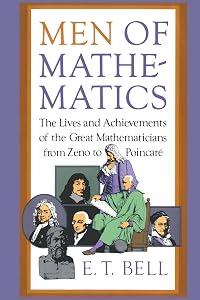
Men of Mathematics
by E. T. Bell
On This Page
Description
From one of the greatest minds in contemporary mathematics, Professor E.T. Bell, comes a witty, accessible, and fascinating look at the beautiful craft and enthralling history of mathematics. Men of Mathematics provides a rich account of major mathematical milestones, from the geometry of the Greeks through Newton's calculus, and on to the laws of probability, symbolic logic, and the fourth dimension. Bell breaks down this majestic history of ideas into a series of engrossing biographies of show more the great mathematicians who made progress possible--and who also led intriguing, complicated, and often surprisingly entertaining lives. Never pedantic or dense, Bell writes with clarity and simplicity to distill great mathematical concepts into their most understandable forms for the curious everyday reader. Anyone with an interest in math may learn from these rich lessons, an advanced degree or extensive research is never necessary. show lessTags
Recommendations


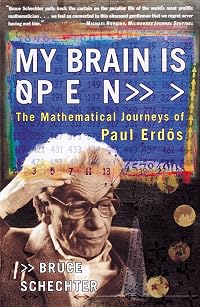
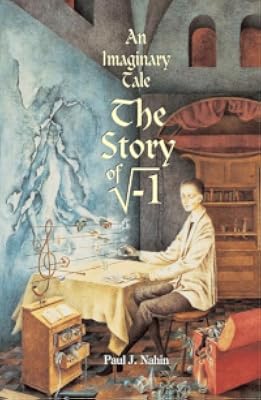
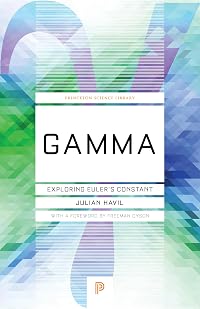
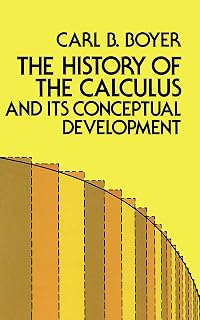




Member Recommendations
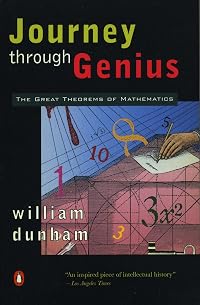
br77rino "Journey" is a wonderful review of a handful of important mathematical theorems, such as the Quadrature of the Lune and the Pythagorean Theorem.
Member Reviews
This was the book that piqued my interest in mathematics and the people who does mathematics for a living. Be aware that this book was written in the days when only caucasian western men did mathematics. Asian mathematics weren't considered and women mathematicians were considered to be novelties, not worthy of attention.
This book considered all of the heavy weights in mathematics at the time. From the Greeks onward until those mathematicians considered worthy at the time of Bell's writing. Bell's review of their lives are partly general biography, part assessment of their mathematics, and part psychological studies of why they did what they did. Bell is by no means an objective reporter of the facts. He definitely had his favorites and show more he had his not so favorites, and he was not shy about letting you know. That is partly why this is such a good book. He puts in his opinions of the foibles and genius of each of the men he is writing about and he puts their genius in a pecking order that he himself created. I found it informative and entertaining. Others may find it bothersome, but this is by far the most complete book of its kind for its day. I recommend it to anyone even remotely interested in mathematics and mathematicians. show less
This book considered all of the heavy weights in mathematics at the time. From the Greeks onward until those mathematicians considered worthy at the time of Bell's writing. Bell's review of their lives are partly general biography, part assessment of their mathematics, and part psychological studies of why they did what they did. Bell is by no means an objective reporter of the facts. He definitely had his favorites and show more he had his not so favorites, and he was not shy about letting you know. That is partly why this is such a good book. He puts in his opinions of the foibles and genius of each of the men he is writing about and he puts their genius in a pecking order that he himself created. I found it informative and entertaining. Others may find it bothersome, but this is by far the most complete book of its kind for its day. I recommend it to anyone even remotely interested in mathematics and mathematicians. show less
Don't let the introduction of this book fool you! While the front-matter is enticing and exciting, the rest of the book fails to live up to these expectations. This book manages to make an exciting topic boring and hard to suffer through via a combination of flowery, say-nothing prose and a focus on the people rather than the math.
OK, I get it -- for the most part, readers do want people stories over math, but those are not the people who are going to be reading this book. Know your audience, Eric Temple Bell. I would not recommend this book in the slightest.
If you're looking for a book that presents the history of nerdy shit well, treat yourself to "The Making of the Atomic Bomb" and skip over this drivel.
OK, I get it -- for the most part, readers do want people stories over math, but those are not the people who are going to be reading this book. Know your audience, Eric Temple Bell. I would not recommend this book in the slightest.
If you're looking for a book that presents the history of nerdy shit well, treat yourself to "The Making of the Atomic Bomb" and skip over this drivel.
When I was younger, I liked this book a lot. Later, however, it is easy to notice that there are several great mathematicians who are curiously omitted simply because they were female, and that some of the biographies have a few liberties taken with them to be more dramatic. As another reviewer said, this is a product of the times in which it was written. Still, a readable overview of the sometimes overly dramatic lives of the greatest male contributors to mathematics, but by now there are many more accurate and complete texts on the history of mathematics.
While there is one chapter on ancient mathematicians, the rest of the book is basically a chapter by chapter review of a dozen or so mathematicians, and their work, of the 17th, 18th, and 19th centuries.
The writing is clear and lucid, occasionally humorous for some barbs that stick out like sore thumbs (he doesn't care for Napoleon for example), and thoroughly enjoyable. If you are a math or physics major you will learn a lot you didn't know. Highly recommended.
Fermat, Pascal, Descartes, Newton, Leibniz, Lagrange, Legendre, Euler, Gauss, Galois, Cantor, Lobachevsky, and many others.
The writing is clear and lucid, occasionally humorous for some barbs that stick out like sore thumbs (he doesn't care for Napoleon for example), and thoroughly enjoyable. If you are a math or physics major you will learn a lot you didn't know. Highly recommended.
Fermat, Pascal, Descartes, Newton, Leibniz, Lagrange, Legendre, Euler, Gauss, Galois, Cantor, Lobachevsky, and many others.
This is a wonderful book. The only reason I dock it a star is that a few of the accounts (Galois, Cantor) have proven to be inaccurate-to-lurid -- this fact does detract somewhat from its ultimate value. However, it is a fabulous read and a perennial inspiration, so I give the book loads of credit.
I finally read it. As the math evolved, the more it went over my head. It's a good resource at understanding great mathematicians, yet it's better if you understand the formulas.
Thoroughly opinionated, sometimes historically inaccurate romp through mathematical genius.
Members
- Recently Added By
Lists

Vote: Science, Religion, and History Group Reads
30 works; 17 members

HS Mathematics class library
79 works; 6 members

Books in the bibliography of Godel, Escher, Bach by Douglas Hofstadter
97 works; 3 members

Trinity College Booklist (1951): Class One, Natural Science
98 works; 2 members

To read
23 works; 1 member
Author Information

37+ Works 1,803 Members
Awards and Honors
Series
Belongs to Publisher Series
Work Relationships
Common Knowledge
- Canonical title
- Men of Mathematics
- Original title
- Men of Mathematics
- Original publication date
- 1937
- People/Characters
- Pierre de Fermat; Blaise Pascal; Isaac Newton; Gottfried Wilhelm von Leibniz; Zeno; Eudoxus (show all 35); Archimedes; Zeno of Elea; Joseph-Louis Lagrange; Pierre-Simon Laplace; Gaspard Monge; Joseph Fourier; Jean-Victor Poncelet; Carl Friedrich Gauss; Augustin-Louis Cauchy; Nikolas Ivanovitch Lobatchewsky; Niels Henrik Abel; Carl Gustav Jacob Jacobi; William Rowan Hamilton; Evariste Galois; Arthur Cayley; James Joseph Sylvester; Karl W.T. Weierstrass; Sonja Kowalewski; George Boole; Charles Hermite; Leopold Kronecker; Georg Friedrich Bernhard Riemann; Ernst Eduard Kummer; Richard Dedekind; Henri Poincaré; Georg Cantor; Jacob Bernoulli; Nicolas Bernoulli; Johannes Bernoulli
- Important places
- St. Petersburg, Russia; Berlin, Germany; Paris, France
- Dedication
- TO TOBY
- First words
- This section is headed 'Introduction' rather than 'Preface' (which it really is) in the hope of decoying habitual preface-skippers into reading - for their own comfort - at least the following paragraphs down to the first r... (show all)ow of stars before going on to meet some of the great mathematicians.
- Quotations
- In general every essentially new problem in physics leads to types of differential equations which demand the creation of new branches of mathematics for their solution.
To the early developers of the calculus the notions of variables and limits were intuitive; to us they are extremely subtle concepts hedged about with thickets of semi-metaphysical mysteries concerning the nature of numbers, ... (show all)both rational and irrational. - Last words
- (Click to show. Warning: May contain spoilers.)As Cantor said, "The essence of mathematics resides in its freedom"; the present "revolution" is but another assertion of that freedom.
- Blurbers
- Russell, Bertrand
Classifications
Statistics
- Members
- 1,072
- Popularity
- 23,960
- Reviews
- 17
- Rating
- (3.91)
- Languages
- 7 — Danish, English, Finnish, German, Italian, Spanish, Swedish
- Media
- Paper, Ebook
- ISBNs
- 15
- ASINs
- 22