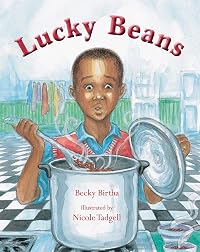
Lucky Beans
by Becky Birtha
On This Page
Description
During the Great Depression, Marshall, an African American boy, uses lessons learned in arithmetic class and guidance from his mother to figure out how many beans are in a jar in order to win her a new sewing machine in a contest.Tags
Recommendations
















Member Reviews
grades 2-6
At first, I wasn't sure why this book was tagged as a math book. This book is about a young boy, Marshall, who hates eating beans, but that is all his family can afford. When he and his younger brother walk by a nearby store, he sees a sign that says "How many beans are in this jar? Win this brand new sewing machine!" The family joins together to solve the puzzle. At first, they try to use a similar size jar, but that strategy doesn't quite work out. The next day, the teacher says, "Use what you already know to solve the problem." That gives Marshall an idea, and he gathers what he knows about measurement to solve the problem.
I think this book is an important read because it addresses how math connects to everyday life. Students are show more always going to ask, "why do I need to know this?" Students need help bridging math concepts to its real-world application, and I think that this book shows how what the student was learning in school actually applied to his life. I will definitely use this book when teaching about volume during a measuring unit. show less
I think this book is an important read because it addresses how math connects to everyday life. Students are show more always going to ask, "why do I need to know this?" Students need help bridging math concepts to its real-world application, and I think that this book shows how what the student was learning in school actually applied to his life. I will definitely use this book when teaching about volume during a measuring unit. show less
Lucky Beans by Becky Birtha is the story of a young African-American boy named Marshall Loman's glimmer of happiness during the Great Depression. He uses the math/arithmetic he is learning in school to estimate the number of beans in a large jar on display at a furniture store to help his mom win a sewing machine. After she wins the contest, things start getting better for the family.
In my opinion, I think this book is very well written and is a nice way for children to learn about The Great Depression. I like how the story is written because it is not too difficult for children to read or understand but at the same time it is not too easy that there is barely any substance to the story. I also really like how the language of the book reflects that of an African American family. For example, when the young boy says, "whats for dinner Ma, I'm starving." I also really liked the illustrations of this books. They were not all straight lined and "perfect" looking. But they kind of looked "sloppy" in a sense, I think that was a really good effect to add to the book because The Great Depression was a troubling time, and show more these pictures really help to show that. I think the main idea of this story is that it doesn't matter what you have, it is just important to be grateful. show less
Lucky Beans takes place during the great depression. Marshall Loman's dad loses his job and the family is very poor. Due to this they eat beans almost every night. During the depression beans were often given out to the poor because they were cheap and nutritious. Marshall despises beans until he and his brother see a contest at the local furniture store where you must guess the amount of beans in a jar. The price is a new sewing machine that Marshall's mother has been wanting. His only concern is if they will allow his mother to participate in the contest due to their race. During the great depression African Americans faced discrimination. My family enjoyed the historical information in this book, but as a future educator I enjoyed show more that this book tied in a Math and History lesson. show less
The book takes place during the Great Depression here in America. Marshall is a young boy belonging to a black family. Just as many other people during this period, Marshall's dad had lost his job and money was very tight. They were unable to buy many different kinds of food, but one thing they did not run low on was beans. One day he goes walking by a store and he sees a jar of beans on display for people to guess the amount. Marshall wanted to guess to win a sewing machine for his mom. He was faced with a little girl who told him his mom was unable to guess because she was not white. The store owner allowed anyone to guess, so Marshall ran home and used his math skills to help guess the amount. They guessed the closest and won the show more sewing machine. His mom was able to take up sewing for some money and his dad was finally able to find a job.
I thought this was a good book. I felt myself getting upset about the little girl's remark about being unable to guess if you're not a white woman, but that was just the times back then. It is different now, well, mostly. Aside from that, I found it to be interesting. It was very funny how he was tired of beans, but then won that entire jar of beans. He doomed himself to a life of eating beans for his mom.
This is a good book to help open a conversation with children about the Great Depression. Though the story does not provide a whole lot of information about the period, children could be asked about the historical details. They could be asked why the little girl said only white women could guess or what the Great Depression meant and how it had effected Marshall's dad's employment. show less
I thought this was a good book. I felt myself getting upset about the little girl's remark about being unable to guess if you're not a white woman, but that was just the times back then. It is different now, well, mostly. Aside from that, I found it to be interesting. It was very funny how he was tired of beans, but then won that entire jar of beans. He doomed himself to a life of eating beans for his mom.
This is a good book to help open a conversation with children about the Great Depression. Though the story does not provide a whole lot of information about the period, children could be asked about the historical details. They could be asked why the little girl said only white women could guess or what the Great Depression meant and how it had effected Marshall's dad's employment. show less
I found this story to be more about a math lesson than about the Great Depression. Marshall is frustrated with his family’s financial situation, he has to eat beans every single night. One day in a store window Marshall sees a contest, guessing the number of beans in the jar, and the prize was a brand new sewing machine. Marshall wants to win for his mother. Marshall is able to use his knowledge of measurements to correctly guess the number of beans. This story touches on the importance of education, family, hard work, and even a touch on segregation. The illustrations were my favorite part of this story. I really enjoyed the watercolor.
Members
- Recently Added By
Author Information
7+ Works 650 Members
Awards and Honors
Classifications
Statistics
- Members
- 252
- Popularity
- 129,324
- Reviews
- 25
- Rating
- (4.19)
- Languages
- English
- Media
- Paper, Ebook
- ISBNs
- 5
- ASINs
- 1