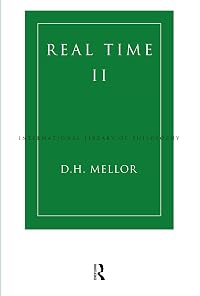
Real Time II (International Library of Philosophy)
by D. H. Mellor
International Library of Philosophy and Scientific Method
On This Page
Description
Real Time II extends and evolves D.H. Mellor's classic exploration of the philosophy of time, Real Time. This new book answers such basic metaphysical questions about time as: how do past, present and future differ, how are time and space related, what is change, is time travel possible? His Real Time dominated the philosophy of time for fifteen years. Real TIme II will do the same for the next twenty.Tags
Recommendations














Member Reviews
A good read! It’s a treatise on the nature of time, which made quite an impression on me when I read it. It presents a vision of the world in metaphysical categories. It tells you about the nature of time, the nature of space, things, objects, events, in a way that is connected, but not the same as the physics of time and space.
Hugh is someone who is very informed by those views and knows the physics of space and time very well. He uses his knowledge of those, and his philosophical arguments, to defend a view of time, where time is rather like space. I think the simplest way to put it is to say that there’s no such thing in reality as now, there’s nothing that marks out in fundamental reality, which time is now, any more than show more there’s something that marks out in the fundamental reality of space which place is here. Here is just where I am, and now is just the point in time which we’re thinking or uttering those words, so Hugh Mellor’s view has been called a block universe view of space and time.
Block universe in the sense that time is just one of the dimensions of space-time. It’s a view that is common in physics, that we should think of space-time as a whole, like a four-dimensional block. If you imagine things occurring within space-time are just regions of that block, four-dimensional regions of it, or what sometimes people call space-time worms. So, it’s called the block universe because time and space have the same ontological standing, that is to say, they exist in exactly the same way. show less
Hugh is someone who is very informed by those views and knows the physics of space and time very well. He uses his knowledge of those, and his philosophical arguments, to defend a view of time, where time is rather like space. I think the simplest way to put it is to say that there’s no such thing in reality as now, there’s nothing that marks out in fundamental reality, which time is now, any more than show more there’s something that marks out in the fundamental reality of space which place is here. Here is just where I am, and now is just the point in time which we’re thinking or uttering those words, so Hugh Mellor’s view has been called a block universe view of space and time.
Block universe in the sense that time is just one of the dimensions of space-time. It’s a view that is common in physics, that we should think of space-time as a whole, like a four-dimensional block. If you imagine things occurring within space-time are just regions of that block, four-dimensional regions of it, or what sometimes people call space-time worms. So, it’s called the block universe because time and space have the same ontological standing, that is to say, they exist in exactly the same way. show less
A good read! It’s a treatise on the nature of time, which made quite an impression on me when I read it. It presents a vision of the world in metaphysical categories. It tells you about the nature of time, the nature of space, things, objects, events, in a way that is connected, but not the same as the physics of time and space.
Hugh is someone who is very informed by those views and knows the physics of space and time very well. He uses his knowledge of those, and his philosophical arguments, to defend a view of time, where time is rather like space. I think the simplest way to put it is to say that there’s no such thing in reality as now, there’s nothing that marks out in fundamental reality, which time is now, any more than show more there’s something that marks out in the fundamental reality of space which place is here. Here is just where I am, and now is just the point in time which we’re thinking or uttering those words, so Hugh Mellor’s view has been called a block universe view of space and time.
Block universe in the sense that time is just one of the dimensions of space-time. It’s a view that is common in physics, that we should think of space-time as a whole, like a four-dimensional block. If you imagine things occurring within space-time are just regions of that block, four-dimensional regions of it, or what sometimes people call space-time worms. So, it’s called the block universe because time and space have the same ontological standing, that is to say, they exist in exactly the same way. show less
Hugh is someone who is very informed by those views and knows the physics of space and time very well. He uses his knowledge of those, and his philosophical arguments, to defend a view of time, where time is rather like space. I think the simplest way to put it is to say that there’s no such thing in reality as now, there’s nothing that marks out in fundamental reality, which time is now, any more than show more there’s something that marks out in the fundamental reality of space which place is here. Here is just where I am, and now is just the point in time which we’re thinking or uttering those words, so Hugh Mellor’s view has been called a block universe view of space and time.
Block universe in the sense that time is just one of the dimensions of space-time. It’s a view that is common in physics, that we should think of space-time as a whole, like a four-dimensional block. If you imagine things occurring within space-time are just regions of that block, four-dimensional regions of it, or what sometimes people call space-time worms. So, it’s called the block universe because time and space have the same ontological standing, that is to say, they exist in exactly the same way. show less
Ratings
Members
- Recently Added By
Author Information

14+ Works 262 Members
Series

Classifications
Statistics
- Members
- 31
- Popularity
- 905,246
- Reviews
- 2
- Rating
- (4.50)
- Languages
- English
- Media
- Paper, Ebook
- ISBNs
- 6
- ASINs
- 1