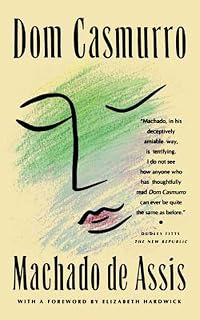
Dom Casmurro
by Machado de Assis
On This Page
Description
Bentinho Santiago, cosseted only child of a rich widow, lives next door to Capitu, the daughter of a lowly government official. As childhood friendship turns to adolescent love, an obstacle to the union exists in the form of a vow made by Bentinho's mother before his birth: her son is to be a priest. The lovers' situation appears hopeless, but resourceful Capitu is not easily discouraged. De Assis weaves a powerful and ultimately tragic story of love and disillusionment, full of the subtle show more irony that is the hallmark of his writing. In Capitu, his enigmatic heroine, he has also created one of the most fascinating characters in Brazilian fiction. show lessTags
Recommendations



















Member Reviews
Boy meets girl, boy gets girl, boy proceeds to enact tragicomic variations on Othello.
My family is officially sick of me bursting into a room and saying, "Okay, wait, you've got to hear this bit, no, really, it's brilliant," and then reading chapters from Dom Casmurro. And even now, after I've finished the book, I am hard-pressed to select my favorite part. Is it the chapter where life is a libretto written by God and conducted by Satan? Is it the bit where the hero bemoans the inconvenience of a dead boy who blights an otherwise peerless day? Is it when he blithely endorses the benevolent prophecies of the witches from Macbeth? Is it when he sighs over the inability of ignorant people to commit suicide? Is it when he tries to poison show more his son?
No. No, I think my favorite part comes right after the hero has received an ambiguous signal from his best friend's wife (who is named Sancha). His mind busy cataloging possible interpretations (both innocent and adulterous), he talks to his best friend about swimming in the sea the next day. The best friend invites him to feel his biceps; the hero touches them tenderly: "I felt his arms as if I were feeling those of Sancha." [218] There is so much bundled up in that line -- his arousal, his guilt, and his reassignment of virtues -- but it is so dryly ironic and straight-faced. (People complain about the Helen Caldwell translation, but I found it very precise and cognizant of Machado de Assis' wide-ranging allusions. But then, I have not read the original Portuguese.) show less
My family is officially sick of me bursting into a room and saying, "Okay, wait, you've got to hear this bit, no, really, it's brilliant," and then reading chapters from Dom Casmurro. And even now, after I've finished the book, I am hard-pressed to select my favorite part. Is it the chapter where life is a libretto written by God and conducted by Satan? Is it the bit where the hero bemoans the inconvenience of a dead boy who blights an otherwise peerless day? Is it when he blithely endorses the benevolent prophecies of the witches from Macbeth? Is it when he sighs over the inability of ignorant people to commit suicide? Is it when he tries to poison show more his son?
No. No, I think my favorite part comes right after the hero has received an ambiguous signal from his best friend's wife (who is named Sancha). His mind busy cataloging possible interpretations (both innocent and adulterous), he talks to his best friend about swimming in the sea the next day. The best friend invites him to feel his biceps; the hero touches them tenderly: "I felt his arms as if I were feeling those of Sancha." [218] There is so much bundled up in that line -- his arousal, his guilt, and his reassignment of virtues -- but it is so dryly ironic and straight-faced. (People complain about the Helen Caldwell translation, but I found it very precise and cognizant of Machado de Assis' wide-ranging allusions. But then, I have not read the original Portuguese.) show less
This book was so tragically boring that it took me four months to read it.
I find this tragic because on the back of my copy it is described as “Machado’s masterpiece” and I loved The Posthumous Memoirs of Bras Cubas by the same author, but good god Dom Casmurro fails in every way to live up to it. Machado de Assis still uses all his literary and rhetorical tricks, his meta references and his asides to the reader, but unfortunately they’re all in service of a story that is mediocre in every way. The characters are indistinct, the plot only gains impetus in the final ten pages, the narrator’s voice is less wry and unique than the late Bras Cubas’ was.
Rarely have I experienced such a distinction between the style of a story show more and its content—I loved the way this was told but absolutely could not care less about what it was telling.
____________________
Global Challenge: Brazil show less
I find this tragic because on the back of my copy it is described as “Machado’s masterpiece” and I loved The Posthumous Memoirs of Bras Cubas by the same author, but good god Dom Casmurro fails in every way to live up to it. Machado de Assis still uses all his literary and rhetorical tricks, his meta references and his asides to the reader, but unfortunately they’re all in service of a story that is mediocre in every way. The characters are indistinct, the plot only gains impetus in the final ten pages, the narrator’s voice is less wry and unique than the late Bras Cubas’ was.
Rarely have I experienced such a distinction between the style of a story show more and its content—I loved the way this was told but absolutely could not care less about what it was telling.
____________________
Global Challenge: Brazil show less
Dom Casmurro is a tender and intimate look at a budding love that flowers and dies before it has had the opportunity to experience the seasons of a lifetime. The roots remain for a while, alive and struggling for life, but the climatic conditions are not enough to sustain it. The once beautiful flower suffers a slow and painful death. One can attempt to replace the plant with a fabric imitation, but without real life, it would be soul-less. Such is the essence of Machado’s lovely portrait of a man so consumed by love, that with fits of obsessive jealousy, he destroys it.
Machado’s is a timeless theme, yet the elegance with which he develops his characters is unique. There is, Jose Dias with his beloved superlatives and his tendency show more to walk with, “a casual slow step; not the lethargic gate of a lazy man, but a logical calculated slowness, a complete syllogism, the premise before the consequence, the consequence before the conclusion”. Exquisite! There is Benito, the protagonist, narrator and beloved of Capitu. The man who feels, “Daydreams are like other dreams; they are woven according to the patterns of our wishes and memories.” Yet, he forgets to bear this in mind when sharing his story. Thus, the reader is left to question the accuracy of Benito’s narrative. Machado plays with the reader through Benito’s voice so we are left to wonder, what is real and what was only real in the eyes of Benito. Finite conclusions cannot be drawn. Such is the mystery and genius of Machado’s writing. His is a story that continues to play in the readers psyche, long after its reading. show less
Machado’s is a timeless theme, yet the elegance with which he develops his characters is unique. There is, Jose Dias with his beloved superlatives and his tendency show more to walk with, “a casual slow step; not the lethargic gate of a lazy man, but a logical calculated slowness, a complete syllogism, the premise before the consequence, the consequence before the conclusion”. Exquisite! There is Benito, the protagonist, narrator and beloved of Capitu. The man who feels, “Daydreams are like other dreams; they are woven according to the patterns of our wishes and memories.” Yet, he forgets to bear this in mind when sharing his story. Thus, the reader is left to question the accuracy of Benito’s narrative. Machado plays with the reader through Benito’s voice so we are left to wonder, what is real and what was only real in the eyes of Benito. Finite conclusions cannot be drawn. Such is the mystery and genius of Machado’s writing. His is a story that continues to play in the readers psyche, long after its reading. show less
Well that was good! This is why I like the idea of the book gift box, this is something I doubt I'd have picked up for myself, but I really enjoyed it. Narrated by the titular character, Dom Casmurro is a nickname, it means something along the lines of Lord Aloof, in that he holds himself apart from the rest of the world. He tells the story of his life, his great love for the girl next door, Capitu, and how he believes that she has betrayed him. Told entirely from one side, there is no answer to his belief in her adultery with his best friend. And, seen as an impartial reader, there is no evidence presented either, is is all extremely flimsy and circumstantial. This is in contrast to his being trained as a lawyer, he never seems to show more weigh the evidence he believes he has, nor does he give anyone else a fair hearing. As an unreliable narrator, you learn what he wants you to learn, and anything else is not presented. As to motive and the real facts of the situation, I will leave that one to you to determine for yourself. I think this would make a realy good book for a discussion group, with different opinions on the true events.
As to the characters he includes in his story, they are all in the shade of the love of Bento's life, Capitu. She is many things and different characters in the story react to her differently. She is, regardless of the actual facts, a great leading lady.
Although written at the turn of the 20th century in Brazil, this does not necessarily evoke a particular time and place. What feels very contemporary is the way the story centers entirely on Bento's emotional response to the world around him. He is also breaking the forth wall by talking directly to the reader in a way that feels far more modern a device. show less
As to the characters he includes in his story, they are all in the shade of the love of Bento's life, Capitu. She is many things and different characters in the story react to her differently. She is, regardless of the actual facts, a great leading lady.
Although written at the turn of the 20th century in Brazil, this does not necessarily evoke a particular time and place. What feels very contemporary is the way the story centers entirely on Bento's emotional response to the world around him. He is also breaking the forth wall by talking directly to the reader in a way that feels far more modern a device. show less
If you want to read a classic of Brazilian literature, then it has to be Dom Casmurro by Joaquim Maria Machado de Assis. Never heard of him? Not surprising — on the rare occasions when you come across anything about literature from South America, it will typically reference the big names like Colombia's Gabriel García Márquez or Isabel Allende from Chile. As for Brazilian writers, about the only one to get much world wide attention is Paulo Coelho.
Machado de Assis isn't as well-known outside his home country but within Brazil it's a completely different story. Dom Casmurro, the book considered his finest novel, is required reading for every child in the country. It's on the school syllabus in much the same way that Bronte, Dickens show more and Austen were in the UK (until the government started messing around with eduction and children were no longer have to read whole books)
This is a novel in the realist mode that ranks alongside many other great nineteenth century novels like Madame Bovary or Anna Karenina which similarly focus on love, marriage and adultery. But the similarity only extends to the theme and not to the way de Assis handles his subject.
The novel purportes to be an autobiography written by Bento Santiago, a lawyer from Rio de Janeiro. We meet him as a semi reclusive man in the maturity of his life, the occupant of a substantial house built as a replica of his childhood home. He is alone, with few friends still alive.
After years of wedded bliss to a childhood sweetheart, he suspects that he has been cuckolded; that his wife Capitú, has cheated on him with his best friend and that her child is not his.
Writing, he decides, will relieve the monotony of his life. Ideally he wants to write something about jurisprudence or politics but that will require more energy than he has available right now; so instead he opts for the easier path of recording reminiscences from his past.
Through the narration that ensues, we follow him from his early adoration of Capitú, the girl next door who he believes similarly adores him. They cannot declare their love publicly however — his mother has him marked down for a glittering career in the church and would not welcome any disruption to those plans. So off he goes to the seminary, the first stage of the journey towards accomplishing the vocation his mother is sure is his destiny. Bento of course has other plans and the rest of the story traces his desperate efforts to keep Capitú's affection, win over his mother to his plans, and marry the girl of his dreams.
Described in such terms would suggest Dom Casmurro is a straight forward linear narrative. Far from it. The chapters are very short (some in fact just one paragraph long) and not necessarily connected to each other by the order of the events they supposedly relate so undermining the usual 'beginning, middle and end' way of narrating.
Machado also plays with his reader's expectations about the traditions of a love story, confounding those expectations by making Bento so completely unreliable as a narrator that we question whether there really was any grande passion with Capitú. Bento says his version of events is 'the unvarnished truth' and yet he admits that he has a poor memory, unable to remember even the colour of the trousers he wore yesterday let alone the colour of his first pair. Once we begin to doubt his veracity on the nature of his early relationship with Capitú, then the field is wide open to question whether she really is an adulteress. Is this a figment of Bento's over active imagination?
Inventive he certainly is. He frequently digresses from the story of his love and his life to pontificate on Brazilian life and society or about ministerial reshuffles, slavery, the need to re-write Othello and train travel. Beneto is someone inclined to chatter about anything that just pops into his head, regardless of whether it has anything to do with his story.
Reading this novel I gained the distinct impression that Bento - and Machado - were inviting the reader to understand that their story was a complex series of illusions, that nothing is really what it seems.
"Shake your head reader; make all the incredulous gestures you like. throw the book out even, if boredom hasn't made you do it already; anything is possible. But if you haven't done so and only now do you feel like it, I trust that you will pick the book up again and open it at the same page without believing that the author is telling the truth."
In questioning the narrator's ability to accurately render the very events they are meant to be presenting, Machado also draws attention to the way in which the whole process of writing is an artifice.
Mischevious. Quirky. Puzzling. By the end of Dom Casmurro I wasn't absolutely sure what kind of book I had just read or what was true and what was fabricated. But I did know I had enjoyed being led down many garden paths. show less
Machado de Assis isn't as well-known outside his home country but within Brazil it's a completely different story. Dom Casmurro, the book considered his finest novel, is required reading for every child in the country. It's on the school syllabus in much the same way that Bronte, Dickens show more and Austen were in the UK (until the government started messing around with eduction and children were no longer have to read whole books)
This is a novel in the realist mode that ranks alongside many other great nineteenth century novels like Madame Bovary or Anna Karenina which similarly focus on love, marriage and adultery. But the similarity only extends to the theme and not to the way de Assis handles his subject.
The novel purportes to be an autobiography written by Bento Santiago, a lawyer from Rio de Janeiro. We meet him as a semi reclusive man in the maturity of his life, the occupant of a substantial house built as a replica of his childhood home. He is alone, with few friends still alive.
After years of wedded bliss to a childhood sweetheart, he suspects that he has been cuckolded; that his wife Capitú, has cheated on him with his best friend and that her child is not his.
Writing, he decides, will relieve the monotony of his life. Ideally he wants to write something about jurisprudence or politics but that will require more energy than he has available right now; so instead he opts for the easier path of recording reminiscences from his past.
Through the narration that ensues, we follow him from his early adoration of Capitú, the girl next door who he believes similarly adores him. They cannot declare their love publicly however — his mother has him marked down for a glittering career in the church and would not welcome any disruption to those plans. So off he goes to the seminary, the first stage of the journey towards accomplishing the vocation his mother is sure is his destiny. Bento of course has other plans and the rest of the story traces his desperate efforts to keep Capitú's affection, win over his mother to his plans, and marry the girl of his dreams.
Described in such terms would suggest Dom Casmurro is a straight forward linear narrative. Far from it. The chapters are very short (some in fact just one paragraph long) and not necessarily connected to each other by the order of the events they supposedly relate so undermining the usual 'beginning, middle and end' way of narrating.
Machado also plays with his reader's expectations about the traditions of a love story, confounding those expectations by making Bento so completely unreliable as a narrator that we question whether there really was any grande passion with Capitú. Bento says his version of events is 'the unvarnished truth' and yet he admits that he has a poor memory, unable to remember even the colour of the trousers he wore yesterday let alone the colour of his first pair. Once we begin to doubt his veracity on the nature of his early relationship with Capitú, then the field is wide open to question whether she really is an adulteress. Is this a figment of Bento's over active imagination?
Inventive he certainly is. He frequently digresses from the story of his love and his life to pontificate on Brazilian life and society or about ministerial reshuffles, slavery, the need to re-write Othello and train travel. Beneto is someone inclined to chatter about anything that just pops into his head, regardless of whether it has anything to do with his story.
Reading this novel I gained the distinct impression that Bento - and Machado - were inviting the reader to understand that their story was a complex series of illusions, that nothing is really what it seems.
"Shake your head reader; make all the incredulous gestures you like. throw the book out even, if boredom hasn't made you do it already; anything is possible. But if you haven't done so and only now do you feel like it, I trust that you will pick the book up again and open it at the same page without believing that the author is telling the truth."
In questioning the narrator's ability to accurately render the very events they are meant to be presenting, Machado also draws attention to the way in which the whole process of writing is an artifice.
Mischevious. Quirky. Puzzling. By the end of Dom Casmurro I wasn't absolutely sure what kind of book I had just read or what was true and what was fabricated. But I did know I had enjoyed being led down many garden paths. show less
I really loved Epitaph of a Small Winner (aka The Posthumous Memoirs of Bras Cubas) so Dom Casmurro had a bit of an unfair basis of comparison going in. There were a number of parts that reminded me of what I loved in Epitaph but it was too meandering overall. I knew that the book was about a husband whose jealousy destroys his marriage; however, the majority of the plot describes the childhood love of Bentinho and his sweetheart Capitu. It also follows him at his school and with his best friend. His marriage and unhappiness felt rushed at the end. The random tangents and humor were great as in Memoirs but there were not as many of the bittersweet observations that countered the lightness in Epitaph until the final few chapters of Dom show more Casmurro.
Bentinho Santiago comes from a good family but is dangerously “getting into corners” with the neighbor girl, Capitu. The trusted family servant Jose Dias pushes Bentinho’s mother to send him to the seminary as part of a promise she made when he was born. A good chunk of the novel is taken up by Bentinho’s attempts to get out of going to the seminary and solidify his relationship with Capitu, who does most of the planning. Along the way, he muses on everybody and everything, giving backstories, thoughts on random things he happens to come across and side relationships that don’t affect the plot but are interesting all the same. The structure of the book is very metafictional, with many short chapters, some of which speculate on things to come or comment on the writing of the book or reassure the reader that this boring part is past or more excitement is to come. Bentinho is finally sent to the seminary and Capitu makes him promise not to take orders. School is boring though he does meet someone important - his best friend, Escobar. Things turn out well for Bentinho and Capitu but the last section hurtles through his growing jealousy and conviction that Capitu has been unfaithful.
Bentinho is more of a passive character than his wife – an observer and somewhat wishy-washy. He does seem prone to wallowing in his misery. He describes writing the book in a house that he has built as an exact replica of his childhood home as if trying to recapture the good days that he himself destroyed. Capitu is the one who figures out the plans to convince Jose Dias and Bentinho’s mother to let him leave the seminary and she modestly makes herself indispensable to the household in his absence. She’s active, intelligent, self-possessed and loving (much better at maintaining her calm when they get caught in corners). I never quite believed that the evidence against her was that solid – a lot of it is in Bentinho’s head and he seems the melancholy, suspicious type. Many of her reactions could be explained by everyday emotions or her anger at being accused. I thought that perhaps the author had gone for some ambiguity there but it didn’t mention that in the introduction. This book doesn’t measure up to Epitaph and is a bit random but is well worth reading. show less
Bentinho Santiago comes from a good family but is dangerously “getting into corners” with the neighbor girl, Capitu. The trusted family servant Jose Dias pushes Bentinho’s mother to send him to the seminary as part of a promise she made when he was born. A good chunk of the novel is taken up by Bentinho’s attempts to get out of going to the seminary and solidify his relationship with Capitu, who does most of the planning. Along the way, he muses on everybody and everything, giving backstories, thoughts on random things he happens to come across and side relationships that don’t affect the plot but are interesting all the same. The structure of the book is very metafictional, with many short chapters, some of which speculate on things to come or comment on the writing of the book or reassure the reader that this boring part is past or more excitement is to come. Bentinho is finally sent to the seminary and Capitu makes him promise not to take orders. School is boring though he does meet someone important - his best friend, Escobar. Things turn out well for Bentinho and Capitu but the last section hurtles through his growing jealousy and conviction that Capitu has been unfaithful.
Bentinho is more of a passive character than his wife – an observer and somewhat wishy-washy. He does seem prone to wallowing in his misery. He describes writing the book in a house that he has built as an exact replica of his childhood home as if trying to recapture the good days that he himself destroyed. Capitu is the one who figures out the plans to convince Jose Dias and Bentinho’s mother to let him leave the seminary and she modestly makes herself indispensable to the household in his absence. She’s active, intelligent, self-possessed and loving (much better at maintaining her calm when they get caught in corners). I never quite believed that the evidence against her was that solid – a lot of it is in Bentinho’s head and he seems the melancholy, suspicious type. Many of her reactions could be explained by everyday emotions or her anger at being accused. I thought that perhaps the author had gone for some ambiguity there but it didn’t mention that in the introduction. This book doesn’t measure up to Epitaph and is a bit random but is well worth reading. show less
Sir Pigheaded and the Art of Digression
Review of the Daunt Books paperback edition (2015) of the Portuguese language original (1899)
After 6 weeks of very, very slow reading, I had to take this book down the mementoize route.
The first 2/3rds of the book took me 6 weeks to read. There was really nothing happening for most of that time. The boy Bentinho is promised to the priesthood by his mother, instead falls in love with the neighbour girl, he plots and schemes to get out of the seminary so that he can marry. The crisis and resolution doesn't arrive until about 25 pages from the end and after losing patience I read backwards from the end chapter by chapter until I got there. Then the rest (reading again forwards) went faster as I at least knew when something was going to happen. The crisis is given away in the book's synopsis so no spoilers from me here.
So I can understand it being quite ahead of its time for 1899. It is meta with the author regularly addressing the reader and even making suggestions of what to review, assess and notice. Maybe if you are Catholic it all means more or something. I was just waiting for something to happen while the digressions just carried on. Unfortunately it was simply not the style of plot I could really enjoy. I'm in the minority here based on the overall reviews and ratings, so don't let this discourage you if you are an adventurous reader.
I read Dom Casmurro as part of a blind subscription to independent bookshop Shakespeare and Company's 2020 Year of Reading Lost Treasures. show less
Review of the Daunt Books paperback edition (2015) of the Portuguese language original (1899)
After 6 weeks of very, very slow reading, I had to take this book down the mementoize route.
mementoizeshow more
məˈmenˌtōˈīz/
verb / neologism
Definitions:
• 1. to tell a story in reverse order, as in the film “Memento” (2000) by director Christopher Nolan.
“Christopher Nolan didn’t invent reverse chronology story telling, but his film title “Memento” is the easiest to make into a verb: mementoize."
• 2. to read a book in reverse order to finish it, especially when reading it in forward order is not very interesting or compelling.
“The book was so dull I had to mementoize it in order to get through
it."
The first 2/3rds of the book took me 6 weeks to read. There was really nothing happening for most of that time. The boy Bentinho is promised to the priesthood by his mother, instead falls in love with the neighbour girl, he plots and schemes to get out of the seminary so that he can marry. The crisis and resolution doesn't arrive until about 25 pages from the end and after losing patience I read backwards from the end chapter by chapter until I got there. Then the rest (reading again forwards) went faster as I at least knew when something was going to happen. The crisis is given away in the book's synopsis so no spoilers from me here.
So I can understand it being quite ahead of its time for 1899. It is meta with the author regularly addressing the reader and even making suggestions of what to review, assess and notice. Maybe if you are Catholic it all means more or something. I was just waiting for something to happen while the digressions just carried on. Unfortunately it was simply not the style of plot I could really enjoy. I'm in the minority here based on the overall reviews and ratings, so don't let this discourage you if you are an adventurous reader.
I read Dom Casmurro as part of a blind subscription to independent bookshop Shakespeare and Company's 2020 Year of Reading Lost Treasures. show less
Members
- Recently Added By
Lists

The Guardian's 1000 Novels Everyone Must Read
1,005 works; 551 members

Favourite 19th century fiction
257 works; 62 members

Unreliable Narrators
170 works; 43 members

Latin American Literature
50 works; 11 members

The 10 greatest novels ever in portuguese language
10 works; 1 member
Author Information

694+ Works 12,998 Members

Machado de Assis has a Legacy Library. Legacy libraries are the personal libraries of famous readers, entered by LibraryThing members from the Legacy Libraries group.
Some Editions
Awards and Honors
Awards
Notable Lists
Series
Belongs to Publisher Series
Common Knowledge
- Canonical title*
- Dom Casmurro
- Original title
- Dom Casmurro
- Original publication date
- 1899
- People/Characters
- Bento Santiago
- Important places
- Rio de Janeiro, Brazil; Brazil
- Important events*
- Segundo Império
- First words
- Uma noite destas, vindo da cidade para o Engenho Novo, encontrei no trem da Central um rapaz aqui do bairro, que eu conheço de vista e de chapéu.
One night not long ago, as I was coming from the city to Engenho Novo, on the Brazil Central, I ran into a young man from here in the neighborhood, with whom I have a bowing acquaintance. [Caldwell translation]
One evening just lately, as I was coming back from town to
Engenho Novo on the Central line train, I met a young man from this neighborhood, whom I know by sight: enough to raise my hat to him. [Gledson translation] - Last words
- (Click to show. Warning: May contain spoilers.)A terra lhes seja leve! Vamos à História dos Subúrbios.
- Publisher's editor*
- Ediouro; PubliFolha
*Some information comes from Common Knowledge in other languages. Click "Edit" for more information.
Classifications
- Genres
- Fiction and Literature, General Fiction, Romance
- DDC/MDS
- 869.3 — Literature & rhetoric Spanish Literature Literatures of Portuguese and Galician languages Portuguese fiction
- LCC
- PQ9697 .M18 .D613 — Language and Literature French, Italian, Spanish and Portuguese literatures Portuguese literature Provincial, local, colonial, etc. Brazil
- BISAC
Statistics
- Members
- 2,616
- Popularity
- 7,250
- Reviews
- 57
- Rating
- (4.29)
- Languages
- 12 — Chinese, Danish, Dutch, English, Estonian, French, German, Italian, Norwegian (Bokmål), Russian, Spanish, Portuguese (Portugal)
- Media
- Paper, Audiobook, Ebook
- ISBNs
- 167
- ASINs
- 60