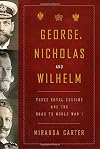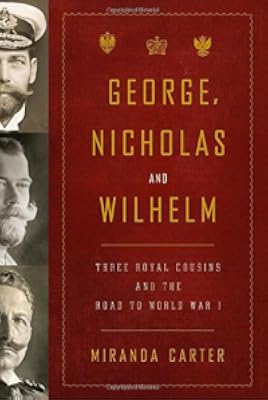
George, Nicholas and Wilhelm: Three Royal Cousins and the Road to World War I
by Miranda Carter
On This Page
Description
In the years before World War I, the great European powers were ruled by three first cousins: King George V, Kaiser Wilhelm II, and Tsar Nicholas II. Carter uses the cousins' correspondence and a host of historical sources to tell their tragicomic stories.Tags
Recommendations









Member Recommendations
Member Reviews
This is an excellent nonfiction book focusing on the lives of George V of England, Tsar Nicholas in Russia, and Kaiser Wilhelm in Germany and the lead up to WWI. George and Nicholas, and George and Wilhelm are first cousins and Wilhelm and Nicholas are something like third cousins from Tsar Paul I. They definitely thought of each other as cousins/family and saw each other at family events over the course of their lives. I wouldn't say they were necessarily close, but they communicated through letters and telegrams and tried to influence each other.
Queen Victoria was really the glue that held this large royal family together. She had so many children and married them off so widely, that it seems that just about every royal family was show more related by blood or marriage to her. Her husband, Prince Albert, was a huge proponent of the idea that familial relations between royalty in different countries would bring about peace and understanding between countries that were otherwise prone to disagreements and fighting. Obviously, this did not hold true. I thought a lot about this idea and I haven't yet seen much evidence that it ever worked. All the way back to Medieval Europe, Kings were marrying off daughters to Kings and Princes in other countries to try to broker peace or gain territory. I can't think of many instances where it actually worked, or at least not without a lot of fighting and war to maintain gained lands. In this book, though the royal cousins got along somewhat, they both didn't have enough power (or education or leadership skills) to get the results they wanted and, when it came down to it, they valued their individual power and status over their family relations. Really, that seems obvious to me. In any job or position of power, wouldn't you hope that a leader would put his/her convictions and the welfare of the whole over what would benefit family most? Now, in this situation it didn't work out either way because these men were terrible leaders, but I don't like the idea of royalty making decisions for their country to appease each other.
One thing I found shocking was how poorly educated these future Kings were as children. They seem to all have had sub-par tutors who kind of let them do whatever. It's amazing to me that they wouldn't have had the best education that money could buy. There seemed to be an attitude from their parents that it didn't matter since it was a God-given right to be king. Crazy. I also wasn't shocked by this, but all three of these men were really terrible leaders. I mean, when you're just there because of who you happened to be born to, there's no reason to think you'll be able to run an entire, complex country. Both Wilhelm and Nicholas had real power if they had been able to use it, but both were inept in different ways.
Carter does a great job of focusing this book. The build-up to WWI has a lot of elements and she stays focused on the role of royalty and the drastic change that royalty in all of Europe was about to experience. It really was the end of an era for kings. One minor criticism of this book is that I sometimes found the transitions between the three countries and kings to be a little jarring. I would just be getting in to understanding the conditions in Germany and all of a sudden we'd be back in Russia. But, I think that it did serve the purpose of keeping the focus on these three men, so it is a minor complaint.
This is very readable and I learned a lot. I'd definitely recommend it to anyone with an interest in WWI or the downfall of the monarchies. show less
Queen Victoria was really the glue that held this large royal family together. She had so many children and married them off so widely, that it seems that just about every royal family was show more related by blood or marriage to her. Her husband, Prince Albert, was a huge proponent of the idea that familial relations between royalty in different countries would bring about peace and understanding between countries that were otherwise prone to disagreements and fighting. Obviously, this did not hold true. I thought a lot about this idea and I haven't yet seen much evidence that it ever worked. All the way back to Medieval Europe, Kings were marrying off daughters to Kings and Princes in other countries to try to broker peace or gain territory. I can't think of many instances where it actually worked, or at least not without a lot of fighting and war to maintain gained lands. In this book, though the royal cousins got along somewhat, they both didn't have enough power (or education or leadership skills) to get the results they wanted and, when it came down to it, they valued their individual power and status over their family relations. Really, that seems obvious to me. In any job or position of power, wouldn't you hope that a leader would put his/her convictions and the welfare of the whole over what would benefit family most? Now, in this situation it didn't work out either way because these men were terrible leaders, but I don't like the idea of royalty making decisions for their country to appease each other.
One thing I found shocking was how poorly educated these future Kings were as children. They seem to all have had sub-par tutors who kind of let them do whatever. It's amazing to me that they wouldn't have had the best education that money could buy. There seemed to be an attitude from their parents that it didn't matter since it was a God-given right to be king. Crazy. I also wasn't shocked by this, but all three of these men were really terrible leaders. I mean, when you're just there because of who you happened to be born to, there's no reason to think you'll be able to run an entire, complex country. Both Wilhelm and Nicholas had real power if they had been able to use it, but both were inept in different ways.
Carter does a great job of focusing this book. The build-up to WWI has a lot of elements and she stays focused on the role of royalty and the drastic change that royalty in all of Europe was about to experience. It really was the end of an era for kings. One minor criticism of this book is that I sometimes found the transitions between the three countries and kings to be a little jarring. I would just be getting in to understanding the conditions in Germany and all of a sudden we'd be back in Russia. But, I think that it did serve the purpose of keeping the focus on these three men, so it is a minor complaint.
This is very readable and I learned a lot. I'd definitely recommend it to anyone with an interest in WWI or the downfall of the monarchies. show less
A first-rate study of three cousins, King George V of the United Kingdom, Tsar Nicholas II of Russia, and Kaiser Wilhelm II of Germany, and how these three helped the world stumble into a war the magnitude of which not even previously hinted at. The fact that one of them was barking mad and the other two had no idea of the world around them merely adds to the readability of George, Nicholas and Wilhelm.
Carter has obviously researched widely and accessed the cousins' correspondence with each other, highlighting the utter dullness of George and Nicholas and the strangeness of Wilhelm, and building a compelling story about how none of them were ready to lead their country at such a dangerous time in history.
Carter has obviously researched widely and accessed the cousins' correspondence with each other, highlighting the utter dullness of George and Nicholas and the strangeness of Wilhelm, and building a compelling story about how none of them were ready to lead their country at such a dangerous time in history.
Well written, accessible style: this book provides an in-depth analysis of how the monarchies in three countries affected, and were affected by, the start of World War I.
King George V of England and Kaiser Wilhelm II of Germany were first cousins. Tsar Nicholas II of Russia was a cousin of their grandmother (Queen Victoria) and married to the Queen's granddaughter. The book looks at these "three royal cousins". It is largely a biography of the three men, but set in a context of pre-war Europe. I found it very enlightening to explore the politics from a family perspective; to look at how personal relationships could help in international relations, and to assess their limits. The book also explored the post-war impact on monarchies in show more all three countries. This is a great companion to standard historical accounts -- the blend of biography and history is well handled by Ms. Carter. show less
King George V of England and Kaiser Wilhelm II of Germany were first cousins. Tsar Nicholas II of Russia was a cousin of their grandmother (Queen Victoria) and married to the Queen's granddaughter. The book looks at these "three royal cousins". It is largely a biography of the three men, but set in a context of pre-war Europe. I found it very enlightening to explore the politics from a family perspective; to look at how personal relationships could help in international relations, and to assess their limits. The book also explored the post-war impact on monarchies in show more all three countries. This is a great companion to standard historical accounts -- the blend of biography and history is well handled by Ms. Carter. show less
Perfect book to listen to. King George of England, Kaiser Wilhelm of Germany, and Czar Nicholas of Russia are all first cousins and grandsons of Queen Victoria. The book covers the childhood of each man, and although all similar in that they were never allowed a normal childhood, each man was raised differently. The personalities of each man were never allowed to develop into adulthood, and they became emotionally immature leaders of great nations although the actual power varied from country to country.
This book portrays the ending of the great monarchies in Europe as World War I created very different states. Although very well researched with details of treaties, conflicts (the Boer War), and much political intrigue, the personal show more stories of each man and his family is what is most interesting. It is amazing that such people in power could be so totally removed from the life and culture of those they were ruling. show less
This book portrays the ending of the great monarchies in Europe as World War I created very different states. Although very well researched with details of treaties, conflicts (the Boer War), and much political intrigue, the personal show more stories of each man and his family is what is most interesting. It is amazing that such people in power could be so totally removed from the life and culture of those they were ruling. show less
This was an excellent read. The story of these three cousins gives us an intimate picture of life in the upper stratosphere of government and society before and after the turn of the last century. The lives of all three are explored from their births, and their places in the Byzantine connections of European royal families of the era.
Thanks to Queen Victoria and her penchant for marrying her multitudinous children into all the royal courts of Europe, the relationships are tangled and confusing. Fortunately there are family trees in the front to help keep all the Georges, Victorias, Alexanders, Franzs, Wilhelms, Franz-Wilhelms and others straight.
This book is not just a recitation of a string of events and names, but rather a real tale show more of personalities and family disputes. Fortunately for the author this was an era steeped in written communication. Ms Carter had access to hundreds of letters, telegrams, notes, diary entries, and government documents that give us a real idea of how these people thought and acted. We can see how they interacted with each other, how their upbringing and their characters influenced their actions and the actions of their governments. In the end, keeping all the players straight is not difficult because they are all so vividly portrayed.
All three cousins were trapped in the rigid confines of 19th century protocol and social structure and were completely mismatched with the vast changes happening in the world of the Gilded Age. Changes in dress, mechanization, communication, armaments, suffrage, class distinction and social mores were happening all around them, and they were blind to it all. I was struck with how totally inept and unfit for their roles they truly were. Good men at heart (well, Wilhelm was fairly insane), but unwilling and/or unable to see the larger picture. I was also amazed at the amount of lying and deceit practiced as they and their governments played each off each other trying to enhance the nations' status while professing to pursue peace.
A very readable and fascinating look at a part of history not always studied in depth. Highly recommended. show less
Thanks to Queen Victoria and her penchant for marrying her multitudinous children into all the royal courts of Europe, the relationships are tangled and confusing. Fortunately there are family trees in the front to help keep all the Georges, Victorias, Alexanders, Franzs, Wilhelms, Franz-Wilhelms and others straight.
This book is not just a recitation of a string of events and names, but rather a real tale show more of personalities and family disputes. Fortunately for the author this was an era steeped in written communication. Ms Carter had access to hundreds of letters, telegrams, notes, diary entries, and government documents that give us a real idea of how these people thought and acted. We can see how they interacted with each other, how their upbringing and their characters influenced their actions and the actions of their governments. In the end, keeping all the players straight is not difficult because they are all so vividly portrayed.
All three cousins were trapped in the rigid confines of 19th century protocol and social structure and were completely mismatched with the vast changes happening in the world of the Gilded Age. Changes in dress, mechanization, communication, armaments, suffrage, class distinction and social mores were happening all around them, and they were blind to it all. I was struck with how totally inept and unfit for their roles they truly were. Good men at heart (well, Wilhelm was fairly insane), but unwilling and/or unable to see the larger picture. I was also amazed at the amount of lying and deceit practiced as they and their governments played each off each other trying to enhance the nations' status while professing to pursue peace.
A very readable and fascinating look at a part of history not always studied in depth. Highly recommended. show less
This was an overview of the history of three cousins who reigned as a King, a Kaiser, and a Tsar, during the tumultuous period that was World War I. Ultimately, only the King would emerge with his throne intact.
I found the narrative to be a bit jumpy, going back and forth between the three subjects in a disjointed way. The information is all there; it was just difficult to digest. There were a few factual mistakes that should've been checked by any editor worth their salt. One example is that one of the Kaiser's sons was named Eitel Friedrich. The author, within a page, named him as "Eitel Frederick" and "Friedrich Eitel", which is enormously inconsistent.
You really should know the story before delving into this hefty tome.
I found the narrative to be a bit jumpy, going back and forth between the three subjects in a disjointed way. The information is all there; it was just difficult to digest. There were a few factual mistakes that should've been checked by any editor worth their salt. One example is that one of the Kaiser's sons was named Eitel Friedrich. The author, within a page, named him as "Eitel Frederick" and "Friedrich Eitel", which is enormously inconsistent.
You really should know the story before delving into this hefty tome.
Don't be misled by the title of this book. It's as much a biography of three monarchies than of the three men named in the title. Victoria and her son, Edward VII, receive as much, if not more, attention as George V since Wilhelm became Kaiser and Nicholas became Tsar during Victoria's reign. Wilhelm had reigned in Germany for more than two decades before George V became King.
I referred often to the family trees at the front of the book to figure out who the people mentioned in the book were and how they were related to each other. I could have used more detail in the trees. Some of the cousins, uncles, aunts, and their spouses who mentioned in passing didn't make the cut in the design of the trees, where they were represented as “2 show more other children”, “3 other boys, 1 girl”, etc. It doesn't help when every family seems to have a Victoria and an Alexandra. Sometimes the author refers to a person by his or her given name and sometimes by a family nickname. Nicholas II's mother is sometimes referred to as Marie and sometimes as Minny; his wife Alexandra is sometimes referred to as Alix and sometimes as Alicky.
George V was first cousin to both Nicholas (their mothers were sisters) and Wilhelm (George's father and Wilhelm's mother were brother and sister). George and Nicholas bore an uncanny resemblance to each other as adults, and on the few occasions when they were together, one was sometimes mistaken for the other. Nicholas and Wilhelm were more distantly related – something like 3rd cousins once removed. From a purely family perspective, Wilhelm seems to be that relative whose visits everyone dreads and who no one wants to get stuck in conversation with at a family gathering. There's one in every family, right? The difference is that with these royals, their relationships, good or bad, had international consequences. It appears that none of the three men who reigned as war broke out were eager for war – not even Kaiser Wilhelm, with all of his bluster – but they were powerless to prevent it. Carter shows just how out of touch they were with the average person in the United Kingdom, Russia, and Germany.
The author quotes extensively from private journals and family letters, memoirs, and some secondary sources. While the title and concept of the book seem to target a general/popular audience, the writing style seems better suited for an academic audience. I don't often see words like “antipodean” in popular literature. Recommended for readers with an interest in European royalty in the late 19th and early 20th centuries. show less
I referred often to the family trees at the front of the book to figure out who the people mentioned in the book were and how they were related to each other. I could have used more detail in the trees. Some of the cousins, uncles, aunts, and their spouses who mentioned in passing didn't make the cut in the design of the trees, where they were represented as “2 show more other children”, “3 other boys, 1 girl”, etc. It doesn't help when every family seems to have a Victoria and an Alexandra. Sometimes the author refers to a person by his or her given name and sometimes by a family nickname. Nicholas II's mother is sometimes referred to as Marie and sometimes as Minny; his wife Alexandra is sometimes referred to as Alix and sometimes as Alicky.
George V was first cousin to both Nicholas (their mothers were sisters) and Wilhelm (George's father and Wilhelm's mother were brother and sister). George and Nicholas bore an uncanny resemblance to each other as adults, and on the few occasions when they were together, one was sometimes mistaken for the other. Nicholas and Wilhelm were more distantly related – something like 3rd cousins once removed. From a purely family perspective, Wilhelm seems to be that relative whose visits everyone dreads and who no one wants to get stuck in conversation with at a family gathering. There's one in every family, right? The difference is that with these royals, their relationships, good or bad, had international consequences. It appears that none of the three men who reigned as war broke out were eager for war – not even Kaiser Wilhelm, with all of his bluster – but they were powerless to prevent it. Carter shows just how out of touch they were with the average person in the United Kingdom, Russia, and Germany.
The author quotes extensively from private journals and family letters, memoirs, and some secondary sources. While the title and concept of the book seem to target a general/popular audience, the writing style seems better suited for an academic audience. I don't often see words like “antipodean” in popular literature. Recommended for readers with an interest in European royalty in the late 19th and early 20th centuries. show less
Members
- Recently Added By
Published Reviews
ThingScore 80
“George, Nicholas and Wilhelm” is an impressive book. Ms. Carter has clearly not bitten off more than she can chew for she — as John Updike once wrote about Günter Grass — “chews it enthusiastically before our eyes." You turn this book’s pages with interest, however, but rarely with eagerness. It’s a volume that never quite warms in your hands, packed perhaps too airlessly with show more what Ms. Carter describes at one point as “backstabbing, intrigue and muddle.” That phrase would have made a good alternative title. show less
added by Shortride
Carter’s theme is the social and political linkage between the great royal families of Europe in the late 19th and early 20th centuries. This provides gossip of a richness to raise Nigel Dempster from the tomb.
...
Carter’s view of the descent towards the first world war as a family quarrel among the royal houses of Europe certainly makes entertaining reading. Her story is full of vivid show more quotations, such as "the House of Hanover, like ducks, produce bad parents. They trample on their young". She observes justly that all her monarchs were anachronisms, "ill-equipped by education and personality to deal with the modern world... The system within which they existed was dying, and the courts of Europe had turned from energetic centres of patronage into stagnant ponds of tradition and conservatism."
...
For all the incidental colour, however, The Three Emperors falls short when she tries to put it all in focus. Carter’s first book was an excellent biography of that most cultured of traitors, Anthony Blunt. This time around, she offers a romp through the palaces of Europe in their last decades before Armageddon, but there is little here to surprise any student of modern history. In particular, she does not know enough about the rival forces, tensions and ambitions that precipitated war in 1914 to analyse them convincingly. She has shown that she is capable of writing a much better book than this one, but perhaps it should have been within a less ambitious compass. show less
...
Carter’s view of the descent towards the first world war as a family quarrel among the royal houses of Europe certainly makes entertaining reading. Her story is full of vivid show more quotations, such as "the House of Hanover, like ducks, produce bad parents. They trample on their young". She observes justly that all her monarchs were anachronisms, "ill-equipped by education and personality to deal with the modern world... The system within which they existed was dying, and the courts of Europe had turned from energetic centres of patronage into stagnant ponds of tradition and conservatism."
...
For all the incidental colour, however, The Three Emperors falls short when she tries to put it all in focus. Carter’s first book was an excellent biography of that most cultured of traitors, Anthony Blunt. This time around, she offers a romp through the palaces of Europe in their last decades before Armageddon, but there is little here to surprise any student of modern history. In particular, she does not know enough about the rival forces, tensions and ambitions that precipitated war in 1914 to analyse them convincingly. She has shown that she is capable of writing a much better book than this one, but perhaps it should have been within a less ambitious compass. show less
added by wandering_star
"When so markedly eccentric a nature dominates a realm there cannot but be convulsions." So commented Philipp zu Eulenburg, one of Kaiser Wilhelm II of Germany's few friends. His remark encapsulates the problem with autocracy, the danger of allowing a single, flawed, human being to exercise absolute, or near absolute, power.
Part of Miranda Carter's argument in The Three Emperors: three show more cousins, three empires and the road to the First World War is that the autocratic cousins, Kaiser Wilhelm and Tsar Nicholas II (known to each other as Willy and Nicky) were not always quite as powerful as they thought they were. Nevertheless, they still exercised a lot more of the real thing than did the third cousin, King George V (or Georgie). show less
Part of Miranda Carter's argument in The Three Emperors: three show more cousins, three empires and the road to the First World War is that the autocratic cousins, Kaiser Wilhelm and Tsar Nicholas II (known to each other as Willy and Nicky) were not always quite as powerful as they thought they were. Nevertheless, they still exercised a lot more of the real thing than did the third cousin, King George V (or Georgie). show less
added by wandering_star
Lists

r/AskHistorians' Recommended Books
1,068 works; 19 members

World War I - fiction & non-fiction
19 works; 4 members

Non-Fiction Worth Reading
1,025 works; 264 members
Author Information

5 Works 2,099 Members
Miranda Carter was educated at St Paul's Girls' School and Exeter College, Oxford. She worked as a publisher and journalist before beginning research on Anthony Blunt
Awards and Honors
Awards
Distinctions
Common Knowledge
- Original title
- The Three Emperors: Three Cousins, Three Empires, and the Road to World War One
- Alternate titles
- George, Nicholas and Wilhelm: Three Royal Cousins and the Road to World War I
- Original publication date
- 2009 (UK) (UK); 2010-03-28 (US) (US)
- People/Characters
- George V, King of the United Kingdom; Nicholas II, Emperor of Russia; Wilhelm II, German Kaiser and King of Prussia; Victoria, Queen of the United Kingdom; Victoria, German Empress and Queen of Prussia; Edward VII, King of the United Kingdom (show all 13); Mary of Teck, Queen Consort of the United Kingdom; Alexandra Feodorovna, Empress of Russia; Augusta Viktoria of Schleswig-Holstein, German Empress and Queen of Prussia; Otto von Bismarck; David Lloyd George; Grigori Rasputin; Prince Albert Victor, Duke of Clarence
- Important places
- Tsarskoye Selo, Saint Petersburg, Russia; Osborne House, Isle of Wight, UK; Potsdam, Brandenburg, Germany
- Important events
- World War I (1914-1918); Assassination of Russian imperial family
- Dedication
- For Finn and Jesse
- First words
- July 1917, as the First World War reached its third exhausting year, was not a good month for monarchs. In London, George V, King of Great Britain and Emperor of India, decided to change his name. A month or so before, he had... (show all) held a dinner party at Buckingham Palace. The occasion would have been slightly grimmer and plainer than usual for a European monarch. In an effort to show their commitment to the war effort, George and his wife, Mary, had instituted a spartan regime at the palace: no heating, dim lighting, "simple" food - mutton instead of lamb, pink blancmange instead of mousses and sorbets - and no alcohol. The king had taken a pledge of abstinence for the duration as an example to the nation - an example to which it had remained noticeably deaf. Since there was no rationing in England, the aristocratic guests would almost certainly have eaten better at home. -Introduction
It was a horrible labour. The baby was in the breech position and no one realized until too late. The eighteen-year-old mother had been too embarrassed to allow any of the court physicians to examine or even talk to her about... (show all) her pregnancy - a prudishness learned from her own mother. The experience of childbirth would cure her of it. -Chapter 1, Wilhelm, An Experiment in Perfection, 1859 - Quotations
- Nevertheless, each country, each emperor, continued to paper over the cracks with cousinly gestures, each increasingly irrelevant.
- Last words
- (Click to show. Warning: May contain spoilers.)As the Armistice Day crowds came to Buckingham Palace to cheer, George was the only emperor still standing on his balcony.
(Click to show. Warning: May contain spoilers.)(Epilogue) In 2000 the Russian Orthodox Church, buoyed by a great surge in Russian patriotism and a desire to wipe away seventy-two years of Soviet rule, declared the last tsar and his family saints. - Blurbers
- Brown, Craig; Hughes, Kathryn; MacMillan, Margaret; Davenport-Hines, Richard; Howard, Anthony; Montefiore, Simon Sebag (show all 8); Bradford, Sarah; Clark, Christopher
- Canonical DDC/MDS
- 940.3112
- Canonical LCC
- D517 .C34
Classifications
Statistics
- Members
- 860
- Popularity
- 31,867
- Reviews
- 26
- Rating
- (3.93)
- Languages
- Dutch, English, Portuguese, Romanian
- Media
- Paper, Audiobook, Ebook
- ISBNs
- 13
- ASINs
- 11