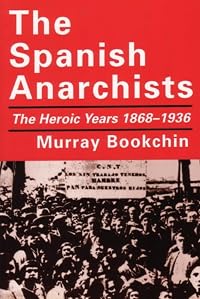
The Spanish Anarchists: The Heroic Years 1868-1936
by Murray Bookchin
On This Page
Description
The Heroic Years 1868-1936 A long-awaited new edition of the seminal history of Spanish Anarchism. I have learned a great deal from this book. It is a rich and fascinating account.' - Howard Zine'Tags
Recommendations

























Member Reviews
This book is not about the nearly forgotten simultaneous revolution and reaction that took place in the second half of 1936 in Spain. Instead, the book focuses on the even more buried account of the preceding 70 years of anarchist agitation and organization that lead to that standoff. Murray Bookchin meticulously reconstructs the organizations, ideologies, theories, movements, historical events, intellectuals and important persons of the time in a compelling history.
What struck me the most about the Spanish Anarchists was the boldness of their actions. The Spanish Anarchists set out to polarize society on class lines through class warfare and strikes, destabilize the state apparatus through insurrection and mass non-participation, and show more then arm the people to resist the reaction of capitalists and state reactionaries. Entire villages simply declared "libertarian communism," took over land and factories, and started operating them in the interest of all until they were smashed by the reaction forces. And this before there was solidarity enough to spread this type of action across the country. This shows what is possible when oppressed people take it upon themselves to fight for their own freedom.
Bookchin takes careful note of the mistakes made by the revolutionary movement, criticising the foolhardy moves of the anarchists as well as when they seemed too conservative in their strategy. But Bookchin saves his most poisonous vitriol for excoriating Spanish Socialists, and they deserve it. Spending the majority of their time and energy on opportunistic efforts, the Spanish Socialists and Communists stood in the way of revolution far more often than they inspired it. Waiting for conditions to appear, they undermined the organizing already taking place. Acting as scabs, putting themselves in the position of mediators between the working class and the state, and refusing solidarity with anyone outside of their narrow dogma, they undermined the Spanish working class and peasant movements towards freedom. show less
What struck me the most about the Spanish Anarchists was the boldness of their actions. The Spanish Anarchists set out to polarize society on class lines through class warfare and strikes, destabilize the state apparatus through insurrection and mass non-participation, and show more then arm the people to resist the reaction of capitalists and state reactionaries. Entire villages simply declared "libertarian communism," took over land and factories, and started operating them in the interest of all until they were smashed by the reaction forces. And this before there was solidarity enough to spread this type of action across the country. This shows what is possible when oppressed people take it upon themselves to fight for their own freedom.
Bookchin takes careful note of the mistakes made by the revolutionary movement, criticising the foolhardy moves of the anarchists as well as when they seemed too conservative in their strategy. But Bookchin saves his most poisonous vitriol for excoriating Spanish Socialists, and they deserve it. Spending the majority of their time and energy on opportunistic efforts, the Spanish Socialists and Communists stood in the way of revolution far more often than they inspired it. Waiting for conditions to appear, they undermined the organizing already taking place. Acting as scabs, putting themselves in the position of mediators between the working class and the state, and refusing solidarity with anyone outside of their narrow dogma, they undermined the Spanish working class and peasant movements towards freedom. show less
I went to Barcelona in 1978 for a day. There were nervous looking teenagers standing around in uniforms w/ machine guns. Franco had been dead for 4 yrs. I left. I went to Madrid in 1984 to visit a friend. It was amazing. Very liberated. I went to Barcelona again in 2004 - pd to do so by the Center for Contemporary Culture of Barcelona to participate in a hactivist festival of sorts. I read this bk before & during being there. It was extremly useful in understanding the culture. Of course, for anarchists like myself, Republican Spain was an amazing thing, a peak in the history of anarchy. Nonetheless, the anarchists lost the civil war to the fascists. As such, I think it's important to remember that to win against fascism there must be a show more total revolution in human consciousness. If it boils down to a war, the fascists are more likely to 'win' because that type of winning is based almost solely on levels of brutality & that's the specialty of fascists - wch is, obviously, why anarchists oppose them. show less
This is flat out the best book on the history of anarchism in Spain and one of the best books every written on Spanish history. Why isn't it considered necessary reading for the Spanish historians? Because Anarchism is too dangerous of an idea to go mainstream. The Catalan part of Spain was probably the most progressive society in world history when the Anarchists had democratic control there. (If you don't believe me, ask Noam Chomsky or any other honest leftist.) Essential reading for any truth-seeker.
Ratings
Members
- Recently Added By
Published Reviews
ThingScore 100
Above all, it is fascinating to read about how the “Idea” of anarchism inspired normal workers and peasants to build movements and institutions on their own, largely without the assistance of a vanguard of intellectuals, and largely without forming stultifying bureaucracies.
added by abclaret
Author Information

166+ Works 3,268 Members
Common Knowledge
- Canonical title*
- Espanjan anarkistit: Sankarilliset vuodet 1868-1936
- Important places
- Spain
*Some information comes from Common Knowledge in other languages. Click "Edit" for more information.
Classifications
Statistics
- Members
- 251
- Popularity
- 129,634
- Reviews
- 3
- Rating
- (4.29)
- Languages
- English, Finnish
- Media
- Paper
- ISBNs
- 4