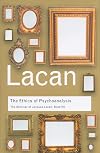
The Seminar of Jacques Lacan, Book VII: The Ethics of Psychoanalysis 1959-1960
by Jacques Lacan
The Seminar of Jacques Lacan (7)
On This Page
Description
In his famous seminar on ethics, Jacques Lacan uses this question as his departure point for a re-examination of Freud's work and the experience of psychoanalysis in relation to ethics. Delving into the psychoanalyst's inevitable involvement with ethical questions, Lacan clarifies many of his key concepts. During the seminar he discusses the problem of sublimation, the paradox of jouissance, the essence of tragedy, and the tragic dimension of analytical experience. One of the most show more influential French intellectuals of this century, Lacan is seen here at the height of his powers. show lessTags
Recommendations










































Member Reviews
I have to admit I'm at a bit of a loss as to what to write about this one. For those new to Lacan and wanting to get a sense of his thinking from his own words, this isn't a bad place to start. Not saying this is easy reading but it's definitely more approachable than what I have read in Ecrites.
I feel like I truly started to understand some of Lacan's basics concepts (even if there is still much that I couldn't ever truly grasp as solid for long). Maybe one of the most frustrating parts of reading this seminar is that I spent much of it wondering what exactly it had to do with ethics as I understood the term. And it's not as if Lacan starts the seminar by outlining what he intends by the title of the seminar or what the general area show more he plans to cover is exactly. Does he intend to talk about the desired ethics of the analyst in practice? The ethics possible for the analysand? The ethics possible for any human or society? (In the end the answer was all three because of course they are all intricately related.) In terms of being readily understandable Lacan can be his own worst enemy! However, by the time I finished the seminar and worked through his concepts of das Ding, Desire, Kant/Sade, courtly love, etc. I really felt I had a somewhat firm grasp of how parts of this theoretical system fit together. The way I became convinced of this is when I tried to offer my friend a short description of this work and instead found myself rattling off all of these concepts and ideas and how they all fit together. I've never been able to do that with Lacan before.
And then when you get to the end and everything he has been lecturing on starts to sort of snap into place, there was almost this feeling of electricity running through me. In fact, there was a passage on one of the last pages that struck me as so human, so sympathetically aware of our human condition (similar to my impression of the first 50 or so pages of Freud's Civilization and Its Discontents) that it just stopped me in my tracks. I will quote it here but my guess is that because there seems nothing very complicated or cryptic in the wording and nothing overtly deep in what's said, that its effect was strongly caused by everything that Lacan said right up to this point...
"What I call "giving ground relative to one's desire" is always accompanied in the destiny of the subject by some betrayal – you will observe it in every case and should note its importance. Either the subject betrays his own way, betrays himself, and the result is significant for him, or, more simply, he tolerates the fact that someone with whom he has more or less vowed to do something betrays his hope and doesn't do for him what their pact entailed – whatever that pact may be, fated or ill-fated, risky, shortsighted, or indeed a matter of rebellion or flight, it doesn't matter.
Something is played out in betrayal if one tolerates it, if driven by the idea of the good – and by that I mean the good of the one who has just committed the act of betrayal – one gives ground to the point of giving up one's own claims and says to oneself, "Well, if that's how things are, we should abandon our position; neither of us is worth that much, and especially me, so we should just return to the common path." You can be sure that what you find there is the structure of giving ground relative to one's desire.
Once one has crossed that boundary where I combined in a single term contempt for the other and for oneself, there is no way back. It might be possible to do some repair work, but not to undo it. Isn't that a fact of experience that demonstrates how psychoanalysis is capable of supplying a useful compass in the field of ethical guidance?
I have, therefore, articulated three propositions.
First, the only thing one can be guilty of is giving ground relative to one's desire.
Second, the definition of a hero: someone who may be betrayed with impunity.
Third, this is something that not everyone can achieve; it constitutes the difference between an ordinary man and a hero, and it is, therefore, more mysterious than one might think. For the ordinary man the betrayal that almost always occurs sends him back to the service of goods, but with the proviso that he will never again find that factor which restores a sense of direction to that service."
That, right there, was the moment when Lacan's "highfalutin abstract philosophy" hit me right in the gut and spoke to me of my own life experience in words that cut like a velvet knife. show less
I feel like I truly started to understand some of Lacan's basics concepts (even if there is still much that I couldn't ever truly grasp as solid for long). Maybe one of the most frustrating parts of reading this seminar is that I spent much of it wondering what exactly it had to do with ethics as I understood the term. And it's not as if Lacan starts the seminar by outlining what he intends by the title of the seminar or what the general area show more he plans to cover is exactly. Does he intend to talk about the desired ethics of the analyst in practice? The ethics possible for the analysand? The ethics possible for any human or society? (In the end the answer was all three because of course they are all intricately related.) In terms of being readily understandable Lacan can be his own worst enemy! However, by the time I finished the seminar and worked through his concepts of das Ding, Desire, Kant/Sade, courtly love, etc. I really felt I had a somewhat firm grasp of how parts of this theoretical system fit together. The way I became convinced of this is when I tried to offer my friend a short description of this work and instead found myself rattling off all of these concepts and ideas and how they all fit together. I've never been able to do that with Lacan before.
And then when you get to the end and everything he has been lecturing on starts to sort of snap into place, there was almost this feeling of electricity running through me. In fact, there was a passage on one of the last pages that struck me as so human, so sympathetically aware of our human condition (similar to my impression of the first 50 or so pages of Freud's Civilization and Its Discontents) that it just stopped me in my tracks. I will quote it here but my guess is that because there seems nothing very complicated or cryptic in the wording and nothing overtly deep in what's said, that its effect was strongly caused by everything that Lacan said right up to this point...
"What I call "giving ground relative to one's desire" is always accompanied in the destiny of the subject by some betrayal – you will observe it in every case and should note its importance. Either the subject betrays his own way, betrays himself, and the result is significant for him, or, more simply, he tolerates the fact that someone with whom he has more or less vowed to do something betrays his hope and doesn't do for him what their pact entailed – whatever that pact may be, fated or ill-fated, risky, shortsighted, or indeed a matter of rebellion or flight, it doesn't matter.
Something is played out in betrayal if one tolerates it, if driven by the idea of the good – and by that I mean the good of the one who has just committed the act of betrayal – one gives ground to the point of giving up one's own claims and says to oneself, "Well, if that's how things are, we should abandon our position; neither of us is worth that much, and especially me, so we should just return to the common path." You can be sure that what you find there is the structure of giving ground relative to one's desire.
Once one has crossed that boundary where I combined in a single term contempt for the other and for oneself, there is no way back. It might be possible to do some repair work, but not to undo it. Isn't that a fact of experience that demonstrates how psychoanalysis is capable of supplying a useful compass in the field of ethical guidance?
I have, therefore, articulated three propositions.
First, the only thing one can be guilty of is giving ground relative to one's desire.
Second, the definition of a hero: someone who may be betrayed with impunity.
Third, this is something that not everyone can achieve; it constitutes the difference between an ordinary man and a hero, and it is, therefore, more mysterious than one might think. For the ordinary man the betrayal that almost always occurs sends him back to the service of goods, but with the proviso that he will never again find that factor which restores a sense of direction to that service."
That, right there, was the moment when Lacan's "highfalutin abstract philosophy" hit me right in the gut and spoke to me of my own life experience in words that cut like a velvet knife. show less
Ratings
Members
- Recently Added By
Author Information

205+ Works 6,087 Members
Jacques Lacan was born into an upper-middle-class Parisian family. He received psychiatric and psychoanalytic training, and his clinical training began in 1927. His doctoral thesis, "On Paranoia and Its Relation to Personality," already indicated an original thinker; in it he tried to show that no physiological phenomenon could be adequately show more understood without taking into account the entire personality, including its engagement with a social milieu. Practicing in France, Lacan led a "back to Freud" movement in the most literal sense, at a time when others were trying to interpret Sigmund Freud (see also Vol. 3) broadly. He emphasized the role of the image and the role of milieu in personality organization. Seeking to reinterpret Freud's theories in terms of structural linguistics, Lacan believed that Freud's greatest insight was his understanding of the "talking cure" as revelatory of the unconscious. By taking Freud literally, Lacan led a psychoanalytic movement that evolved into a very specific school of interpretation. Often embroiled in controversy, in the 1950s he opposed the standardization of training techniques, the classification of psychoanalysis as a medical treatment, and the then emerging school of ego psychology. Although general readers may find Lacan difficult to read, his works are provocative and rewarding. (Bowker Author Biography) show less
Series

Belongs to Publisher Series
Work Relationships
Common Knowledge
- Canonical title
- The Seminar of Jacques Lacan, Book VII: The Ethics of Psychoanalysis 1959-1960
Classifications
- Genres
- Nonfiction, Philosophy, General Nonfiction
- DDC/MDS
- 150.195 — Philosophy & psychology Psychology Emotions, Relationships, & Family Theory And Instruction Systems, schools, viewpoints Psychoanalytic systems
- LCC
- BF173 .L14613 — Philosophy, Psychology and Religion Psychology Psychology Psychoanalysis
- BISAC
Statistics
- Members
- 342
- Popularity
- 92,943
- Reviews
- 1
- Rating
- (4.14)
- Languages
- 7 — English, French, German, Italian, Portuguese, Spanish, Swedish
- Media
- Paper, Ebook
- ISBNs
- 17
- ASINs
- 3