The School is Not White!: A True Story of the Civil Rights Movement
by Doreen Rappaport
On This Page
Description
The Carter family stuggles to integrate an all-white school in Drew, Mississippi, in 1965.Tags
Recommendations




Member Reviews
The School Is Not White! written by Doreen Rappaport is a heartbreaking true story about the Carter family of Drew, Mississippi and their fight against segregation. The story is set in 1965, in all of the U.S. segregation is illegal, however, in Drew, MS schools are still segregated. Until Mae Bertha, the mother decides to send seven of her kids to be the first to integrate all white schools.
"She looked into their hurt and angry eyes and reminded them, 'The school is not white. It's brown brick. and that school belongs to you as well as it belongs to them.'"
The children are tortured by their white schoolmates, the family is forced off of their land, they were even shot at by the owner.
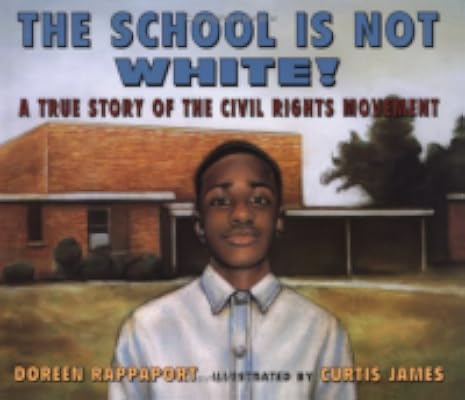
The illustrations within the book were just as show more heartbreaking as the story itself. Pictures of white kids and their angry faces and balled fist compared to the Carter kids with faces filled with hurt and confusion. The Carters remained strong and unbreakable through those times, in the end, they all graduated high school and more black families began to enroll their kids into majority white schools.
Personally, stories like this break my heart and make me so angry that my people, black people, have been dealing with racism for so long! Books like these are important to black culture because it reminds us of how far we have come. But it also gives me the strength to continue to fight for equality for all people of color. show less
"She looked into their hurt and angry eyes and reminded them, 'The school is not white. It's brown brick. and that school belongs to you as well as it belongs to them.'"
The children are tortured by their white schoolmates, the family is forced off of their land, they were even shot at by the owner.
The illustrations within the book were just as show more heartbreaking as the story itself. Pictures of white kids and their angry faces and balled fist compared to the Carter kids with faces filled with hurt and confusion. The Carters remained strong and unbreakable through those times, in the end, they all graduated high school and more black families began to enroll their kids into majority white schools.
Personally, stories like this break my heart and make me so angry that my people, black people, have been dealing with racism for so long! Books like these are important to black culture because it reminds us of how far we have come. But it also gives me the strength to continue to fight for equality for all people of color. show less
I found this book to be an inspirational story of great courage and endurance. I love to hear stories of ordinary people doing extraordinary things. I mainly enjoyed this book for its brutal honesty and emotive speech.
We have all heard of the dark time in American history when we segregated whites and blacks and the suffering young African-Americans had to endure to attend all-white schools. This book tells the story of one family who aspired to “get their children out of the cotton fields” and sent “their seven children off to war in a shiny yellow school bus”. I appreciate that Rappaport does not gloss over what the Carter children had to endure just so they could receive an acceptable education, one equal to those of white show more children. She tells of the spitballs, ugly words, and the social exclusion of the Carter children. Rappaport’s brutal honestly allows the reader to feel the children’s pain and gives a greater sense of admiration for all African-American children who braved the all-white schools with the dream of a better life.
Rappaport’s use of words was moving and stirring. If I cited all my favorite excerpts from the book, I would basically be writing the entire book. A perfect example of Rappaport’s emotive story telling is, “Up the steps, onto the spanking-clean bus where no one sat next to them. Past the school yard where no one played with them. Into the school where only unfriendly eyes met them.” These words are so poignant and sets the reader back in time in the Carter children’s shoes.
The big message of this book is one of courage. The Carter family was not just fighting for a better life for themselves. They were fighting for a better life for a ll African-Americans. One person, one family can make a difference. show less
We have all heard of the dark time in American history when we segregated whites and blacks and the suffering young African-Americans had to endure to attend all-white schools. This book tells the story of one family who aspired to “get their children out of the cotton fields” and sent “their seven children off to war in a shiny yellow school bus”. I appreciate that Rappaport does not gloss over what the Carter children had to endure just so they could receive an acceptable education, one equal to those of white show more children. She tells of the spitballs, ugly words, and the social exclusion of the Carter children. Rappaport’s brutal honestly allows the reader to feel the children’s pain and gives a greater sense of admiration for all African-American children who braved the all-white schools with the dream of a better life.
Rappaport’s use of words was moving and stirring. If I cited all my favorite excerpts from the book, I would basically be writing the entire book. A perfect example of Rappaport’s emotive story telling is, “Up the steps, onto the spanking-clean bus where no one sat next to them. Past the school yard where no one played with them. Into the school where only unfriendly eyes met them.” These words are so poignant and sets the reader back in time in the Carter children’s shoes.
The big message of this book is one of courage. The Carter family was not just fighting for a better life for themselves. They were fighting for a better life for a ll African-Americans. One person, one family can make a difference. show less
Wow, this story was so touching. It broke my heart to hear that the Carters never received acceptance while they were at the school. It hurt me, even more, the fact that the teachers and principal were just as rude. I love how they never gave up and their parents strongly encouraged them to stand with courage and to love their enemies. They created a chain and after them, multiple black families brought their children to a "white" school. No one really wants to be that first person who gets treated wrongly. But what they did was so inspiring. This will teach young readers about the civil rights movement and how things were back then in school.
The first thing I noticed about the book is that there's a page explaining that this book is a true story. I feel that knowing that a story isn't just speculation helps put things into perspective for readers. The writer and illustrator did a great job showing just how brave this family was. The language in this book is simple and the hardships of this family are portrayed in a way that isn't too much for children so I think this would be a great book to read. I'd pull this book out during a Civil Rights Movement lesson because not only is it a history lesson, it can teach things like kindness and forgiveness.
Matthew and Mae Bertha Carter were sharecroppers on a cotton plantation in Mississippi. They dreamed of a better life for each of their eight children. The Carters realized that an essential part of their children’s future was dependent upon the quality of the education that they received. Even though the U. S. Supreme Court declared school segregation to be illegal, in 1954, it wasn’t until 1965 that counties in Mississippi offered a freedom of choice plan. This plan allowed black children to attend the school of their choice. The Carters were the first family to exercise this choice. The School is Not White recalls the family’s courage and determination in the fight for equality in education. Despite the taunts, name-calling, show more and threats, all eight of the Carter children attended and graduated from the white school. Their example of strength and perseverance also inspired other black families to send their children to the school.
I thoroughly enjoyed reading this book. The Carter family’s story is very inspirational. The story is written in a simplistic manner, but the seriousness of the situation is not downplayed. This book could be used in a history class as an example of the obstacles that blacks faced during desegregation. I would recommend that this book be used in grade levels first through sixth. Younger students will be able to understand the vocabulary used in the book, and they will also appreciate the beautiful illustrations. Older students will also be able to appreciate the content of the story and the struggle that the family endured. show less
I thoroughly enjoyed reading this book. The Carter family’s story is very inspirational. The story is written in a simplistic manner, but the seriousness of the situation is not downplayed. This book could be used in a history class as an example of the obstacles that blacks faced during desegregation. I would recommend that this book be used in grade levels first through sixth. Younger students will be able to understand the vocabulary used in the book, and they will also appreciate the beautiful illustrations. Older students will also be able to appreciate the content of the story and the struggle that the family endured. show less
True stories always touch my heart because those types of stories explain real-life situations also, very inspiring. This family in the story showed how brave they were; they made it possible for other black families to bring their children to white schools. In Mississippi, during segregation, schools were segregated. Mae and Matthew want their eight children to get the best education by attending the white school. However, her children had to deal with death threats, name-calling, and embarrassment. That did not stop the Carters from fighting for equality in education. It took the family courage, determination, and confidence by making a difference for their family and other black families. As the carter children became young adults, show more they all graduated from Drew because of strength and perseverance. Their parents knew if their children go to a white school, a difference will be made for them, and their dreams would come true by faith. This story is a true inspiration to our black culture. This story is a perfect example for younger and older students because they would appreciate and understand the content, also, the lesson of this true story. Even though the family struggled, they kept fighting for equality. I learned so much from this story. The illustrations in the story are amazing because it has a chalk pastel texture. I love how the Carter family was the first to attend the white school of their choice. show less
This book is similar to the Little Rock Five in that it has to do with the beginning of the desegregation of schools. I liked the book because it depicted a family who sent all seven or so of their kids to a white school despite threats and taunting that they received. It gives an account of how the kids were treated when they went to school everyday. I think that any child reader could identify with the children in this book because sadly most every child has been taunted by one of their peers. It could be a good activity to have these kids share their feelings of when they were taunted and how they related to a character. The class could then resolve to abolish behavior that made someone else feel little.
Members
- Recently Added By
Author Information

55 Works 11,123 Members
All Editions
Awards and Honors
Common Knowledge
- Canonical title
- The School is Not White!: A True Story of the Civil Rights Movement
- Important places
- Drew, Mississippi, USA
Classifications
Statistics
- Members
- 145
- Popularity
- 225,707
- Reviews
- 11
- Rating
- (4.31)
- Languages
- English
- Media
- Paper, Ebook
- ISBNs
- 2
- UPCs
- 1
- ASINs
- 2