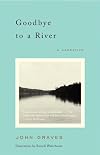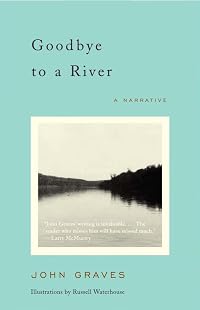
Goodbye to a River: A Narrative
by John Graves
On This Page
Description
In the 1950s, a series of dams was proposed along the Brazos River in north-central Texas. For John Graves, this project meant that if the stream’s regimen was thus changed, the beautiful and sometimes brutal surrounding countryside would also change, as would the lives of the people whose rugged ancestors had eked out an existence there. Graves therefore decided to visit that stretch of the river, which he had known intimately as a youth. Goodbye to a River is his account of that farewell show more canoe voyage. As he braves rapids and fatigue and the fickle autumn weather, he muses upon old blood feuds of the region and violent skirmishes with native tribes, and retells wild stories of courage and cowardice and deceit that shaped both the river’s people and the land during frontier times and later. Nearly half a century after its initial publication, Goodbye to a River is a true American classic, a vivid narrative about an exciting journey and a powerful tribute to a vanishing way of life and its ever-changing natural environment. show lessTags
Recommendations















Member Reviews
I have always heard of this book, but never read it until my 44th year. I lived and worked near the bit of the Brazos, in the early 2000s, that is described here by Graves in 1957/1960. A lot of his views align with mine on the landscape, hunting, fishing, etc. (though I am a cat-fisherman, when I fish, and a rod-and-reel man or trotliner). Graves is a good writer, descriptive and wordy but unpretentious, and a good storyteller, when he reaches back to his stories or retells the stories of others. Some modern writers may wince at some of the words and descriptions here, of Black Americans or Amerindians. Graves was a man of his time, but a liberal man of his time too. On the Comanche: yes, they were that terrible. If you cringe and find show more yourself unbelieving, you've bought into what I call the "hippie Indian" trope. Graves does not shy away from telling of their barbarities. But, he doesn't shy away from the barbarities of the whites who settled this stretch of Brazos River country either. It isn't a bright and shining lie Graves offers here. Seventy years on from this book, what has changed? Let me give you a bit. Only one of the dams and reservoirs that were planned for this stretch of water was built: at DeCordova Bend near Granbury, creating Lake Granbury. Graves mentions how the huge DeCordova Bend was turning in his day from hardscrabble farms and cow pastures into a pecan plantation. Well, DeCordova Bend is now one huge set of subdivisions with cookie-cutter homes called "Pecan Plantation" in the highway and lakehouse sprawl that is Granbury, Texas. Probably only a small minority of the population is descended from the original "Anglo Ams" Graves discussed. The downtown courthouse and square he saw is now a bougie, gentrified collection of high-end shops and stores. Not bad, but not the Texas that Graves saw; that Texas is gone. But, sometimes parts of the land may surprise you as being roughly the same. I too am one of those people who would love to have ten to fifty acres or so on a creek or river in Somervell or Hood County so I can build a big house and chill with the land. It's more like the Central Texas I know, and where I went to college. But, most of Graves' book is a little west of there, in Parker and Palo Pinto Counties. Harder, redder, drier, flatter, more West Texas than Central Texas. I knew those places too, in college and in history class. But, I'm rambling. Let's sum it up: a good bit of philosophy, history, landscape, hunting, fishing, outdooring, a bit in the vein of a less ascetic Thoreau, but Texan too. I was pleased to read it, learned from it, and thought about it. Which is what a book should do. show less
I think this is a truly great book, but am so tied to it through my background that I admit that there is little to no objectivity in my judgement. I grew up on the Brazos myself, but was mostly a disinterested teenager paying more attention to girls and cars and parties. Somehow my surroundings seeped into me though. When I finally read this book it was both familiar (as in family) and a revelation. Graves says it himself towards the end "One scawny, salty bit of river on the edge of West Texas seemed at the moment, together with its unsignificantly bloody past and its bypassed present and the kid memories I had of going there, to be maybe less than a noble focus for a man's whole interest." Seems a cinch to me that all central Texans show more should read it, but I think it holds a much wider appeal than that. show less
In my opinion, John Graves is an important writer, not only for North Texas, not only for Texas itself, but also for the United States. In Goodbye to a River, he describes in elegant and sensitive prose a canoe journey he took in the late 1950s down the portion of the Brazos River from just below the Possum Kingdom dam to the vicinity of Glen Rose. The book has an elegiac tone because it looked at the time as though the river was going to be dammed at several points along the stretch Mr. Graves traveled. The dams that ultimately were built were fewer in number than planned at that time, but I'm not sure how much Mr. Graves's writing had to do with any changes that may have occurred.
In addition to wonderful pondering on the relationship show more of man and nature, including Mr. Graves's doubts about the propriety of taking game with gun and rod, the book is an important reminder of how man should "move into the land rather than onto it." Mr. Graves does that by illustrating by example the importance of knowing the history of the land you inhabit, as well as the names and characteristics of the flora and fauna of that land. In the case of this particular region, of course, much of the history involves the movement of the "Anglo-Ams" into the area long ruled by "The People", i.e. the fierce Comanche tribe, a barrier for a time to the westward progression of the United States.
I learned a lot from reading this book and feel inspired to live up to the example set by Mr. Graves. show less
In addition to wonderful pondering on the relationship show more of man and nature, including Mr. Graves's doubts about the propriety of taking game with gun and rod, the book is an important reminder of how man should "move into the land rather than onto it." Mr. Graves does that by illustrating by example the importance of knowing the history of the land you inhabit, as well as the names and characteristics of the flora and fauna of that land. In the case of this particular region, of course, much of the history involves the movement of the "Anglo-Ams" into the area long ruled by "The People", i.e. the fierce Comanche tribe, a barrier for a time to the westward progression of the United States.
I learned a lot from reading this book and feel inspired to live up to the example set by Mr. Graves. show less
I have read this book many, many times. I always bring it along in a ziploc bag when I float the river. I wish that exploring private property was in my nature, because I would love to visit the spots that Graves details.
One of my favorite passages deals with the historical significance, or lack thereof, of the entire Comanche/settler struggle. I love how Graves downplays the Hollywood version of the frontier.
I also appreciate Graves for not pitying the Comanche to the point of obfuscating their great accomplishments as a "People."
One of my favorite passages deals with the historical significance, or lack thereof, of the entire Comanche/settler struggle. I love how Graves downplays the Hollywood version of the frontier.
I also appreciate Graves for not pitying the Comanche to the point of obfuscating their great accomplishments as a "People."
When John Graves found out the state of Texas was going to dam parts of the Brazos River he decided to take a three week journey on the river of his childhood to say goodbye. Portions of the Brazos clearly reflected Graves's childhood memories. Other times he reflects on the history, myths and legends of the region. At times he becomes philosophical, thinking of "Saint" Henry David Thoreau and "Prince" Ernest Hemingway, but more often he recounts tales of violence and racism: scalpings, hangings, raps, and murders indicative of the Comanche history of the region. He mentions Charles Goodnight from time to time. Occasionally, he interacts with locals he meets along the way, but most of the time he is alone with a dog he calls the show more passenger. My favorite parts was when Graves remembered the exact same trees he used to climb and the same beaches he used to build campfires on.
Did you know that October is the best month for traveling the Brazos for the weather is at its most pleasant? show less
Did you know that October is the best month for traveling the Brazos for the weather is at its most pleasant? show less
In the 1950s, a series of dams was proposed along the Brazos River in north-central Texas. For John Graves, this project meant that if the stream’s regimen was thus changed, the beautiful and sometimes brutal surrounding countryside would also change, as would the lives of the people whose rugged ancestors had eked out an existence there. Graves therefore decided to visit that stretch of the river, which he had known intimately as a youth.
Goodbye to a River is his account of that farewell canoe voyage. As he braves rapids and fatigue and the fickle autumn weather, he muses upon old blood feuds of the region and violent skirmishes with native tribes, and retells wild stories of courage and cowardice and deceit that shaped both the show more river’s people and the land during frontier times and later. Nearly half a century after its initial publication, Goodbye to a River is a true American classic, a vivid narrative about an exciting journey and a powerful tribute to a vanishing way of life and its ever-changing natural environment. show less
Goodbye to a River is his account of that farewell canoe voyage. As he braves rapids and fatigue and the fickle autumn weather, he muses upon old blood feuds of the region and violent skirmishes with native tribes, and retells wild stories of courage and cowardice and deceit that shaped both the show more river’s people and the land during frontier times and later. Nearly half a century after its initial publication, Goodbye to a River is a true American classic, a vivid narrative about an exciting journey and a powerful tribute to a vanishing way of life and its ever-changing natural environment. show less
I was, and shit, still am, confused as all hell as to why this book here by a John Graves, some old fart I'd never heard of (surprise surprise), was chosen this year of '07 as the 'core text' of the freshman University Seminar course, a course that makes no sense at all in its recent necessity, at Texas State University. Or whatever. (57 owners, man, are you kidding me? Where did they get this bad boy from?)
It appears to be some forgotten 'classic', a book that was able to achieve quite the amount of fame on its release (1960), but over many years lost its impact and hazed out into absolute obscurity, known now only to Larry McMurtry and other literary Texans.
I'm-a gonna say right here, right now, that Goodbye to a River deserves this show more reputation given to it by few. That Graves, boy, he really knows how to craft a sentence. The writing is beautiful, edging on poetic always. The story: simple, but done right: Graves gives the Brazos one last a-travelin' in the '50s before a number of dams are constructed that, in his view, will ruin it, and along the way he informs the reader of local history surrounding any landmark or non-landmark he spots or looks for. The stories are fascinating...Stories that most every town has, and only the old folk know, stories that can't be found on the Internet, usually dealing with 19th century tales of what spawned from the enmity between Indians ('The People') and the many whites movin' in on their turf, mannn.
Goodbye to a River is chock-full (what does that mean? where does it come from?) of literary references, many to Juan Jiménez, some forgotten-in-a-similar-fashion-to-Graves Andalusian poet punk whose Platero and I I wrote a much more satisfying review in need of less editing and re-writing for last month.
Eighty percent, I sez. Read it.
P.S. Legend has it the fame this book had upon release prevented the construction of all but three of the dams that were at one time planned for the Brazos River. But don't take my word for it, I don't know a damn thing.
P.P.S. I appear to be the only student who enjoyed the work in my class. Even the teacher agreed with the students that Goodbye to a River and, o boy, books in general are boring. Reading is boring....This is, my good man, a beautiful world we live in.
[57 copies at time of review...] show less
It appears to be some forgotten 'classic', a book that was able to achieve quite the amount of fame on its release (1960), but over many years lost its impact and hazed out into absolute obscurity, known now only to Larry McMurtry and other literary Texans.
I'm-a gonna say right here, right now, that Goodbye to a River deserves this show more reputation given to it by few. That Graves, boy, he really knows how to craft a sentence. The writing is beautiful, edging on poetic always. The story: simple, but done right: Graves gives the Brazos one last a-travelin' in the '50s before a number of dams are constructed that, in his view, will ruin it, and along the way he informs the reader of local history surrounding any landmark or non-landmark he spots or looks for. The stories are fascinating...Stories that most every town has, and only the old folk know, stories that can't be found on the Internet, usually dealing with 19th century tales of what spawned from the enmity between Indians ('The People') and the many whites movin' in on their turf, mannn.
Goodbye to a River is chock-full (what does that mean? where does it come from?) of literary references, many to Juan Jiménez, some forgotten-in-a-similar-fashion-to-Graves Andalusian poet punk whose Platero and I I wrote a much more satisfying review in need of less editing and re-writing for last month.
Eighty percent, I sez. Read it.
P.S. Legend has it the fame this book had upon release prevented the construction of all but three of the dams that were at one time planned for the Brazos River. But don't take my word for it, I don't know a damn thing.
P.P.S. I appear to be the only student who enjoyed the work in my class. Even the teacher agreed with the students that Goodbye to a River and, o boy, books in general are boring. Reading is boring....This is, my good man, a beautiful world we live in.
[57 copies at time of review...] show less
Members
- Recently Added By
Lists

Top Five Books of 2015
811 works; 240 members

McMurtry's Texas Literature
27 works; 1 member
Author Information
20+ Works 812 Members
John Alexander Graves III was born in Fort Worth, Texas on August 6, 1920. He attended what is now Rice University. In 1942, he joined the Marine Corps and served in the Pacific. He was wounded by a Japanese grenade in Saipan, which left him blind in one eye. He taught English at the University of Texas at Austin for three years. He received a show more master's degree in English at Columbia University. He wrote numerous books during his lifetime including Goodbye to a River, Hard Scrabble, and From a Limestone Ledge. He died on July 31, 2013 at the age of 92. (Bowker Author Biography) show less
Some Editions
Awards and Honors
Awards
Distinctions
Common Knowledge
- Original publication date
- 1960
- People/Characters
- John Graves
- Important places
- Brazos River, Texas, USA; Palo Pinto County, Texas, USA; Parker County, Texas, USA; Hood County, Texas, USA; Somervell County, Texas, USA; Weatherford, Texas, USA (show all 8); Brazos, Texas, USA; Granbury, Texas, USA
- Dedication
- for H.,
who came along at about the same time.
I hope the world she will know will still have a few rivers and other quiet things in it. - First words
- Usually, fall is the good time to go to the Brazos, and when you can choose, October is the best month—if, for that matter, you choose to go there at all, and most people don't.
- Quotations
- People are people, and if you put some of them down the way they are, they likely wouldn't be happy. I don't blame them.
- Last words
- (Click to show. Warning: May contain spoilers.)"I had a dog."
- Original language
- English
- Canonical DDC/MDS
- 917.641
Classifications
- Genres
- Nonfiction, Travel, General Nonfiction, Biography & Memoir
- DDC/MDS
- 917.641 — History & geography Geography & travel Geography of and travel in North America South Central U.S. Texas Gulf Coast and East Texas
- LCC
- F392 .B842 .G7 — Local History of the United States, Canada and Latin America United States local history Texas
- BISAC
Statistics
- Members
- 407
- Popularity
- 76,480
- Reviews
- 16
- Rating
- (4.32)
- Languages
- English, Spanish
- Media
- Paper, Audiobook, Ebook
- ISBNs
- 11
- ASINs
- 8